






by
Robert Todd Mitchell
Liberty University
A Dissertation Presented in Partial Fulfillment
Of the Requirements for the Degree
Doctor of Education
Liberty University
2018
APPROVED BY:
James Swezey, Ed.D., Committee Chair
Deanna Keith, Ed.D., Committee Member
ABSTRACT
The purpose of this phenomenological study is to describe the lived experiences of students who graduated from modern classical Christian schools. The theoretical framework utilized is Bandura’s Social Learning Theory (SLT) as it relates to his concept of academic self-efficacy (ASE). Bandura (1986) posited that there are four constructs that serve as predictors in the development of ASE: mastery experiences, vicarious experiences, social persuasion, and physiological response. To address the research problem, I identified a purposive criteria sampling of 8 participants who graduated from accredited and member ACCS schools having experienced all three components of the trivium. Of the eight participants, five maintained a journal entering qualitative responses that described their respective ACCS school experience. All eight participants were interviewed using semi-structured, open-ended questions that allowed for follow-up discussion and elaboration. Finally, I facilitated a focus group interview with four of the eight participants, which was guided by semi-structured questions designed to elicit discussion on the emerging themes from the interviews and journals. The data was analyzed using Moustakas’ (1994) seven step model of transcendental phenomenology. The research resulted in a Kingdom-oriented, composite, metaphorical description of student experiences in trivium-based education within ACCS schools.
Keywords: classical Christian education, grammar, liberal arts, logic, paideia, quadrivium, rhetoric, trivium.
Dedication
The Psalmist says, “Behold, children are a heritage from the LORD, the fruit of the womb a reward” (127:3, English Standard Version). I dedicate this work to my bride, Tricia, and our heritage: Hallie Kathryn, Jacob, Caleb, Caroline, Olivia, and Virginia Leigh. May you all never cease to learn and inquire about the depths of God’s wonder.
Acknowledgments
I must acknowledge that this work will not be completed without the dedicated encouragement from my wife, Tricia. I was originally compelled to pursue the doctoral level degree by my father, Richard Dale Mitchell, who modeled a work ethic second to none and always assured me of his pride and love for me.
Table of Contents
ABSTRACT
Dedication
Acknowledgments
List of Tables
List of Abbreviations
CHAPTER ONE: INTRODUCTION
Overview
Background
Historical Context
Social Context
Theoretical Context
Situation to Self
Problem Statement
Purpose Statement
Significance of the Study
Research Questions
Central Question
Subordinate Questions
Definitions
Summary
CHAPTER TWO: LITERATURE REVIEW
Overview
Theoretical Framework
Self-Efficacy
Academic Self-Efficacy
Related Literature
Christian Education
Trivium-Based Education
Historical Foundations of the Trivium
Classical and Christian Education
Contemporary Theorists of Classical Education
Contemporary CCE Research
Student Descriptions of Educational Environments
A Framework for Lived Experiences
Summary
CHAPTER THREE: METHODS
Overview
Design
Research Questions
Setting
Participants
Procedures
The Researcher’s Role
Data Collection
Interviews
Journaling
Focus Group
Data Analysis
Bracketing
Horizontalizing
Clustering Horizons
Coherent Textural Descriptions
Imaginative Variation
Trustworthiness
Credibility
Dependability and Confirmability
Transferability
Ethical Considerations
Summary
CHAPTER FOUR: FINDINGS
Overview
Participants
Sophia – Veritas Classical Christian School (VCCS)
Lyla – Paideia Classical School (PCS)
Libby – Veritas Classical Christian School
Mya – Paideia Classical Christian Academy (PCCA)
Marleigh – Cornerstone Classical Academy (CCA)
Oak – Paideia Classical Christian Academy
Kain – Trinity Classical Academy (TCA)
Mason – Covenant Christian School (CCS)
Development of the Composite Description
Narrative Responses to Research Questions
Summary
CHAPTER FIVE: CONCLUSIONS
Overview
Summary of Findings
Discussion
Theoretical Framework
Related Literature
Implications
Theoretical Implications
Empirical Implications
Practical Implications
Delimitations and Limitations
Recommendations for Future Research
Summary
REFERENCES
APPENDICES
Appendix A: IRB Approval Letter
Appendix B: Recruitment Letter
Appendix C: Demographic Screener
Appendix D: Consent Form
Appendix E: Thank You Letter to Co-Researchers
Appendix F: Interview Questions
List of Tables
Table 1
List of Abbreviations
Association of Classical Christian Schools (ACCS)
Cornerstone Classical Academy (CCA)
Classical Christian Education (CCE)
Covenant Christian School (CCS)
English Standard Version (ESV)
Individual Education Plan (IEP)
Paideia Classical Christian Academy (PCCA)
Paideia Classical School (PCS)
Social Cognitive Theory (SCT)
Social Learning Theory (SLT)
Trinity Classical Academy (TCA)
Veritas Classical Christian School (VCCS)
CHAPTER ONE: INTRODUCTION
Overview
Since the early 1990s Christian education has undergone an expansion of sorts with the emergence of a classical educational paradigm. The Association of Classical Christian Schools (ACCS) began as an accrediting organization in 1993 with 10 member schools in the United States. As of the 2015-16 school year, the same organization had grown to 247 members worldwide; an equivalent growth rate of 96% in 22 years (ACCS, 2016). In the modern sense, classical Christian education (CCE) mimics the enlightenment training given to students in ancient civilizations like that of Greece and Rome, combined with an even greater emphasis on a Christian worldview. While evidence exists to show significant growth among ACCS schools, this study will seek to describe the students’ perception of the pedagogy in this modern sense. Chapter One surveys the historical, social, and theoretical context of the study to be performed. Moreover, the chapter includes a discussion on why I, the researcher, am motivated to perform this particular study and the philosophical assumptions, worldview, and paradigm that I bring to the research. Chapter One concludes with a discussion of the problem to be addressed throughout the research, the purpose and significance of the study, and the research questions that will guide the inquiry.
Background
The preponderance of literature written on the topic of classical education are ancient philosophical writings that discuss the efficacy and implementation of the pedagogy in specific cultural settings. While classical pedagogy has made a resurgence of late in America, the pedagogy has deep roots in ancient civilizations (Scott, 1999). The trivium—a language arts curriculum developed by the Greeks and later codified in late antiquity by the Roman, Martianus Capella, is considered to be the entrance to and core of the classical pedagogy (Scott, 1999). The ACCS and CCE were born out of this rich tradition and a deep understanding of their historical, social, and theoretical context is important.
Historical Context
Veith (2012) stated, “Classical education is a method of education rooted in the classic, especially Ancient Greek and Latin, based on the seven liberal arts comprised of the trivium (grammar, logic, and rhetoric) and the quadrivium (astronomy, arithmetic, music, and geometry)” (p. 2). The medieval components of the trivium and quadrivium comprise what classical educators refer to as the seven liberal arts. The trivium, the first three components of liberal arts education, are the preliminary courses where primary, intermediate, and secondary students learn how to think about truth and reality. In her speech delivered to Oxford University, Sayers (1948) had this to say about the trivium:
Now the first thing we notice is that these “subjects” are not what we should call “subjects” at all: they are only methods of dealing with subjects. Grammar, indeed, is a “subject” in the sense that it does mean definitely learning a language‐‐at that period it meant learning Latin. But language itself is simply the medium in which thought is expressed. The whole of the Trivium was, in fact, intended to teach the pupil the proper use of the tools of learning, before he began to apply them to “subjects” at all. First, he learned a language; not just how to order a meal in a foreign language, but the structure of a language, and hence of language itself‐‐what it was, how it was put together, and how it worked. Secondly, he learned how to use language; how to define his terms and make accurate statements; how to construct an argument and how to detect fallacies in argument. Dialectic, that is to say, embraced Logic and Disputation. Thirdly, he learned to express himself in language‐‐how to say what he had to say elegantly and persuasively. (p. 4)
In grammar, students learn the basic building blocks of reality, be they words, numbers, or a simple concept in any subject area. For instance, the grammar of mathematics would be the concepts of numbers, addition, or a number line. In logic, students learn to think about how those basic building blocks fit together in an orderly fashion. In rhetoric, students learn how to communicate winsomely about those various building blocks and to communicate with wisdom as to how those parts interact with one another. The quadrivium, the last four components of liberal arts education, are the secondary subjects where students develop expertise in a particular field of study (Sayers, 1948). These four subjects were historically studied following the mastery of the trivium. In a modern sense, they would compare with university studies at the collegiate level.
Boutin and Rogers (2011) argued that upon examination of educational means from the classical period into the Roman Empire, one could find a common goal of producing useful citizens. It was this common goal of useful citizenship that, in addition to political ideology, also had influenced the United States in its infancy. “The beginnings of Western educational thought are as evident in Greece and Rome as are origins of Western political structures” (Boutin & Rogers, 2011, p. 400). The purpose of Boutin and Rodgers’ research was to examine the classical roots of Thomas Jefferson’s personal education and the influence that those classical roots had on what he believed to be his ideal curriculum for students in that age. That ideal curriculum entailed the use of the trivium similar to its use in ancient Greece and Rome.
However, the use of the trivium fell out of favor with modern American educators as Dewey’s (1922) pragmatism influenced the educational landscape during the world war eras. These educators generally thought the modes of the trivium were incompatible with the modes of learning in the contemporary student. While literacy remained the primary focus of educators during this time, the trivium was superseded by other educational paradigms thought to be more valuable. Abeles (2014) asserted that post-secondary education had undergone substantive change since the development of the trivium and the quadrivium as the core curriculum; particularly toward the end of the eighteenth century.
To the contrary, beginning around the early 1980s, some educators began to realize the well-suited design that the trivium provided today’s students. Douglas Wilson, a pastor in Moscow, Idaho and founder of The Logos School, published Rediscovering the Lost Tools of Learning. In it Wilson (1991) recounted an essay written by Dorothy Sayers. Sayers (1948), a classicist, author, and Christian wrote The Lost Tools of Learning, pointing out the dangerous shift away from classical education during the time of Dewey (1922). Wilson concurred with Sayer’s essay when she described the ancient foundation of education, the trivium, and explained why it was still essential even in its modern sense. From these writings, and the pioneering of several Christian educators and American families, was born the modern movement of the ACCS.
Social Context
This research will study the participant perceptions who attended ACCS schools for the entirety of their primary, intermediate, and secondary educational careers. For the purpose of this study, the social context of a generic private school environment was viewed as the setting to be studied. According to Bitterman, Gray, Goldring (2013) and the National Center for Educational Statistics (NCES) only 4% of private school students in America received Title I services as compared to 37% in traditional public schools and 49% in public charter schools. This speaks to the typical income of the households who attend private school. Families earning above a specific level of income are not eligible for Title I services (Bitterman et al., 2013). Private educational settings are comprised of families who are highly educated or individuals who place a great emphasis on education in general (Egalite & Wolf, 2016). Bitterman et al. (2013) found the average percentage of private school graduates who attended a 4-year college was 64% as compared to 40% for traditional public schools. Bitterman et al. (2013) also stated that approximately 98% of public schools had at least one student with an Individual Education Plan (IEP) for of special academic needs, while only 64% of private schools had at least one student with a formal IEP.
Beyond private school graduates, CCE graduates attend educational environments steeped in a Christian worldview where pedagogical practices are common to the ancient trivium. The social context of CCE students is aptly described in the following excerpt from the ACCS’ statement of faith.
The authority granted to fathers and mothers in Scripture is passed to the school in loco parentis. This means that, for the development of paideia in students while at school, the school operates with the same authority that fathers have in the raising of children. (ACCS, 2016, p.1)
Furthermore, the ACCS (2016) described their mission as treating theology as the queen of knowledge. Students are taught the medieval principle that every experience, every skill, every idea, all knowledge, and every creation is only understood in the context of God and His nature (ACCS, 2016). Classical Christian educators view education as the cultivation of virtue. Their mission is to teach children to think well (Intellectual Virtues), train them to lead (Cardinal virtues), transform them with a love of goodness (Moral Virtues), train them to be winsome as they write and speak with eloquence (Rhetorical virtues), deepen their knowledge of God, history, and our world (the virtue of Wisdom), and to immerse them in a Christian view of all things (ACCS, 2016).
Finally, CCE students function within the bounds of the trivium and are required to learn how to acquire knowledge using all five senses (Wright, 2015). Learning in CCE settings requires strong skills in memorization. Students discover and discern patterns in academic subjects, be they visual, casual, or structural. Practice and repetition are common tools used to guide in the finding of associations or relationships. Trivium schools place a high value on the importance of order, belief in objective truth, invention, commitment to universal truth, experimentation, evidence, and discipline (Wright, 2015). Furthermore, CCE students learn to appreciate and reflect on truth, goodness and beauty as they are cultivated as worshippers of the God of the Old and New Testament scriptures (ACCS, 2016).
Theoretical Context
CCE, in the modern sense, is to yet to undergo extensive empirical scrutiny, especially with regard to a specific theoretical lens. This study utilizes a specific component of Bandura’s (1971) SLT known as ASE. Guided by Bandura’s (1986) four predictors of self-efficacy (mastery experiences, vicarious experiences, social persuasion, and philosophical response) this research categorizes and describes the lived experience of students within the phenomenon of CCE. The four predictors will serve as a framework for the descriptions provided by each participant.
ASE was chosen because the four predictors can be used to study the description of student experiences while simultaneously categorizing and evaluating the experiences as they relate to the effectiveness of the pedagogy. Each experience of the student, in the academic setting, can be classified into one of these four descriptors. Where the experience is classified, should determine the impact the experience had on the student’s ASE and how the student perceives their learning environment. An in-depth discussion of each level can be found in the Framework for Lived Experience section of Chapter Two.
Situation to Self
This research is born out of a desire to give voice to students who have experienced the phenomenon that is CCE. From a parental perspective, I echo the motto of the ACCS that says, “You’ll wish you could go back to school.” Having seen the opportunities afforded to students within the phenomenon, I understand that CCE uniquely positions students to excel academically, professionally, and spiritually. I did not experience the pedagogy firsthand as a student. However, my experience with CCE began as a homeschool parent-teacher and later included a position as a private school teacher and administrator. I have witnessed the remunerations of this pedagogy in my own children’s success and the students I have personally taught and served with as an administrator. However, in neither case did I experience the fulleffect, kindergarten through twelfth grade or grammar through rhetoric, of the phenomenon. I want to discover if student perceptions will align with the common perceptions of parents, ACCS patriarchs, or fellow teachers and administrators within classical Christian school sites.
According to Creswell (2018), qualitative research is born out of the worldview of the inquirer, observed through a particular theoretical lens, guided by specific research questions, and grounded in fixed philosophical assumptions. As I seek to understand the phenomenon, it is important that I identify my worldview, theoretical framework, guiding questions, and the assumptions that I intend to maintain throughout the study. The assumptions I will maintain throughout the study are ontological and axiological.
The ontological assumption of the study is that each student participant will show evidence of multiple realities, viewing their experience within the phenomenon as different. Moustakas (1994) asserted that phenomenological researchers are reporting how individuals participating in a study view their experiences through these various realities. The emphasis of this study will be to identify the common themes among the participants but only as they describe them singularly.
A second consideration must be given to my axiological assumptions as the researcher. It is important that I identify and disclose my personal values and how those values affect the proposed research. Creswell (2018) stated, “Inquirers admit the value-laden nature of the study and actively report their values and biases as well as the value-laden nature of information gathered from the field” (p. 21). I previously served as an ordained minister after earning a Master of Divinity degree. I approached this research with a Christian worldview. A critical component of the phenomenon under inquiry is the Christian worldview and Christian thought common among those schools employing the classical Christian pedagogy. Biblical integration is not just an appendage, but rather a primary emphasis of the curriculum. The combination of my personal experience and the norms of the ACCS schools have the potential to impact the interpretive process during the analysis phase of research.
Finally, after disclosing my biography and philosophical assumptions as they relate to the research, it is also important to discuss the interpretive paradigm to be used. As a social constructivist, I believe that learning is a constructive process. Therefore, my interpretation of the learning process is that learners are actively constructing their own subjective representations of reality. The learning process, while social, should then have a significant role in the lived experience of students and their descriptions. My Christian, constructivist worldview, along with the chosen theoretical framework, will be employed during this research to interpret the descriptions of students in their trivium-based educational environments.
Problem Statement
There is currently an absence of empirical research that describes the lived experience of students who were educated in a classical Christian school environment. In addition, the field of literature is sparse concerning student perceptions in general. Littlejohn and Evans (2006) explained that 75% of today’s needed workforce should be characterized as “knowledge workers,” (p. 11) while intellectual capital is at an all-time high. Littlejohn and Evans (2006) went on to state, “Demand for mere training in a particular trade or craft has faded with the industrial age, rendering the educational paradigms that catered to such demands obsolete. Instead, the need for men and women who can think outside the box pervades the American business culture” (p. 11). British scholar and noted Christian philosopher, Harry Blamires (1963) wrote about the absence of a shared field of discourse and Christian thinking on secular ideas in his work entitled The Christian Mind. In it, Blamires (1963) stated,
There is no Christian mind…Under all the frustrations of inactivity from which Churchmen suffer, under all the misuse of energy, mental and manual, which the Church delights in, and under the appalling catastrophe of a world cut off from the Church, there lies a deficiency, a gaping hole, where there ought to be the very bedrock basis of fruitful action, the Christian mind. (p. 43)
Blamires (1963) is emphasizing his belief that there is no conversation being had in which writers are reflecting christianly on the modern world and modern man. Classical educators believe that graduates of classical Christian schools are the incoming critical, Christian thinkers of the modern age and they are being enculturated into the paideia of God through education (ACCS, 2016; Wilson, 1999; & Wright, 2015). The problem to be examined by this study is whether students describe their experience in trivium-based education as an effective model for primary, intermediate, and secondary education and do they describe being able to think critically and christianly about the modern secular world. This empirical research intends to give voice to the students in this setting to determine if they describe the same outcomes as do the classical educators who train them.
The phenomenal growth of the ACCS demonstrates a tremendous buy-in from a critical mass of parents and families who are either convinced of the pedagogies benefits or influenced by the failures of the available alternatives (ACCS, 2016). In either case, the relevant statistics and lack of existing research uncover a need for understanding the essence of CCE, particularly from the student’s perspective. While literature exists that describe teacher and administrative perspectives, and anecdotal evidence exists to describe parental perspectives, students are yet to have a voice that describes their experience within the phenomenon.
Purpose Statement
The purpose of this transcendental phenomenological study is to describe the lived experiences of students who graduated through trivium education and classical Christian schools at the primary, intermediate, and secondary level. For the purpose of this study, trivium-based education will be generally defined as the modern use of classical educational methods established by the ancient Greeks, Romans, and Middle Ages (Sayers, 1948). CCE will be generally defined as the integration of trivium-based education with a Christian worldview (Dernlan, 2013). The theoretical framework that will serve to advance this study will be Bandura’s (1971) Social Learning Theory (SLT) as it relates to ASE (Bandura, 1986). According to the theory, four constructs are instrumental in the development of an individual’s ASE: mastery experiences, vicarious experiences, social persuasion, and physiological response. These four constructs should significantly impact the student’s description of their lived experiences within the phenomenon of the trivium and classical Christian schools.
Significance of the Study
This research will provide benefits to a variety of stakeholders. The significance of this study will be described from an empirical, theoretical, and practical perspective. The empirical elements of the study will address the gaps in the literature regarding student perceptions of CCE. The theoretical elements will integrate the trivium with ASE as well as use its four predictors as a framework to describe student experience. Finally, the applied or practical significance of the study will address the effectiveness of the trivium’s use within Christian education.
The empirical significance of the study is that the research will add to the existing literature regarding student perceptions of educational experiences, particularly in CCE. This addition will serve to inform educational researchers who study pedagogy and curriculum. Furthermore, this supplementation to the literature will allow professional educators and administrators to gain helpful insight on student perspectives and allow CCE teachers to improve their own craft in the classroom (ACCS, 2016).
The theoretical significance of the research is that it will uniquely utilize the theoretical framework in conjunction with a trivium-based education, informing theorist of its usefulness or application. This research will demonstrate whether the constructs of SLT and ASE has the impact theorized by Bandura (1971) in terms of descriptions or narrative accounts. By serving as a framework for lived experiences in this research, future educational researchers should be able to use the four predictors in their narrative descriptions of student experiences in traditional,
unique, or novel educational environments.
Perhaps most important significance of this research are its practical applications. The applied significance of the study will be to determine if student perceptions align with the perceptions of teachers, parents, or the general public regarding the efficacy of the pedagogy (Veith & Kern, 2001). This practical application will inform parental stakeholders, CCE teachers, CCE administrators, and potential donors who desire to invest in the successful educational practices of ACCS schools. Additionally, the ACCS as an accrediting organization may gain practical insight into how they maintain or adopt new policies and procedures for accreditation, recruiting, and professional development.
Research Questions
The research questions are derived from the problem and purpose of the study. The questions are rooted in the literature available and not based on the agendas, personal passions, or curiosity of myself or any other stakeholder related to CCE. As was previously stated, the problem to be examined by this study is that students do not currently have a voice in the description of CCE or its effectiveness within the ACCS. The purpose of the study is to describe the lived experiences of students who graduated from these classical Christian schools.
Central Question
Scholars have argued that a return to classical education in American schools, while rejecting elitist traditions, could be accomplished through a well-designed program and would be academically beneficial for all stakeholders involved (Adler, 1983; Bauer, 2003; Sayers, 1948; Stanek, 2013; & Wilson, 1999). Moreover, because classical educators describe a rich cultural impact and ascribe such leadership potential from graduates of ACCS schools, student perceptions of pedagogy are relevant to the field of education and worthy of study (Wilson, 1999; Wright, 2015; & ACCS, 2016). This is certainly true since no empirical research exists giving students a voice regarding CCE (Jain, 2015; Stanek, 2013). Therefore, the central research question of this study is: How do graduates of classical Christian schools metaphorically describe their lived experiences during their trivium-based education?
Subordinate Questions
The goal of phenomenology is to study how individuals make meaning of their lived experience (Moustakas, 1994). The subordinate questions of the research are rooted in the developing framework for lived experiences of the participants and Bandura’s (1986) theoretical framework guiding the study. Bandura’s (1993) research findings related to ASE support the implementation of the four descriptors to be used as a framework to describe lived experiences. Additionally, Sayers (1948) research supports the concept of specific levels of learning that correspond to the three trivium stages. Therefore, the subordinate questions which will be used to determine student experiences are:
SQ1. How do participants describe their mastery experiences during the grammar, logic, or rhetoric levels of CCE (Bandura, 1993; Sayers, 1948)?
SQ2. How do participants describe their vicarious experiences during the grammar, logic, or rhetoric levels of CCE (Bandura, 1993; Sayers, 1948)?
SQ3. How do participants describe their socially persuasive experiences during the grammar, logic, or rhetoric levels of CCE (Bandura, 1993; Sayers, 1948)?
SQ4. How do participants describe their physiological response to adversity during the grammar, logic, or rhetoric levels of CCE (Bandura, 1993; Sayers, 1948)?
This research will use student descriptions that are categorized into metaphorical, mastery, vicarious, social, and physiological experiences as predictors of Bandura’s (1986) ASE and will be used to describe or make meaning of the lived experience. The answers to the central and subordinate research questions should provide a student evaluation to the overall educational quality provided by accredited ACCS (2016) schools.
Definitions
1. Trivium-based Education – The modern use of classical educational methods established by the ancient Greeks, Romans, and Middle Ages (Sayers, 1948).
2. Classical Christian Education – The integration of trivium-based education with a Christian worldview (Dernlan, 2013).
3. Paideia – Paideia is a word, derived from the Greek, which emphasized education being central to the classical mind. Going far beyond the scope and sequence of formal education, the paideia was all-encompassing and involved nothing less than the enculturation of the future citizen (Wilson, 1999).
4. Trivium – The qualitative arts, coined during the middle ages, it refers to “the three ways” and is the first three stages of the seven liberal arts in classical education; grammar, logic, rhetoric (Perrin, 2004).
5. Quadrivium – The quantitative arts, coined during the Middle Ages, it refers to “the four ways” and is the last four stages of the seven liberal arts in classical education; arithmetic, geometry, music, and astronomy (Perrin, 2004).
6. Grammar – (Content) Not just a subject, but rather the primitive years of schooling (primary and intermediate elementary) where the building blocks of knowledge are delivered. During the grammar stage of learning, the rules of phonics and spelling, rules of grammar (as a subject), poems, the vocabulary of foreign languages, the stories of history and literature, descriptions of plants and animals and the human body, the facts of mathematics, etc.…these make up the “grammar,” or the first stage of learning (Wise & Bauer, 1999).
7. Logic – (Thinking) The second phase of the classical education, the Logic stage occurs in middle school and is a time when the student begins to pay attention to cause and effect, to the relationships between different fields of knowledge, to the way facts fit together into a logical framework, or the way the parts or building blocks are ordered. It is here where the student’s capacity for abstract thought begins to mature (Wise & Bauer, 1999).
8. Rhetoric – (Expression) Rhetoric stage of learning occurs during the high school years, after the student learns to write and speak with force and originality. Building on the first two stages of learning, the student of rhetoric applies the rules of logic learned in middle school to the grammar or foundational information learned during the grammar stage. He expresses his conclusions in clear, forceful, winsome language. It is here where students begin to specialize in whatever branch of knowledge attracts them (Wise & Bauer, 1999).
9. Self-efficacy – A person’s beliefs about his or her own ability to produce certain desired results (Bandura, 1994).
10. Mastery experiences – “The most effective way of creating a strong sense of efficacy is through mastery experiences. Successes build a robust belief in one’s personal efficacy. Failures undermine it, especially if failures occur before a sense of efficacy is firmly established” (Bandura, 1994, pg. 1).
11. Vicarious experiences – “Seeing people similar to oneself succeed by sustained effort raises observers’ beliefs that they too possess the capabilities to master comparable activities required to succeed” (Bandura, 1994, pg. 1).
12. Social persuasion – The process of being persuaded by peers or other trusted individuals that you have the skills or ability to succeed (Bandura, 1994).
13. Physiological response – The physiological reduction of stress reactions and the altering of negative emotional proclivities within an individual’s physical state. This method of increasing self-efficacy is especially influential in athletic or physical activities (Bandura, 1994).
Summary
The ideology related to classical Christian education is becoming increasingly important to the educational landscape of America as CCE continues to grow and expand both in America and globally. This chapter serves to introduce the problem to be studied and the purpose of the research to be performed as it relates to the perceptions of classical Christian school students. Understanding or having a description of these perceptions, should they result in positive findings, would encourage stakeholders to invest more deeply into the outcomes of the pedagogy. To the contrary, should the findings result in negative perceptions from the student, there may be a call to reevaluate the motives of parental and professional practitioners. This study will seek to describe the essence of what it means to be a classical Christian school graduate.
CHAPTER TWO: LITERATURE REVIEW
Overview
The intent of this research is to determine how modern classical Christian students describe their own lived experiences throughout the trivium stages of learning. Given this intent, Chapter Two provides a review of the relevant literature associated with CCE and student perceptions of the pedagogy in general. The chapter is organized into four major sections: the overview, materials covering the theoretical framework guiding the study, a discussion of the current and seminal related literature revealing the need for study, and a summary analysis of the literature that addresses CCE and student perceptions of the pedagogy.
An extensive search for literature written on CCE and its students’ perceptions was performed, including the use of academic libraries and databases such as Academic Search Complete, Education Research Complete, ERIC, EBSCOhost, Proquest Educational Journals, and Teacher Reference Center. This search yielded few philosophical results and even fewer empirical studies (Stanek, 2013). Considering this deficit of literature, Chapter Two presents the relevant philosophical material in order to provide a historical foundation for CCE. Chapter Two also presents the empirical literature relevant to the theoretical framework and student perceptions of lived experiences within educational environments. This material is synthesized to provide an overview of similar and relevant research. Finally, the chapter concludes with a rationale for why this study was performed.
Theoretical Framework
Albert Bandura developed the SLT throughout his writing and work during the 1960s (Lamorte, 2016). Eventually he published the seminal work on the matter entitled Social Learning Theory (Bandura, 1971). Bandura posited that individuals obtain new information and mimic behaviors through observation, imitation, and modeling. As Bandura’s (1986) thinking developed on the matter, SLT came to be knows as Social Cognitive Theory (SCT) as it was grounded in the paradigm of reciprocal determinism (LaMorte, 2016). With the shift, Bandura (1986) stated that behavior influences and is influenced by three proposed factors (behavioral, cognitive, and environmental). He later came to acknowledge these factors were the criteria in the development of individual success. This belief in individual success came to be known by Bandura (1986) as self-efficacy.
Self-Efficacy
According to Bandura (1986), self-efficacies are the beliefs individuals hold regarding their ability to produce certain desired results. He determined that the self-efficacy of a person impacted how objectives or challenges were approached. Bandura (1994) ascribed certain traits and norms to individuals who possessed high self-efficacy: challenges were viewed as assignments to be completed, interest developed as participation occurred, they showed a commitment to completing task, and they possessed a high level of perseverance in the face of adversity. Alternatively, Bandura (1994) ascribed counter norms to individuals who possessed low self-efficacy: challenges were avoided, they perceived themselves as incapable of completing tasks, they focused on failures or negative results, and saw adversity as coinciding with a lack of ability. Bandura’s (1993) theoretical framework continued to develop and became even more specific with the application of self-efficacy to educational settings for students. In fact, Bandura’s theory of self-efficacy and its applications to countless arenas has become one of the most investigated subjects within the social sciences (Huebner, Gilman, & Furlong, 2008).
Academic Self-Efficacy
Bandura (1993) found that students’ beliefs in their ability to control individual learning tasks and show mastery on difficult academic tasks affected their academic motivation and thus their achievement. Additionally, Bandura (1994) found that ASE empowered students to persist through adversity and afforded endurance and enhanced performance. Pajaras (1996) defined ASE as a student’s belief that he or she can successfully engage in and complete an assigned task. Bandura (1997) stated, “Educational practices should be gauged not only by the skills and knowledge they impart for present use but also by what they do to children’s beliefs about their capabilities, which affects how they approach the future” (p. 176). Bandura (1997) believed that students with a strong ASE are even prepared to self-educate if left to their own devices.
As applied to this study, the ability of students to perceive academic success should impact their description of their experiences within the phenomenon of CCE. ASE was the specific component of the broader SLT used to frame the research questions of this study and Bandura’s (1986) four predictors were used to classify participant descriptions. Mastery experiences, vicarious experiences, social persuasions, and physiological responses served as the framework for how the student descriptions of lived experiences were organized and developed in the narrative that follows (Bandura, 1986).
Related Literature
Classical Christian educational settings are certainly in vogue, but not for the reasons typical of parochial or independent schools (ACCS, 2106). During the early 1990s Christian families across America began to band together to bring about educational reform and protest their opposition to and disappointment in public education (Veith & Kern, 2001). Perrin (2004) asserted, “Constant change and novelty can themselves grow old, becoming the cheap promise of radical newness, which is the most boring and repetitious of all modern ideas” (p.4).
Stakeholders looked intently for an educational program that was the “passing on of wisdom and knowledge; cultural transmission” (Perrin, 2004, p. 4). From this reformation was born the ACCS, its schools, and the Classical Conversations homeschool co-operative movement.
Christian Education
In the 1920s and 1930s non-parochial Christian day schools were a rare phenomenon in America and most evangelical Christians saw little need to challenge public education (Johnson, 1990). However, the Christian school movement has grown significantly in America since that time, due to the outspoken nature of Christian educational reformers and the desire of some families to flee the dangers of secular educational venues. Christian educational reformer’s polemical speech has sparked debate not only between secular and Christian educators but also among Christian educators themselves (Johnson, 1990). The reason for the former is that some modern parents chose Christian schools for various reasons other than the original rationale for their establishment: deliverance from drugs, premarital sex, teen pregnancy, gangs, or violence (Johnson, 1990). In other words, some parents chose Christian schools because they were private, rather than because they were Christian.
However, Christian education is not at all like secular education, be it private or public. Van Til (1990) stated that non-Christians believe the universe created God, whereas Christians believe God created the universe. Because of this distinction, the Christian educator’s duty is to bring the child face to face with God and to understand God’s creation. The secular educator practices a Godless education determined to bring the child face to face with the universe. Understanding this difference dictates that Christian education not be defined as religion that is a condiment that may be added to the neutral territories of life (Van Til, 1990).
For the purpose of this study, I defined Christian education as it is defined by the ACCS. Never viewing religion as a condiment, the ACCS (2016) depends on the biblical passages of Deuteronomy 6 and Ephesians 6 as the foundational principles for Christian education. In the Shema (Deuteronomy 6) the people of God are commanded to love God and keep his commandments. Furthermore, the people of God are commanded to teach these commandments to their progeny. The Shema concludes with,
You shall teach them diligently to your children, and shall talk of them when you sit in your house, and when you walk by the way, and when you lie down, and when you rise. You shall bind them as a sign on your hand, and they shall be as frontlets between your eyes. You shall write them on the doorposts of your house and on your gates. (ESV)
Orthodox Christianity interprets this passage as the passing on of truth from one generation to the next, during the completion of the most mundane task of life. This is not simply the transmission of knowledge as occurs among the soulless animals by instinct. Rather, this is the transmission of a way of living among one another in harmony and peace, and an inculcation of a particular body of information. In this sense, education is one dimension of fulfilling the original mandate for humanity to multiply according to the command of Genesis 1:28-29 (Pratt, 2003).
In the apostle’s letter to the Ephesians, Paul admonishes Christian families to live in a particular way. Ephesians 6:1-3 stated,
Children, obey your parents in the Lord, for this is right. Honor your father and mother (this is the first commandment with a promise), that it may go well with you and that you may live long in the land. Fathers, do not provoke your children to anger, but bring them up in the discipline and instruction of the Lord. (ESV)
The ACCS (2016) interpreted Paul’s statement as a commission to parents to bear the burden of education. Additionally, the ACCS believes their function as a school site is to be a tool in the hand of the family and an extension of the authority of the family (ACCS, 2016). It is the family’s responsibility to educate their children. And when faced with such a grand task, Christian families commonly look to find the best tool available in achieving their objective. This Latin concept of in loco parentis (in place of the parent), combined with the development of paideia in students while at school is the minimum standard for accredited member schools (ACCS, 2016). Additionally, the ACCS (2016) statement of faith is rooted in the traditional, conservative Christian orthodoxy inherent in the Apostle’s Creed.
Christian education is not only grounded in scripture, but certain pedagogical practices are also informed by scripture. Gunther and Horner (2018) look to the book of Job to produce a clearer understanding of divine pedagogy in the Scripture. Using the teachings of Calvin, in his Institutes, the doctrine of the clarity of scripture, and progressive covenantalism, Gunther and Horner (2018) established what they believed to be a theological foundation for Christian education and biblical pedagogy. Elihu asked in Job 36:22, “Behold, God is exalted in his power; who is a teacher like him” (ESV)? Gleaning from the wisdom of Elihu, Gunther and Horner (2018) asserted that Christian educators should gain greater insight into pedagogical practices by examining God’s revealed intent and practice of instructing his people in Scripture. God’s pedagogical activity in redemptive history should inform the practice and craft of Christian educators (Gunther & Horner, 2018).
Three conclusions were drawn from Gunther and Horner’s (2018) research. First, they found that all areas of study ultimately point to Christ as revealed in Scripture, though some do so more indirectly. Second, in Christian education the study of Scripture should be foundational and should be integrated across content areas in order for students to make connections as they seek to understand the breadth of God’s purposes in creation. Third, God accommodates Himself to His people throughout Redemptive history, and thus sets the precedent for Christian educators to do the same with their students. God’s revealed instruction and model for teaching establishes the proper practice of Christian and biblical instruction.
Trivium-Based Education
The trivium, a core principle of classical education, is comprised of the qualitative arts. It was coined during the middle ages by the Romans and refers to “the three ways” (Perrin, 2004, p. 7). The trivium is the first three stages of the seven liberal arts: grammar, logic and rhetoric (Perrin, 2004). Grammar is the study of the system and structure of language: etymology, prosody, and allusions (Circe Institute, 2018). Logic is the study of reasoning, namely, consistency, soundness, and completeness of the argument (Circe Institute, 2018). Rhetoric is the science of persuasion. Mastery level students understand the use of hyperbole, irony, and alliteration (Circe Institute, 2018). Analogously, Sayers (1948) makes the claim that each of these components come together in the function of the trivium to naturally align with the development of children so that teachers can, when properly informed of these norms, teach in accordance with student’s natural development.
Grammar. In trivium education, grammar (content) is not just a subject, but rather the primitive years of schooling (primary and intermediate elementary) where the building blocks of knowledge are delivered (Wise & Bauer, 1999). Wilson (2003) asserted, “Grammar is not simply linguistic, but should be understood as the constituent parts of each subject” (p. 132). The importance of this stage is the mastery of content so that dialogue and winsome communication about the topic can later occur (Littlejohn & Evans, 2006). During the grammar stage of learning, the rules of phonics and spelling, rules of grammar (as a subject), poems, the vocabulary of foreign languages, the timelines and stories of history and literature, descriptions of plants and animals and the human body, the facts of mathematics, etc.…these make up the “grammar,” or the first stage of learning (Wise & Bauer, 1999).
Logic/Dialectic. The second phase of trivium education, the logic (thinking) stage occurs in middle school and is a time when the student begins to pay attention to cause and effect, to the relationships between different fields of knowledge, to the way facts fit together into a logical framework, or the way the parts or building blocks are ordered (Wise & Bauer, 1999). The memorized piles of data obtained in the grammar stage must be sorted and categorized. But not only are the parts sorted into categories, but the ideas are also evaluated as to good and evil, truth and goodness (Wilson, 2003). It is here where the student’s capacity for abstract thought begins to mature (Wise & Bauer, 1999). Wilson (2003) asserted that discernment for the teacher at this level is critical as students are learning, in brief, who the good guys are and who the bad guys are, who is right and who is wrong. “To learn that a duck is not a horse occurs in the grammar stage. To understand that a horse is a more suitable animal for battle, belongs in the dialectic stage” (Wilson, 2003, p. 135).
Rhetoric. The third and final level of trivium education, the rhetoric (expression) stage, occurs during the high school years, after the student learns to write and speak with force and originality. “The study of rhetoric, according to Quintilian, concerns the art of a good man speaking well” (Wilson, 2003, p. 133). Building on the first two stages of learning, the master student of rhetoric applies the rules of logic learned in middle school to the rudiments or foundational information learned in the grammar stage and communicates with wisdom and eloquence. He expresses his conclusions in clear, forceful, winsome language. Wilson (2003) said, “Polish without substance is sophistry. Substance without polish is…well, actually we don’t know because nobody pays attention” (p. 133). It is in the rhetoric stage where students begin to specialize in whatever branch of knowledge attracts them (Wise & Bauer, 1999).
Historical Foundations of the Trivium
Some debate exists among educational philosophers on the derivation of liberal arts education and the ancient trivium and quadrivium. There is no record of any Greek educator specifically outlining a curriculum that consisted of the seven arts. It was the Romans who began to systematize the arts into a specified universal curriculum (Marrou, 1982). While many hold that it is rooted in the philosophical writings of Plato and his protégé, Aristotle, (Marrou, 1982; Vitanza, 1997) others ascribe that it belongs to the rhetor, Isocrates of Athens (436-338 BCE). Marsh (2010) contends, “The legacy of the educational program of Isocrates has a remarkable consistency: for more than two millennia, it has engendered both controversy and commendation” (p.289). Plato and Aristotle believed it to be misguided and lowbrow while Cicero and Quintilian both believed it to be the most successful educational program (Marsh, 2010). For the purpose of this study, the ongoing debate over ascribing origin to a particular philosopher is not germane to the research or the affected literature. Therefore, only a brief discussion of the individuals who impacted the origins of the trivium or its development through the ages will follow.
Plato. Jaeger (1933) maintained that the Greeks invented the notion of education, by which he meant the original idea of training youth to pursue the ideal conception of the human being. This concept of education, according to Jaeger (1933), is liberal arts education from the platonic perspective. Kimball (2010) asserted that Jaeger’s choice of Plato as the originator of the liberal arts was perfectly consistent, inasmuch as Plato was one of the thoroughly idealistic theorists of education. Even more specifically, Marrou (1998) believed that all theories of education in Ancient Greece took their origins from Homer, the poet. In The Republic, Plato wrote the following,
When you meet encomiasts of Homer who tell us that this poet has been the educator of Hellas, and that for the conduct and refinement of human life he is worthy of our study and devotion, and that we should order our entire lives by the guidance of this poet we must love and salute them. (Plato, trans. 1945)
Marrou (1998) identified this following as “a heroic morality of honour” (p.33). “Just as the Middle Ages bequeathed The Imitation of Christ at its end, so the Greek Middle Ages conveyed The Imitation of a Hero to classical Greece through Homer” (Marrou, 1998, p. 33). This morality, in Plato’s philosophy, became known as paideia, and thus became the unshakeable nucleus of resistance that empowered the soul of the educated to fight against the elemental forces of the world (Bazulak, 2017).
Isocrates. Jaeger (1944), contrary to his original assertion, later declared that a direct line can be traced from our own modern classical pedagogic methods back to Isocrates who had far greater influence on educational methods of humanism than any other Greek or Roman teacher. The educational goals of Isocrates can also be isolated to a basic understanding of the concept of paideia. Marsh (2010) defines paideia as the philosophy and program of a pedagogy that generates the ideal citizen. The concept of citizenship emphasizes the communal nature of education for the Greeks. This definition is similar to Wilson’s (1999), the founder of the modern movement of CCE and the ACCS, who said that paideia was the all-encompassing enculturation of future citizens.
Isocrates believed that his task was making students wise, enabling them to direct the community toward progress and newer possibilities. The foci of his educational goals for each student was moral improvement, service to the state, composition skills, eloquence, and kairos (Marsh, 2010). Kairos is one of two Greek words for the concept of time and refers to one’s ability to seize the moment or capitalize on the opportunity when presented. Each of these concepts are integral to the modern understanding of the trivium and are common goals for CCE (ACCS, 2016). They are also visible in early American democracy and western civilization’s educational ideology (Oldenburg & Enz, 2017; Sayers, 1948; & Shokri, 2015).
Isocrates developed students through a course of study or curriculum that later came to be known as the trivium (Muir, 2015). It was the Isocratic tradition that established liberal education and the seven liberal arts, including the trivium and the quadrivium (Muir, 2005). Finley (1975) reported the Isocratic version of liberal education, with a specific inclusion of the trivium and quadrivium divisions, “passed from the ancient Greeks to the Byzantine world, from the Romans to the Latin West, where it continued to dominate medieval education in Europe” (p. 199).
Cassiodorus. Wilson (2003) ascribed responsibility for organizing elements of paideia into what are now called the seven liberal arts to Cassiodorus. Cassiodorus equated the seven liberal arts with the seven pillars in the house of wisdom from Proverbs 9 (Wilson, 2003). Cassiodorus was born in southern Italy around 480. According to Boyd (1921), Cassiodorus planned the establishment of Christian schools in Rome that would integrate sacred literature instruction with training in liberal arts. He emphasized a sevenfold grouping of knowledge and provided sanctity to the idea by interpreting Proverbs 9 as the seven liberal arts. Graves (1910) asserted, “So it is to Cassiodorus primarily that we owe the organization of these educational elements into seven areas” (p.27).
While Cassiodorus is commonly known for his writing of ancient texts used in the Roman educational system, he also established one of the first institutions known as a university in the monastic tradition (Drane, 1910). At the age of 83, Cassiodorus wrote his treatise De Orthographia, which was the predecessor of two works that served as curriculum guides for his students entitled On the Teaching of the Sacred Letters and On the Seven Liberal Arts. The later expounded on each of the seven arts and served as the seminal work to inform later elementary texts used during the middle ages (Drane, 1910).
Augustine. The Dark Age is the name given to the time period most closely associated with the fall of the Roman Empire (Marrou, 1982). As the Roman social and political structures began to collapse during the fourth and fifth centuries, so too did the Classical Schools of antiquity. It was at this time that Aurelius Augustine, the Bishop of Hippo, publicly and skillfully began to wed the concepts inherent in the liberal arts with the teachings of Christianity. It was as though the Dark Ages served as a womb that nurtured and developed Christian education. Paradoxically, the pedagogy was grounded in the pagan trivium and quadrivium of the seven liberal arts from the previous century (Marrou, 1982). As the Dark Ages descended, it was evident that the governance and institutions of the Classical Schools of antiquity were damaged beyond repair. What took their place, were the monastic, Episcopal, and Presbyterian schools (Marrou, 1982).
The monasteries were established for the training of the monks who served as teachers and the Episcopal and Presbyterian schools trained the clergymen. The two functions of priest and teacher were thus intimately associated with one another and so pedagogy became an important topic of study once again.
Augustine was leery of pagan contamination. In his work On Christian Doctrine he stated, “The disciplines of the pagans are unclean, because there is no wisdom in those who do not have faith.” Yet it was under Augustine’s leadership that the concepts inherent in the trivium were carefully adapted to train Christians (Wilson, 2003). Twelfth century Benedictine theologian Rupert of Deutz said of the liberal arts, “They have bowed to their mistress, wisdom, and have been redeployed and bidden to sit down”. Wilson (2003) commented, “The liberal arts have abandoned their previous promiscuity, have been brought into the household of wisdom, and are now chaste” (p. 122).
By elaborating on the educational system of the seven liberal arts, Augustine established a Christian methodology for education, which remains significant in the modern sense and worthy of attention in terms of educational research (Stancienė & Žilionis, 2006). Modern classical Christian educators are indebted to Augustine, who modeled the careful integration of the pagan liberal arts to Christian theology and educational practices (Wilson, 2003).
Classical and Christian Education
The study of classical philosophy within a Christian educational setting may seem paradoxical or even contradictory as the Greek classics are believed by some to bring harmful influence over the spiritual mind (Mot, 2017). Glanzer, Ream, and Talbert (2003) asserted that the attempt to teach virtue from a distorted, in this case classical, historical tradition is destructive for stakeholders. Variance of belief on the subject is demonstrated by the vast array of denominations within orthodox Christianity, but also the many definitions and purposes presented by those denominations for what Christian education should be. In spite of these beliefs, ACCS members do not agree that education in the classics should be demonized as described above. On the contrary, the classics are to be scrutinized and studied in light of scripture and the Christian worldview (ACCS, 2016). More so, the pagan beliefs of the ancient cultures, the folly of the pagan gods, and the egregious effects on the Christian church should be recognized for what they were; the escalation of sin in the absence the gospel (ACCS, 2016).
The terms classical and Christian merge most appropriately with a proper understanding of the concept of paideia. By Christianizing and re-deploying the liberal arts, Augustine brought back into focus the idea of educating and enculturating citizens. This was inherent to both classical Christian educators and the original philosophers who envisioned the trivium and the quadrivium (Marsh, 2010). The concept was also the focus of Augustine’s work in The City of God. The allegory contrast two cities, the City of Man and the City of God. The Augustinian concept of humanity’s fallen nature, man’s tendencies toward individualism, and the soul’s yearning for redemption is persistently described within the City of Man. However, those who dwell in the City of God basked in perfect enculturation (paideia) and experienced salvation (Gruenwald, 2016). Paideia represented the shaping of the ideal man, who would be able to take his place in the ideal culture. Classical and Christian education is the process of bringing that culture about (Wilson, 1999).
Cheryl Lowe, classical Christian educator and founder of Memoria Press wrote a tenvolume article entitled Why Christians Should Read the Pagan Classics. Lowe (2012) gave ten reasons why it is important for Christians to consider the work of non-Christians from the classical era as not only relevant, but also essential for educating covenant children. Lowe (2012) asserted the following:
Pagan classics provide the foundation for all human knowledge and that, without them, we have no hope of making sense of history or our modern world. The pagan classics are the indispensable foundation of a classical education and, what is more, they provide the key to unlocking the errors of modernism. For the Greeks did more than get some things right; they asked all of the important questions and either gave us the right answers or laid the foundation upon which answers could be found. It is not too much to say that the providence of God prepared two sources of light—one human and one divine—and both are needed to defend and preserve our civilization and our faith. (p. 1)
Lowe’s (2012) rationale, while not formally endorsed by all ACCS accredited member schools, certainly provides a sample opinion that is common among its members. The ten reasons why Christians should read the classics were as follows:
1. Architecture: Scale, mass, proportion, and symmetry—the principles of classical architecture—were worked out by the Greeks in great detail and built upon in succeeding generations.
2. Virtue: The Greeks were the world’s first systematic, abstract thinkers and are most famous for their study of things immaterial, the world of metaphysics, the human soul, ethics, and virtue.
3. Science: The abstract investigation of the natural world began with first principles of Greek philosophy.
4. Education: Classical education focuses on the study of the classical languages of Latin and Greek, and on the study of the ancient civilizations of Greece and Rome.
5. Natural Law: Ancient philosophers first asserted, aside from the particular laws that each people has set up for itself, there is a common law that is according to nature and is universal and binding on all men.
6. Government: The founding fathers of all free peoples were inspired and influenced first and foremost by the democratic republic of ancient Greece.
7. Religion: Many of the early patriarchal Church fathers believed it was the philosophical prodding’s of Cicero, and the Greeks who always asked the right questions, that eventually led them to Christ.
8. Philosophy: The Greeks were the first to ask, how do we know what we know?
9. The Human Condition: While the Bible gives us the clearest picture of the human condition, the high ideals of Socrates and the Greeks show the Gospel was not just good news to the Jews.
10. Literature: Without the study of ancient texts, our study of literature will remain superficial, insufficient, and incomplete.
Modern classical Christian educators were certainly not the only to wrestle with the idea of blending Christian perspectives with the format and content of the classics. Tertullian asked most famously, “What does Jerusalem have to do with Athens?” Many of the Magisterial Reformers debated the inclusion and implementation of the classic pedagogy in their Christian education (Wilson, 2003). Calvin, in opposition to his reformation colleagues, Luther and Melanchthon, supported the use of the liberal arts in training young, Christian minds (Wilson, 2003). Calvin asserted in Boyd (1921),
Although we accord the first place to the Word of God, we do not reject good training. The Word of God is the foundation of all learning, but the liberal arts are aids to the full knowledge of the Word and not to be despised. (p.198)
Dawson (1989) describes the reformation period as not only a time of theological reform but educational reform as well. As the Reformation swept across Europe, educational institutions designed curricular programs to include training in religion, systematic theology, Latin grammar, and the study of the classics (Dawson, 1989). These schools of the reformation deployed a classical Christian education (Wilson, 2003).
Contemporary Theorists of Classical Education
Not all approaches to classical education are created equal. In fact, three major models are currently in operation among independent schools in America. The schools associated with the Paideia Proposal movement inspired by Mortimer Adler provide a democratic classicism (Littlejohn & Evans, 2006). The vein of schools associated with David Hicks and his Norms and Nobility movement provide a moral classicism (Littlejohn & Evans, 2006). Finally, the ACCS member schools associated with Douglas Wilson and his work entitled Recovering the Lost Tools of Learning provide a Christian classicism (Veith & Kern, 2001). Each of these models have their respective historical foundations that informed their philosophy. Adler was Aristotelian with his commonsense approach. Hicks was inspired by Plato as he focused on idealism and saw education as a means to virtue. Lastly, Wilson was inspired by Isocrates and Augustine, as ACCS schools continue to teach with an awareness of human sin and the need for the grace of God (Veith & Kern, 2001).
Adler. In the modern sense, Mortimer Adler was one of the earliest proponents for reinstituting a classical education (Ravitch, 1983). Early in Adler’s teaching career he developed the notion of the great books of western civilization as a course of study. It was launched in 1920 at Columbia University during a two-year seminar course (Chaddock, 2015). Twenty years later, Adler published his best seller, How to Read a Book, that forged the idea into a movement. Originally, Adler sought to promote fine literature for the sake of pluralism, inclusiveness, civic virtues, and as a pathway to democratic culture (Chaddock, 2015). The context for the movement was the rise of progressivism and ideology within pedagogy during the late 1930s among professionals in schools of education and influential groups such as the National Education Association (NEA) (Ravitch, 1983). Adler served as a critic for professional educators, forcing them to defend their foundational principles for pedagogy development. In 1982, with the assistance of The Paideia Group, Inc., his criticism developed into a philosophy and curriculum in the published work entitled The Paideia Proposal (Ravitch, 1983).
Adler’s Paideia philosophy was instrumental in the establishment of public and private schools across America. Research from schools in Chicago, Cincinnati, and Chattanooga suggest that Paideia reforms have positively affected classroom climate, academic interest, and democratic self-governance (Paideia, 2018). Adler’s (1982) greatest critique against professional educators was there laser focus on vocational training instead of liberal arts education. Adler’s work heralded five guiding principles: (a) learning begins in the child’s mind and “it cannot therefore be created by a teacher,” (b) all children are educable, (c) learning is a lifelong process, (d) the teacher must use multiple teaching methods to best enhance the child’s learning of subjects, and (e) the goal of education should not be to prepare a child for a later vocation (Robins, 2012). As an educational practitioner, Adler believed similar to the Greeks, that vocational training was for slaves and liberal arts education was given to all free citizens (Robins, 2012). Because all individuals were free in Adler’s social context, naturally he believed all should be given a liberal arts education, hence the democratic classicism.
Hicks. David Hicks, former president of St. Andrew’s Episcopal School in Jackson, Mississippi, believed the chief aim of education is the teaching of virtue, defined by dogmas of the past (Berard, 1983). Pitts (2011) asserted that Hicks defined classical education as an attempt to develop virtue in each student by recourse to an investigative paradigm that recognizes the importance of mythos, the imaginative domain, in conjoint activity with the logos, the realm of reason. For Hicks (1981),
Classical education is not, preeminently, of a specific time or place. It stands instead for a spirit of inquiry and a form of instruction concerned with the development of style through language and of conscience through myth. The key word being inquiry. (p. 18)
Education was never about the learning of facts or the assimilation of those facts into categories; rather education is “the habituation of the mind and body to will and act in accordance with what one knows” (Hicks, 1981, p. 20).
As a critic of public schools, Hicks (1981) believed graduates, while able to master a variety of technical skills, remained incapable of coping with technological or social change as persons or citizens. His 1981 work, Norms and Nobility: A Treatise on Education demonstrated his distaste for empirical educational research, educational theory, and teacher professional development. Alternatively, he suggested practical curricular alternatives rooted in rigor that included the inclusion of Shakespeare’s Richard II and More’s Utopia as required reading for seventh-graders (Berard, 1983). His philosophy carried the belief that every graduate would be introduced to the most profound thought and writings of western civilization. Mimicking the Greeks, Hicks believed that he could provide the perfect mix of intellectual, cultural, and spiritual formation, known as paideia or moral classicism (Berard, 1983).
Wilson. Douglas Wilson is a reformed, evangelical theologian and pastor of Christ Church in Moscow, Idaho. He is also currently on the faculty at New Saint Andrews College and is a prolific author and speaker who advocates for a distinctly Christian model of classical education (ACCS, 2016). With the support of several families and fellow administrators, Wilson (2003) opened the Logos School and helped to establish the ACCS as an accrediting organization for CCE. In so doing, Wilson (1991) missioned to recover the lost tools of learning originally
identified by Dorothy Sayers (1948) in a speech delivered to Oxford University.
As for how Christian classicism compares to the democratic and moral classicism, Wilson (2003) stated, “The ACCS approach to education is specifically and distinctively Christian, and hence it is more dogmatic and settled than what either Adler or Hicks would propose” (p. 84). Wilson (2003) believed that both Adler and Hicks failed to capture the essence of the trivium as a whole. While Hicks focused mainly on the dialectic (logic) and Adler was most interested on the capstone nature of rhetoric, Wilson (2003) and ACCS schools are driven “to move students from grammar to dialectic, and then from dialectic to rhetoric” (p.84) To remain in any of the three during the tenure of a student or to focus solely on one level would be considered a failure by Wilson (2003).
Yet, it isn’t only modern Christians who have realized the benefits of classical Christian education. Vance (2016) studied the impact that classical education had on the Brothertown Nation of Indians, the composite tribe created by Christian members of seven Algonquian towns located around the Long Island Sound. Vance (2016) traced their migration from New England in 1783 to the Brothertown area and described how the town was organized around a combination of Algonquian principles and Connecticut town laws. While Brothertown has long fascinated scholars, Vance (2016) emphasized how historians have chosen not to give import to an instance of cultural adaptation (classical education) that powerfully shaped the movement. Vance (2016) “reinterpreted the Brothertown movement in the context of its founders’ classical education, which scholars have generally mentioned in passing or even dismissed as irrelevant” (p. 140).
In his study, Vance (2016) surveys how Eleazar Wheelocks, a Congregationalist minister, educated 66 Native Americans, while simultaneously operating his Moor’s school for AngloAmerican boys and missionaries. Wheelock’s approach to education was similar to the British missionary mindset, in that the Native Americans had to be assimilated into British culture before being converted to Christianity. However, what was unique was Wheelock’s commitment to classical education as the means to assimilate. Vance (2016) described this classical education as Latin education, rooted in western culture, using a set of pedagogical principles and norms that affected the Native Americans in “complex and unforeseen ways” (p. 140).
Borrowing from Pierre Bourdieu’s concept of habitus, Vance (2016) investigated the interactions between classical education (known during Wheelock’s time for its inherent elitist spirit) and Native American cultural norms. Vance (2016) defined Bordieu’s habitus as “internalized expectations” (p. 141) that informed actions, habits, or predisposed responses congruent with learned norms. Wheelock’s students were trained in how to behave and educated by teachers whose worldviews were steeped in British missionary practices. They endured the heavy emphasis on western civilization, participated in the foreign language exercises commonly performed in the ancient texts, adhered to the rigid daily schedule, and even endured the physical beatings and behavioral modifications common to the Latin schools. The probing question most relevant to this particular research was what affect did classical education have on the founding of Brothertown, and through its founding, what was the social heritage left of classical education? Vance asserted, “Their education incentivized them to adopt and fuse Algonquian and Anglo norms in specific ways, and the movement that resulted” was a subset of Native Americans, a portion of which who became the founders of the Brothertown community (p.141).
Vance (2016) concluded that two major principles were evident from his research. First, in spite of the elitist mentality associated with classical education during Wheelock’s time and other times in history, the Brothertown community demonstrated that Latin grammar instruction and classical educational principles were not only to be associated with wealthy, Caucasian male scholars; but disenfranchised minority groups were also intellectually capable of interacting within the confines of those principles. Vance (2016) discovered females, African Americans, and Algonquin Indians that had successfully integrated into the classical conversations at different times and in different regions of the world.
Second, Wheelock was determined to use classical education to assimilate the Algonquin to Anglo-American norms. However, something all-together different occurred. The tool proved to be divorced from the agenda and the Algonquin people used Latin and classical educational principles for distinctly Algonquin purposes (Vance, 2016). “Wheelock saw Indian/Christian and Indian/Latinist as irresolvable binaries and did not realize that his students could use their classical education to further Algonquin-centric agendas” (Vance, 2016, p.164). The Vance (2016) study shows the effectiveness of the pedagogy in this particular context as well as the reforming mindset of those who have attempted to implement CCE principles.
Classical education is old. As Perrin (2004) stated, “It was new with the Greeks and Romans over 2000 years ago as they were credited with constructing the rudiments of the classical approach to education” (p. 6). Modernity has brought about the adoption of a revitalized classical education with a new framework; the integration of a protestant, Christian worldview (Veith & Kern, 2001). With the modern influence of protestant, Christian thought, CCE is grounded in the study of western philosophy, Latin grammar, formal logic, and winsome instruction in rhetoric; also known as trivium-based education (Circe Institute, 2018).
Contemporary CCE Research
After searching extensively through the academic libraries and dissertation databases, four empirical studies were discovered that related directly to CCE. All of the studies were dissertations written by doctoral candidates. Three of the studies were quantitative in nature and one was a qualitative research design. The nontraditional qualitative study by Calhoun (1999) was similar to this research in that it sought to evaluate, in some way, the pedagogy of the ACCS and forecast its longevity. The quantitative studies all varied in their focus. Anderson (2015) sought to examine teacher efficacy for ACCS schools as compared to traditional Christian schools. Splittgerber (2010) studied student achievement levels in Lutheran CCE schools as compared to traditional Lutheran schools. Dernlan (2013) studied the effectiveness of spiritual formations in ACCS schools as compared with traditional Christian schools in the Midwest. While each of these studies added to the existing literature in academia and address their specific research problem, none of them address the gap in the literature that this study identifies. Additionally, none of these studies address the problem of giving voice to students who describe their experience in CCE.
Student Descriptions of Educational Environments
During the course of my research queries, several studies were identified where students described their educational settings. The most common method of description was through the use of metaphors (Yilmaz, Esenturk, Demir, & Ilhan, 2017; Nurettin, 2015; Akturk, Mihci, & Celik, 2015). Yildirim and Simsek (2006) determined that metaphors allowed participants to describe phenomena as they are by presenting strong, rich illustrations. The metaphors allowed for the visualization of human life, environments, and events using figures of speech for explanations. Particularly in the qualitative narratives reviewed, the metaphors transformed the complex task of describing into a simple, highly useful descriptor (Nurettin, 2015; Akturk, Mihci, & Celik, 2015).
Aligned to Moustakas’ (1994) analysis methods, the metaphors taken from each study were treated like horizons as the researchers transitioned from data collection into the analysis phase. The metaphors were arranged according to the respective coding method (alphabetical, numerical, etc.) and then regrouped into categories according to their similarities. The groupings naturally developed from the perceptions of the participants. Representative metaphors were used to label the respective groups or categories (Akturk, Mihci, & Celik, 2015). Due to the effectiveness discovered by these studies, listening for metaphors was a priority throughout the data collection and were used similarly to capture the essence of the phenomenon under inquiry during the analysis. Journal prompts, interview questions, and focus group questions were designed to elicit metaphorical descriptors that could be used to describe students’ experiences.
Additionally, empirical studies were discovered where descriptions of student perceptions were provided regarding particular educational environments. First, Bates (2016) used a qualitative, phenomenological approach to explore athletic training students’ perceptions of an intentional peer-assisted learning (PAL) pedagogy. Bates (2016) used focus group interviews with 11 undergraduate athletic training students with a structured interview protocol. Second, Odom (2015) performed an exploratory, qualitative study to examine undergraduate student perspectives of pedagogy in an undergraduate leadership course to describe how students view the effectiveness and impact of pedagogies used in the course.
Bates (2016) determined that both peer-students and peer-tutors perceived that, through PAL, they collaborated, built relationships, gained confidence, and were exposed to varied techniques. Participants describe PAL pedagogy as a way to review and practice, which changed their clinical educational experiences. Bates (2016) also determined that Peer-tutors developed skills in leadership and teaching through their PAL experience. Evidence demonstrated that PAL created a learning environment in the student’s clinical educational experiences that involved collaboration, relationships, confidence building, and more time for review and practice. Bates (2016) used the SLT as the theoretical framework to guide the research and Moustakas’ (1994) work entitled Phenomenological Research Methods was used to evaluate the data and provide the rich description of the findings.
Odom (2015) determined, after the undergraduates reflected on the effectiveness of the pedagogies, that student perspectives should be grouped into three themes: contribution to the overall effectiveness, openness to different perspectives, and learning from peers. Two themes emerged for students’ perceptions of the learning environment including overcoming challenges with discussion and class logistics. Odom (2015) also revealed in her findings other phenomenological studies where student perceptions were used to describe and evaluate pedagogies (DeAngelis, 2009; Dessel & Rogge, 2008; Jenkins, 2012; and Schoem & Hurtado, 2001).
Yin et al. (2015) wrote to provide a rigorous qualitative inquiry to describe the complex realities of children’s actual experiences in massive open online classes (MOOC). Rollins and Cross (2014) used a mixed-methods phenomenological approach to study student perceptions in attending a 2-year residential high school academy in the Midwest. Rehan, Ahmed, Khan, & Rehman (2016) studied student perceptions on the usefulness of the interactive lectures, casebased lectures, and structured interactive sessions (SIS) in teaching and learning of Physiology. Yet, in none of these studies were frameworks developed to qualitatively describe student experiences.
However, Bates (2016) and Odom (2015) did develop frameworks to qualitatively describe student perceptions and both could serve this study as models of empirical research which provide thick descriptions of student perceptions of educational environments or pedagogy. Following a qualitative, phenomenology written in the vein of Moustakas (1994), these studies were able to collect data via the interview process, analyze their data using the horizon coding methods of a transcendental study, and both wrote rich descriptions of those who experienced the phenomenon in narrative formats. In all my survey of the literature, these studies surfaced as having research designs most closely mirroring the intent of describing student perceptions of CCE (Bates, 2016, & Odom, 2015).
A Framework for Lived Experiences
Self-efficacy, a component of SLT, is the confidence one assumes in order to perform certain behaviors and actions to reach set goals (Bandura, 1977). Bandura (1977) believed that self-efficacy is the most important factor to determine behavioral change because it influences the amount of effort exhausted by individuals. Individuals who believe they are capable of achieving tasks are more likely to attempt or initiate actions and more likely to persist in particular behaviors, thus, more likely to be successful. Bandura (1994) later explained that a person’s beliefs regarding ASE are an interpretation of information from four major sources of influence: mastery experiences, vicarious experiences, social persuasion, and physiological response. For the purpose of this study, I used Bandura’s four sources as a framework to classify, interpret, and describe the lived experiences of Christian, trivium-based graduates.
Mastery experiences. Bandura (1994) believed the most effective way of creating a strong sense of self-efficacy is through mastery experiences. When individuals perform successfully in prior experiences, those experiences become mastery experiences (Bandura, 1977). Those mastery experiences develop an individual’s self-efficacy for specific tasks, as related to future attempts. Bandura (1986) stated, “Failures that are overcome by determined effort can also instill robust perceptions of self-efficacy through experience that one can eventually master even the most difficult obstacles” (p. 399). Logically, the same would be true of failure. Past failures of experiences decrease self-efficacy and minimize the risk one is willing to take with repetitive behavior.
Van Dinther, Dochy, Segers, & Braeken (2014) studied student perceptions of assessment and student self-efficacy in competence-based education. Van Dinther et al. (2014) concurred that the same four sources of information influenced a student’s development of self-efficacy. They identified mastery experiences as authentic success in performing tasks within demanding situations. Mastery experiences were particularly important when considering academic settings and education in general. Additionally, mastery experiences were seldom felt without the assistance of practice-oriented learning experiences (Van Dinther et al., 2014).
During this study, mastery experiences were identified from the descriptions of the participant experiences. These experiences were prioritized to determine their impact as Bandura (1997) states that mastery experiences are the most powerful source of self-efficacy information. Following Bandura (1997), I presumed where participants experienced authentic success in the face of adversity greatly impact how students described their participation within the phenomenon.
Vicarious experiences. A vicarious experience is the process of seeing someone of perceived similar abilities succeed by sustained efforts in the face of adversity (Bandura, 1977). This source of information is especially important where no prior experience with a particular task exists. Individuals with high self-efficacy are often imitating a behavior they observed to be successful for others (Bandura, 1977). Via vicarious experiences, individuals observe peers successfully completing assignments and in-turn increase their own self-efficacy. Bandura (1994) stated, “Seeing people similar to oneself succeed by sustained effort raises observers’ beliefs that they too possess the capabilities to master comparable activities to succeed” (p. 461).
Consistent with Bandura (1977), Van Dinther et al. (2014) identified vicarious experiences as observational experiences provided by social models. I assume that few experiences will be described by participants as vicarious, as this would be an admission of dependence on social models. As such, identifying these types of experiences through the journaling, interview, and focus group will be a challenge. However, the vicarious experience remained a major component of the framework for lived experience in spite of its challenges.
Social persuasion. Social persuasion is the process by which individuals are convinced or dissuaded by peers in their ability to succeed (Bandura, 1977). Individuals observe the positive strategies to encourage or negative strategies to deter as signs or sources to interpret self-efficacy. Bandura (1994) said individuals who are persuaded verbally “possess the capabilities to master given activities and are likely to mobilize greater effort and sustain it than if they harbor self-doubts” (p. 1). This is also true to the extent that “persuasive boosts in perceived self-efficacy” lead people to put forth greater effort in order to be successful (Bandura, 1994, p. 1).
Where Bandura (1977) identified peers as persuaders, Van Dinther et al. (2014) identified social persuasion as encouragement and evaluative feedback communicated by individuals considered deeply relevant or important to social environments. For the purpose of my study, I categorized the feedback and encouragement of parents, teachers, and administrators as social persuasion. It is my assumption that this feedback and encouragement would be easily identifiable during data collection as little shame or embarrassment would result from this organic dialogue in educational settings. I theorized, aside from mastery experiences, social persuasion would be the most common source of information influencing student descriptions.
Physiological response. Finally, how individuals respond emotionally or physiologically to success or failure impacts individual self-efficacy. Also identified as physiological arousal, this source of information is subject to a person’s mood, state of mind, stress level, fatigue, depression, or anxiety and can deeply impact a person’s self-perception. Bandura (1994) noted, “It is not the sheer intensity of emotional and physical reactions that is important but rather how they are perceived and interpreted” (p. 73). The minimization of stressors or other factors listed above can allow individuals to re-direct their effort into the completion of tasks, thereby increasing their self-efficacy.
Hoi, Zhou, Teo, and Nie (2017) studied efficacy sources, namely the development and validation of the sources for a teacher efficacy questionnaire used for Chinese teachers. Hoi et al. (2017) defined physiological arousal as, “the physiological and emotional reactions that reflect psychological states when a person is performing a task” (p. 757). The findings of Hoi et al. ranked the four factors in terms of effect on teacher self-efficacy. The results were: social persuasion, physiological arousal, vicarious experience, and mastery experience. To their surprise, physiological arousal was the second highest predictor of teacher self-efficacy.
For the purpose of this study, physiological response or arousal was viewed as potentially impactful. While it was not the goal of this study to determine which type of experience was most impactful, efficacy sources were found to be more effective descriptors for lived experiences. Mood, state of mind, stress level, fatigue, depression, or anxiety were difficult to assess during interviews far removed from the phenomenon. However, the journaling may factor into being a strong outlet where this source of information could be communicated, should the participant(s) be comfortable to share such personal components of their experience.
Summary
This chapter provided a detailed record of the existing literature related to Christian education, trivium-based education, historical foundations of the trivium, a rationale for the integration of classical and Christian education, contemporary theorist of classical education, contemporary research on CCE, an overview of how students describe their experiences in educational environments, and a framework for how lived experiences will be described at the conclusion of this study. There is a plethora of information written about CCE, especially in the last twenty years. However, little empirical research describes the phenomenon of classical Christian education. While philosophical research does exist to discuss the pedagogy from a historical perspective, modern research is sparse (Adeleke, 2015; Fomin, 2005; Holliday, 2012; Hughes, 1999). Research needs within CCE include standardized performance, pedagogical efficacy, teacher persistence, student success at the quadrivium level, and student perceptions of trivium-based education.
The motivation for this study was to learn about the perceptions of CCE students and their lived experiences. This chapter emphasized this need as it exhibited an absence of the topic in the literary landscape of academia. While the theoretical framework of SLT and ASE has been used to determine teacher efficacy in CCE, it is yet to be used as a framework for describing student perceptions in educational settings; particularly one of CCE. Bandura’s ASE has been used countless times to examine the relationship between self-efficacy and positive outcomes for students; most often in quantitative research. However, it is yet to be used to describe the effect of ASE on student’s lived experiences as related to their educational settings. This research adds to the field of literature by describing the individual experiences of the phenomenon of triviumbased education in ACCS schools.
CHAPTER THREE: METHODS
Overview
This study proposed to use qualitative phenomenology to describe the lived experiences of students who graduated from ACCS schools at the primary, intermediate, and secondary level. Chapter Three presents the research design, procedures, and analysis to be performed during the research. The chapter begins by describing the design of the study and explores the research questions that provide direction and focus. The chapter will also review the setting, participants, and criteria for sampling. A brief discussion of my role in the research will be followed by the procedures for data collection and analysis. Chapter Three concludes with discussions on the trustworthiness of the research and the ethical considerations that limit or impact the research. The goal of this chapter is to provide sufficient detail and descriptions of the procedures so as to allow for unhindered replication of the study.
Design
This qualitative, transcendental phenomenology sought to give voice to CCE students and to understand how students would describe their participation in the phenomenon of Christian, trivium-based education. The design of the study was carefully and methodically chosen to emphasize or address certain concepts related to the problem or topic. The design is largely guided by Moustakas’ (1994) design text, Phenomenological Research Methods, whose influence is especially significant in the analysis phase of the research. Each level of design required additional scrutiny to determine the method that best addressed the problem and the purpose of the research. A rationale for each design decision and its implementation follows. Qualitative research was chosen to empower individual participants to share their stories, allow for the hearing of their voices, and minimize the relationships that exist between myself, the researcher, and the participants of the study (Creswell, 2013). Qualitative research allows for researchers to write in a literary, semi-flexible style to communicate narratives or descriptions of experiences without the restriction of formal academic structures (Creswell, 2013). I would argue this flexibility, as well as the first-person narrative accounts, are necessary for the description of personal experiences. Additionally, qualitative research empowers readers to better understand the context and setting in which the phenomena of CCE occurred (Creswell, 2013).
Within qualitative research, I chose to perform a transcendental phenomenology. The term transcendental, as defined by Moustakas (1994) refers to the concept of perceiving everything “freshly, as if for the first time” (p. 34). It is the derivation of knowledge necessary to describe an experience. Phenomenology, as defined by Hegel (as cited in Moustakas, 1994), is “the science of describing what one perceives, senses, and knows in one’s immediate awareness and experience” (p. 26). This study seeks exactly that, to capture a description of students’ immediate awareness or experience within CCE. The design was chosen for the purpose of describing the common meaning of the individual experiences of students who were educated in a classical Christian school. The design components or core processes that facilitate the transcendental phenomenology are epoché, phenomenological reduction, and imaginative variation (Moustakas, 1994). These processes will be explained further in the Data Analysis section from this chapter.
While the term phenomenology was used as early as 1765 in the writings of Kant (Kockelman, 1967), transcendental phenomenology wasn’t introduced until the pioneering work of Edmund Husserl (Moustakas, 1994). The three major components of transcendental phenomenology were also the advancements of Husserl (1931), who was inspired by the philosophical influence of Descartes (Moustakas, 1994). Husserl (1970) believed that the work of phenomenology occurred when descriptions of participants were free from presuppositions of
real existence.
Moustakas (1994) recognized Husserl as a “pioneer for new realms of philosophy and science” (p. 25). Husserl (1977) reflected on the concept of transcendental phenomenology as “a science of pure possibilities carried out with systematic concreteness and that it precedes, and makes possible, the empirical sciences, the sciences of actualities” (p.72). As a result, this scientific investigation will be determined as valid when it is clear that my knowledge of the phenomenon is derived from descriptions that clarify the meaning and essence of the students’ experiences.
Research Questions
The following question guided this study.
CQ: How do graduates of classical Christian schools metaphorically describe their lived experiences during their trivium-based education (ACCS, 2016; Jain, 2015; Stanek, 2013; Wilson, 1999; & Wright, 2015)?
SQ1: How do participants describe their mastery experiences during their trivium-based experience in CCE (Bandura, 1993; Sayers, 1948)? SQ2: How do participants describe their vicarious experiences during their trivium-based experience in CCE (Bandura, 1993; Sayers, 1948)?
SQ3: How do participants describe their socially persuasive experiences during their trivium-based experience in CCE (Bandura, 1993; Sayers, 1948)?
SQ4: How do participants describe their physiological response to adversity during their trivium-based experience in CCE (Bandura, 1993; Sayers, 1948)?
Setting
The settings for this study varied between at least six different sites. The objective of the design was to identify sites from various geographic regions of the United States who incorporate a trivium approach to their program. This purposeful selection of multiple sites was intended to provide maximum variation from among ACCS schools in the United States. The theory in play was that descriptions of experiences would differ from among the various geographic locations within the United States due to the variant cultural milieus that exist. Each site also represented an accredited, member school of the ACCS. According to the ACCS (2016), membership requires that each site:
- Be private and classical Christian.
- Serve some combination of grades k-12.
- Be committed to providing or finding a path to full k-12 classical Christian education for students.
- Operate a school with classrooms (physical or digital) and teachers where students are sent by their parents to be instructed.
- Serve more than one family (homeschool coops that do not offer diplomas or full curricula do not qualify. However, homeschoolers are welcome as affiliates.)
- Agree with the ACCS statement of faith.
- Support the work and mission of the ACCS.
- Not affirm unbiblical family relationships.
- Not discriminate on the basis of race, color, or national/ethnic origin.
- Agree with the ACCS definition of classical Christian education and implement it insofar as you have the ability and resources.
- Not accept government funding sufficient to compromise the classical Christian mission should the government funding be withdrawn in the future.
- Conform to the trivium in the grades that you serve, as well as providing, at a minimum, two years of instruction in Latin or ancient Greek for each student and one year of formal logic and one year of rhetoric in the secondary. Going beyond the requirements for membership, the ACCS (2016) accreditation criteria requires that each school:
- Show evidence that it is and has been meeting its published school mission and goals, serving the cause of Christ in a way consonant with the distinctives of the ACCS.
- Show evidence of established adequate structures and procedures for governance and administration to achieve its mission.
- Show evidence of sufficient faculty, instructional, and facility resources to achieve its mission.
- Shows evidence of adequate classical and Christian curriculum requirements to achieve its mission. The content and goals of the entire curriculum should be challenging and of high quality requiring the following:
o for all schools in their elementary academic program, instruction in reading through the use of phonics
o at least four years of Latin or Greek instruction, with at least two years in the dialectic or rhetoric stages
o for all schools in their secondary education, at least one year each of formal logic and formal rhetoric
o training in classical and modern Western history and literature
o training in writing (both prose and poetry), grammar, spelling, and composition
o training in the Scriptures, to include a well-integrated scriptural understanding of all subjects
o training in mathematics, algebra, geometry, and trigonometry as a minimum
o training in general science, biology, chemistry, and an opportunity to take physics
o an opportunity to take apologetics
o general instruction and training in the arts and music throughout the Trivium.
As mentioned previously, six ACCS schools agreed to serve as sites for this study. The schools represent variant regions of the continental United States. Each site has existed long enough to meet the criterion of developing complete trivium graduates or is located in a region where the same is possible. Two schools represent the Northwest region of the United States, particularly in the Seattle-Metro area and the Boise-Metro area. Two schools represent the Midwestern United States, specifically in the Kansas City-Metro area and Green Bay-Metro area. Finally, two schools represent the Southeastern region of the United States near Mobile, Alabama and Southern Virginia. Each of these sites met the criteria of being an accredited or member school of the ACCS and each respective gatekeeper agreed to be a participating site. The geographic diversity among them was strong and each were expected to serve well to satisfy the criteria and enhance the depth and richness of the participants’ descriptions of their experience.
The listed requirements for both member and accredited schools are simply a brief overview but serve to show the academic rigor and spiritual depth that is commonplace for the CCE institution. The ACCS (2016) and its affiliates regularly reference G.K. Chesterton, who echoed this point for centuries, “Education is not a subject, and does not deal in subjects. It is instead a transfer of a way of life.” The school sites represented by the ACCS seek more than a transfer of knowledge, they are interested teaching covenant children how to think, learn, and become cultural leaders for tomorrow (ACCS, 2016).
Participants
I used a purposeful, criteria sampling resulting in the recruitment of eight participants who met the requirements of the phenomenon. While a participant range of one to 325 exist within phenomenology, the greater preponderance of research (Edwards, 2006; Dukes, 1984; Padilla, 2003; & Polkinghorne, 1989) suggests a recommended sample size of three to 10 participants for an effective phenomenological study (as cited in Creswell, 2013). Creswell (2013) asserted that the intent of qualitative research is not to generalize information from sites or participants, but rather to “elucidate the particular, the specific” (p. 158). Purposeful sampling is “the intentional sampling of a group of people that can best inform the researcher about the research problem” (Creswell, 2013, p. 148) or the phenomenon under investigation. Criteria sampling refers to the establishment of certain criteria by which the purposeful sampling can be achieved. Creswell (2013) stated, “Criterion sampling works well when the individuals studied represent the people who have experienced the phenomenon” (p. 157).
The selection criteria established for this research was that each participant be at least 18 years of age, having graduated from an accredited or member ACCS school site. Each participant attended their respective ACCS school for the duration of their trivium tenure. In order to achieve maximum variation a purposeful sampling drew from the six pre-identified schools, both male and female participants, and participants from diverse ethnic and socio-economic backgrounds, where possible. Similar to the site selection, the rationale for this variation was the assumption that a diversity in geography, gender, affluence and ethnicity would impact the experience and the description of experiences due to the various cultural milieus represented. No participants were contacted prior to Liberty University’s Institutional Review Board (IRB) sanctioned the study and the data collection.
Procedures
After receiving IRB approval, the following procedures were followed in conducting the research for the subject transcendental phenomenology. Using the access provided by school gatekeepers, I identified a contingency of participants who met the criteria listed above. Once I garnered the contact information for students who showed interest, I emailed the recruitment letter found in Appendix B. Responders received a second email containing a link to the screener found in Appendix C and the consent form found in Appendix D. I worked to obtain participants’ written permission in order to be a part of the research (Creswell, 2013). Furthermore, it was my intention to find participants who were as close to their trivium experience in terms of time as possible.
Once written consent was secured, student participants were invited to complete qualitative journal entries in response to open-ended prompts concerning their school site’s mission and vision statements. This data was later added to the participant transcript records and used to determine if the participants believed the schools’ mission and vision was accomplished in their individual education. Furthermore, the journal entries allowed participants to describe their experience metaphorically in writing. Students were encouraged to participate by entrance into a drawing for a gift card of nominal value as determined appropriate by IRB. Five of the eight participants were willing to complete the journals and provide their perspectives in writing.
Next, I organized an interview schedule to complete the one-on-one interviews with students. I used the questions found below in the Data Collection section and in Appendix F to guide the interviews. Due to the nature of the study, face-to-face interviews would be more conducive in data collection to capture the essence of the experience. However, the distance between myself and each of the co-researchers made remote technology-assisted interviews more feasible. During the interviews, audio and video recording occurred to capture the verbal and non-verbal features of communication. The audio portion was later transcribed for coding and analysis procedures. Students were encouraged to participate by entrance into a drawing for a gift card of nominal value as determined appropriate by IRB.
Finally, a focus group was organized to discuss the emerging themes, or horizons, from the interview process and the journal entry responses. As previously mentioned, distance between the various sites and participants prevented a face-to-face meeting. The focus group was performed using a technology-assisted online meeting program. The focus group data was collected using audio and visual recording devices and audio portion was later transcribed for coding and analysis procedures. Similarly, students were encouraged to participate by entrance into a drawing for a gift card of nominal value as determined appropriate by IRB. At the conclusion of the focus group, coding and data analysis procedures began.
The Researcher’s Role
As the researcher, I functioned as the human instrument to be used during the course of study. My responsibilities consisted of: determining the design most appropriate for the research, creating a proposal for research, securing IRB approval for the study, collecting the data using the three methods discussed below in the Data Collection section of Chapter Three, analyzing the data using the methods of transcendental phenomenology, and reporting the findings of the research in a narrative format that is consistent with qualitative research. As the human instrument, I hoped to add to the literature base on student perceptions of lived experience, particularly within the field of CCE.
An additional responsibility that I assumed as the researcher was to report any connections that I had to individuals or settings involved in the research. These connections had the potential to create bias and affect the analysis or interpretation of the data. So, in full disclosure, having personally homeschooled my children using CCE, I do have a personal affinity toward the pedagogy and would personally evaluate it as highly effective. Furthermore, I served as an ACCS member teacher and administrator where I thoroughly enjoyed the rigorous academic nature and collegial experience of my job. While I interacted with certain individuals employed by or associated with the ACCS in the past; I currently have no personal, familial, or recent acquaintance with its current leadership. I have no employment role, past or present, in any of the sites selected, nor with the ACCS as an organization. Finally, I do not have any relationship(s), personal or familial, with any of the participants recruited.
Data Collection
A critical aspect of qualitative inquiry is rigorous and varied data collection techniques. Creswell (2013) defined the data collection process as an all-encompassing circle of locating a site or an individual, gaining access and building a rapport, sampling purposefully, collecting data, recording information, exploring field issues, and storing data. Creswell (2013) also described Moustakas’ (1994) transcendental phenomenological procedures as identifying a phenomenon to be studied, bracketing out one’s experiences, and collecting data via multiple sources from several persons having experienced the phenomenon.
For the purpose of this study, three different data collection methods were employed: qualitative journaling, one-on-one interviews, and a focus group interview. Minimal research exists to define or prescribe a definitive number of sources for data in a qualitative study. Wolcott (as cited in Creswell, 2013) said, “Qualitative studies have no endings, only questions” (p. 53). The goal of data collection is to get the narrative correct and for any description to be an accurate reflection of what the participants say (Creswell, 2013). To that end, multiple forms or layers of information are necessary to ensure the narrative developed resonates with those who experienced the phenomenon of CCE.
Interviews
I used pre-determined, semi-structured, open-ended interview questions designed to reveal the essence of the participants’ experience. Several inquirers and theorist believe the interview to be the most important and primary form of data collection for phenomenology (Anderson & Spencer, 2002; Creswell, 2013; and McCraken, 1988). Creswell (2013) believed that the interview and its observation deserved special attention from inquirers as they were common to all five methods of qualitative research. Additionally, as the work of phenomenology is grounded in the study of the individual, the interview should be the primary source of data (Creswell, 2013). During this research, each individual interview was digitally recorded, using both audio and video technology. My aim throughout was to find emerging themes (horizons) and clusters of meaning among the participants (Moustakas, 1994). Below are examples of questions used during the interview. However, an exhaustive list and question flow design can be found in Appendix F.
Standardized Open-Ended Interview Questions
1. Tell me about your family.
2. What was it like growing up in your home?
3. How would you describe your parent’s interest in your education?
4. What do you believe were your parent’s expectations for your future?
5. What can you tell me about classical Christian education?
6. What are your thoughts on CCE as a school model?
7. How would you describe the CCE culture of your school?
8. Metaphorically speaking, what would you describe your school, and how would you explain the comparison?
9. Describe the elements of your school that made it enjoyable or interesting to be a part of.
10. Which memories of your experience, if any, were most meaningful to your experience? Please share the memory and why it may have been important.
11. How would you describe the religious aspects of your school?
12. What impact did the religious instruction of your school have on your spiritual growth?
13. How did you view yourself among your peers at each level of the trivium?
14. How did you view yourself among peers outside of your school experience?
15. How did you view your peers, in terms of their academic ability?
16. What aspects of CCE did you see as most important to your preparation for the future?
17. How would you describe your relationship with the faculty of your school?
18. How would you describe your everyday interactions with the faculty of your school?
19. How would you describe your everyday interactions with your fellow students?
20. How would you describe the rigor of your school?
21. What components of your education were rigorous? Explain why.
22. What strategies did your school teach to minimize stressors or cope with the demands of the rigor?
23. Having recently graduated from high school, what are your plans for the future?
24. How do you believe CCE as a model prepared you to accomplish your plans?
25. In what ways would you be willing to personally invest into your trivium school’s future?
26. Describe how you might educate your own children when the time comes for them to be educated.
The questions to be used during the interview are categorized into seven major sections, which can be seen in Appendix F. The introductory questions one and two were intended to build rapport with the participant being interviewed and to elicit details regarding the commonalities of families enrolling in CCE (ACCS, 2016; Bitterman et al., 2013; Egalite & Wolf, 2016; & Veith & Kern, 2001). These questions are non-threatening, straightforward inquiries that should serve to build trust and engage the participant in the remaining parts of the interview. As open-ended questions, each will be adjusted as necessary for each participant. Questions three through eight are supported by the literature in Chapter Two and intended to assess the participant’s knowledge of CCE, the culture of their respective school, and the use of metaphors in their descriptions (ACCS, 2016; Akturk, Mihci, & Celik, 2015; Circe Institute, 2018; Nurettin, 2015; Perrin, 2004; Wise & Bauer, 1999; & Yilmaz, Esenturk, Demir, & Ilhan, 2017). Questions nine through 12 were designed as inquiries that gauge the participants understanding of the schools’ culture, religious views, and mastery experiences (Bandura, 1994; Van Til, 1990; Wilson, 1991). Questions 13 through 15 are rooted in the theoretical framework; specifically the descriptor of vicarious experiences (Bandura, 1994). Questions 16 through 19 are rooted in the theoretical framework; specifically the descriptor of social persuasion (Bandura, 1994). Questions 20 and 21 are rooted in the theoretical framework; specifically the descriptor of physiological responses (Bandura, 1994). Finally, questions 22 through 25 are review questions designed to elicit final descriptions and student evaluations for the paradigm as a whole.
Journaling
Research from Polkinghorne (as cited in Creswell, 2013, p. 161) showed, in addition to the interview and self-reflection, that gathering information from depictions of the experience outside of the context of the research project was an effective means of data collection that led to rich descriptions of phenomena. One method to achieve these depictions would be private journaling to reflect on the individual experience. Research (Bauer & Gaskell, 2007; Mitchell, 2011) also supported the emergence of new procedures in journaling using digital media for documentation such as weblogs or life journals (as cited in Creswell, 2013, p. 160).
In this study, each participant was invited to complete a weblog and the data was added to the student’s case record to be analyzed. Individuals responded qualitatively to open-ended prompts concerning their school site’s mission and vision statements. These journals were used to determine not only if the participant agreed with the school’s mission and vision, but also if the school was successful in their endeavor. Data was collected from a weblog journal that I developed in Microsoft Word for the participants. The weblogs required the participant to elaborate with in-depth written responses to questions related to their particular schools mission and vision statements. Participants were encouraged to complete the journaling by entry into a drawing for a gift card. The semi-structured journal prompts for this data collection method were as follows:
P1. How would you metaphorically describe your overall trivium experience in a CCE setting and how would you support or justify your description (Akturk, Mihci, & Celik, 2015; Nurettin, 2015; Yilmaz, Esenturk, Demir, & Ilhan, 2017; Circe Institute, 2018; Sayers, 1948)? Respond qualitatively in 400-600 words.
P2. Your respective school’s mission and vision statement is available on their website. Please reference those statements to respond to the following. Given the nature of the classical pedagogy employed by your school, how successful was your school at achieving its expressed mission and vision, as published in the school handbook, during your tenure as a student (ACCS, 2016)? Respond qualitatively in 400-600 words.
P3. What is your understanding of reformed, covenant theology and how does it relate to your experience in a CCE setting (Wilson, 2003)? Respond qualitatively in 400-600 words.
P4. A copy of the ACCS’ position on faculty interactions with students has been provided below. State your agreement or disagreement with the position paper and describe your experience with your school’s faculty during your tenure as it relates to the ACCS accreditation requirements (ACCS, 2016). Respond qualitatively in 400-600 words.
P5. A copy of the ACCS’ position on the family’s role in education has been provided below. State your agreement or disagreement with the position paper and describe your experience with your family during your tenure as a student, as it relates to CCE (ACCS, 2016). Respond qualitatively in 400-600 words.
Each prompt was grounded in the literature gathered in Chapter Two and was designed to prompt responses that may or may not be consistent with current ACCS and parental stakeholders. The students’ unadulterated voice was the goal. Prompt one was designed to allow for participant introductions as well as elicit a written response that showed the participant’s meta-cognition throughout their CCE tenure. Certain stakeholders associated with CCE believe their graduates are developed into exceptional writers (Circe Institute, 2018; Sayers, 1948). Prompt two was designed to allow the student to discuss the achievement of their respective ACCS accredited school’s mission and vision statement (ACCS, 2016). Prompt three was designed to allow students to express their understanding of the theological positions consistent with the ACCS (2016) and its patriarchs (Wilson, 2003). Finally, prompts four and five were designed to give participants the opportunity to express their understanding of the value of the accredited or member ACCS schools’ faculty and beliefs regarding the family (ACCS, 2016).
Focus Group
Increasingly, with advancements in technology, focus groups are commonly morphing into virtual forms of data collection. New methods include text-based chat rooms, weblogs, webinars, internet message boards, and social media site-based formats (Creswell, 2013). While researchers believe the interview to be the preeminent means of data collection in qualitative research, the focus group serves nicely as a follow-up format to discuss emerging themes with the participants. Focus groups allow for deeper reflections on discussed topics and help to create a nonthreatening, comfortable environment that permits greater ease in participant discussion about the phenomenon. Moreover, the virtual format of the focus group facilitates discussion and interaction for hard to reach groups who may be further marginalized by qualitative research (Garcia, Standlee, Bechkoff, & Cui, 2009; James & Busher, 2009; and Nicholas et al., 2010).
As a final means of data collection, I hosted a focus group to discuss the emerging themes from the interview process and the journal entries. I sought maximum participation for the focus group by entry into a drawing for a gift card of nominal value and used a technology assisted program to provide convenience for the participants. 50 percent of the co-researchers participated the focus group. I began the focus group with an introduction to describe the purpose and objectives for the group (Drake, 2018). The introduction was followed by the establishment of group norms. I provided a neutral ice breaker question that allowed the participants to become familiar with one another. The ice breaker question was followed by warm-up questions designed to help the participants to begin thinking about the topic of the research. The main question concluded with one wrap-up question to mark the end of the discussion and participants were given one last chance to share their final thoughts (Drake, 2018).
While questions developed during the focus group, the following semi-structured questions were used to initiate and guide the dialogue between the participants (Drake, 2018). After the ice breaker question, I selected participants to answer each question or identify the question as open for volunteers. As a part of the group norms, participants were instructed on their freedom to follow-up or comment on the answers provided by others in the group. The semi-structured focus group questions were:
FGQ1. Let’s give everyone the opportunity to introduce themselves. Please give you’re your first name only, the state where you attended your classical school, and feel free to share the college you are attending or plan to attend (ACCS, 2016).
FGQ2. Discuss the level of confidence you have or had going into your freshmen year of college and describe for the group what contributed most to that confidence, or lack thereof (ACCS, 2016).
FGQ3. Please share the metaphor used to describe your experience in the interview or journal and elaborate on the comparison by explaining the connections you intended (Yilmaz, Esenturk, Demir, & Ilhan, 2017; Nurettin, 2015; Akturk, Mihci, & Celik, 2015).
FGQ4. Please identify which level of the trivium you enjoyed most during your school tenure and provide a rationale to the group why (Perrin, 2004).
FGQ5. Please share the most striking memories about your school experience (Bandura, 1994; Wright, 2015).
FGQ6. Please describe what you like most about attending your school (Wright, 2015).
FGQ7. Please describe metaphorically the kinds of interaction you shared with the faculty or peers of your school (Yilmaz, Esenturk, Demir, & Ilhan, 2017; Nurettin, 2015; Akturk, Mihci, & Celik, 2015).
FGQ8. Please describe how your interaction with the faculty or peers at your school affected your perception of the experience (ACCS, 2016).
FGQ9. Please describe any personal hardships you experienced during your trivium tenure (ACCS, 2016; Perrin, 2004; & Wright, 2015).
FGQ10. Please describe any personal hardships you experienced during the research activities I’ve asked you to complete (Anderson & Spencer, 2002; Bauer & Gaskell, 2007; Creswell, 2013; McCraken, 1988; & Mitchell, 2011).
The questions were derived from the literature in Chapter Two and further developed after the individual interviews. The first two questions provided an opportunity to acquaint participants and allow for their discussion regarding their level of confidence as they transition from the trivium to the quadrivium (ACCS, 2016). Similar to the individual interview sessions, questions three, seven, and eight were designed to compare metaphorical descriptions of the trivium and student interaction with their respective school faculty and peers (Akturk, Mihci, & Celik, 2015; Nurettin, 2015; & Yilmaz, Esenturk, Demir, & Ilhan, 2017). Questions four through six are related to the overall enjoyment of student experiences and how that enjoyment may be expressed by students; especially as many stakeholders believe students enjoy the trivium experience (Perrin, 2004; Wright; 2015). Finally, questions nine and ten were designed to elicit discussion on the hardships associated with the CCE and the research process. Researchers and administrative stakeholders are on record discussing the hardships associated with both areas, but what of the student experience (ACCS, 2016; Anderson & Spencer, 2002; Bauer & Gaskell, 2007; Creswell, 2013; McCraken, 1988; Mitchell, 2011; Perrin, 2004; & Wright, 2015)?
In terms of design, distance between the various sites and participants necessitated the virtual completion of the focus group. Creswell (2018) asserted that “Qualitative data collection via web-based platforms has the advantages of cost and time efficiency in terms of reduced cost for travel and data transcription” (p. 160). The focus group data was collected using audio and video recordings through the chosen software host. The audio portions were transcribed for coding and analysis and used in conjunction with the interview results. At the conclusion of the focus group data collection, the recordings were transcribed and entered into Nvivo 12 for Mac to be coded for analyzation.
Data Analysis
Creswell’s (2013) described Moustakas’ (1994) procedures for data analysis: “The researcher will analyze the data by reducing the information to significant statements or quotes and combine the statements into themes” (p. 78). Moustakas (1994) discussed in depth the need for a three-tiered system of data analysis: epoché, phenomenological reduction, and imaginative variation. The goal of the system is to identify common meanings, essences, or themes. Once these common themes or, as Moustakas calls them—horizons, are identified they are developed into textual and structural descriptions to communicate essence. These various descriptions are then compiled into a composite description of the overall essence of the experience.
Epoché, a word derived from the Greek, means to abstain. In transcendental phenomenology, epoché “is the setting aside prejudgments and opening the research interview with an unbiased, receptive presence” (Moustakas, 1994, p. 180). It is the duty of the researcher to abstain from making prejudgments about the participant or their narratives by “reaching a transcendental state of freshness” (Moustakas, 1994, p. 41). So, the phenomenon comes to be known for only what it is in the description of the experience. Epoché, while a challenging concept to understand, is even more challenging to practice. This is especially true for Christians, particularly for the Christian that adheres to presuppositional apologetics (Frame, 2000).
Frame (2000) stated, “We may not lay our faith aside when we study God’s world” (p. 209). I would argue, that reason, along with faith, cannot be set aside when studying individuals or their experiences. Christians presuppose certain realities they are unable to set aside: the existence of God, the infallibility of scripture, the preeminence of Christ. These presuppositions work as axioms by which the individual perceives reality. Frame (2000) defined presuppositional apologetics from an evangelical perspective with the persuasion of the unbeliever in preeminent focus.
Frame (2000) posited the following five constructs as a framework for presuppositional apologetics: (a) Faith is a demand of God; (b) the apologetic argument based on biblical presuppositions convey truth and the work of apologetics is to communicate truth; (c) whether unbelievers admit it or not, God made them to think with a Christian-theistic worldview as their presupposition; (d) knowledge suppressed creates a contradiction in thought and life; and (e) the apologist, then, should legitimately require the unbeliever to reason on Christian presuppositions, which is nothing less than the demand of God. However, Moustakas (1994) explained, epoché does not require the researcher to eliminate everything, nor does it deny the reality of everything or require doubt about everything—”only the natural attitude, the biases of everyday knowledge, as a basis for truth and reality” (p. 83).
While epoché is the first step in understanding the experience, Phenomenological Reduction is the task of “describing in textural language just what one sees” (Moustakas, 1994, p. 90). These descriptions include the external objects and the internal acts of consciousness, and the rhythm and relationship between the phenomenon and the participant (Moustakas, 1994). Schmidt (1968) argued that this process is titled so because “Transcendental” uncovers the ego for which everything has meaning; “Phenomenological” because the world is understood in terms of phenomena; and “Reduction” because phenomena lead us back to our experiences and our perceptions of reality. During the course of my research, Phenomenological Reduction will require a sincere review of the participant descriptions, a rich, deep analysis of the qualities given in the descriptions, and a continuous circling back to ensure that no angle was missed. Moustakas (1994) stated, “Each angle of perception adds something to one’s knowing of the horizons of a phenomenon” (p. 91).
Finally, once the continuous reflective process has occurred to ensure each perspective has been considered, Imaginative Variation will be performed. Moustakas (1994) stated, “The task of Imaginative Variation is to seek possible meanings through the utilization of imagination, varying the frames of reference, employing polarities and reversals, and approaching the phenomenon from divergent perspectives, different positions, roles, or functions” (p. 98).
My aim was to discover structural themes from the participant descriptions collected during Phenomenological Reduction. I targeted meanings and the essence of the phenomenon. While the process of Imaginative Variation seems like the most abstract of the three, Moustakas provides four concrete steps to perform the task. They are: (a) systematically vary the possible structural meanings that underlie the textural meanings; (b) recognize the underlying themes or context that account for the emergence of phenomenon; (c) consider the universal structures that precipitate feelings and thoughts with reference to the phenomenon; and (d) search for exemplifications that vividly illustrate the invariant structural themes and facilitate the structural descriptions of the phenomenon (Moustakas, 1994).
Bracketing
The audio recordings of the interviews and focus group were transcribed into a queryable data base. I then used member checks to ensure the accuracy of each transcript. The member check allowed each participant to review their statements to ensure they were not mischaracterized in any way. Following the transcription, the steps of phenomenological reduction begin (Moustakas, 1994). Bracketing is the process of placing the focus of the research [focus statements] in brackets, setting everything else aside, to ensure the research is rooted solely on the topic and research questions.
Horizonalizing
The next step in the reduction process was the horizonalizing of the data. To begin this process, all data was given equal weight (i.e., focus group statements, written documentation, and interview statements). However, once equal weight was given to all collection methods, horizons begin to emerge and repetitive, overlapping, and irrelevant statements to the topic were deleted. The horizons, as Moustakas (1994) defines are “the textual meanings and invariant constituents of the phenomenon” (p. 97). As the collection methods are initially valued equally, the focus group data is unique in that it is created through participant collaboration as they seek to identify shared meanings of the experiences.
Clustering Horizons
Once the valuable statements were horizonalized, I clustered the meaning units into common categories or themes, removing statements of redundancy. These horizoned themes were used to create or develop the textural descriptions of the phenomenon’s experience (Moustakas, 1994).
Coherent Textural Descriptions
The creation or development of the textural descriptions is the final step in phenomenological reduction. As stated by Moustakas (1994), “Such a description, beginning with the epoché and going through a process of returning to the thing itself, in a state of openness and freedom, facilitates clear seeing, makes possible identity, and encourages the looking again and again that leads to deeper layers of meaning” (p. 96). A full textural description will be derived from recognizing qualities of the phenomenon and each considered a part of the participants’ experiences. The textural description will finally be determined as effective when the experiencing person comes to a self-knowledge of the phenomenon (Moustakas, 1994).
Imaginative Variation
According to Moustakas (1994), the steps required for imaginative variation are to: (a) consider the possible structural meanings derived from textural meanings, (b) recognize underlying themes that bring the phenomenon about, (c) consider the structures that bring about the feelings and thoughts of the phenomenon, and (d) search for ways to illustrate the structural themes and develop their descriptions. Imaginative variation is the process of taking the textural description, created during phenomenological reduction, and developing them into structural descriptions that communicate the essence or synthesize the meaning of the experience or phenomenon being investigated (Moustakas, 1994). This description is the culminating task of the data analysis and the phenomenology.
Trustworthiness
In quantitative research, the language of this section is referred to as validity or reliability. Because qualitative research does not require the use of instruments with established metrics for validity and reliability, it is important to address how qualitative research can be viewed as trustworthy and reliable. Because this study should add to the existing literature on lived experiences of students and will need to be replicated in order to be viewed as empirical, it is critical that the findings be measurably reliable. The four-fold criterion that will be used to establish trustworthiness is: credibility, dependability, confirmability, and transferability (Lincoln & Guba, 1985).
Credibility
Credibility refers to the internal validity of the study. Internal validity is focused on the data collected during the document analysis, interviews, and focus group study. Devault (2018) stated, “Credibility contributes to a belief in the trustworthiness of data through the following attributes: (a) prolonged engagement; (b) persistent observations; (c) triangulation; (d) referential adequacy; (e) peer debriefing; and (f) member checks. The three methods of data collection ensured that prolonged engagement was had with the participants and a triangulation of data was established. I used member checks to ensure the accuracy of the data. All of this should result in a thick description of the findings to be provided in a rich narrative format(Creswell, 2013).
Dependability and Confirmability
Dependability and confirmability refer to the reliability of the study. To ensure dependability I will keep a thorough record of all documents and data to establish a quality audit trial. To ensure confirmability, which focuses also on neutrality and objectivity throughout the study, I used an unrelated, third-party, external auditor to ensure the process and findings were trustworthy. The auditor surveyed the study for consistency throughout and examined the details surrounding the context and setting of the study.
Transferability
Transferability refers to the external validity of the study. It is important to identify which components of the study are relevant for future research. While absolute transferability is difficult to achieve in qualitative research, I worked to emphasize the student’s lived experience for transferability purposes. It was my hope that through describing the experience, researchers can study student’s lived experiences in other important educational settings. In terms of researcher actions, my ability to increase the likelihood of transferability would rest in my use of a thoroughly descriptive narrative.
Ethical Considerations
Confidentiality was a most important ethical consideration during the study. While all participants were over the age of 18, I used pseudonyms for each site and participant to protect their confidentiality. I established a secure storage protocol and maintained that security throughout the research. As previously stated, I used member checks to ensure none of the participants felt mischaracterized or misrepresented during the data collection process.
A second ethical consideration was my ability to synthesize my adherence to presuppositional apologetics and participating in the process of epoché during the data analysis. While Moustakas (1994) does describe some leeway in the task of epoché, I sought to identify where that leeway existed and if that infringed on my beliefs concerning presuppositions. Inherent in the idea of presuppositions is the belief that they are axioms of belief that cannot be set aside for any reason. Presuppositions naturally guide the thinking of the individual, even without consciousness (Frame, 2000).
Summary
The methods of this research are as important as the study itself. Chapter Three discussed the step-by-step procedures to be used during the research. This research is a qualitative, transcendental phenomenological study focused on the lived experiences of classical Christian school graduates. The 15 student participants from various geographic regions of the United States completed journal entries to be analyzed, participated in individual interviews, and participated in a focus group to discuss emerging themes. The data collected from those encounters was transcribed and coded to allow for the emergence of horizons. Those horizons were organized into textural descriptions and later developed into structural descriptions of the phenomenon; resulting in a thick description of the lived experiences of students who graduated from a Christian, trivium-based education.
CHAPTER FOUR: FINDINGS
Overview
The objective of this transcendental phenomenological study was to describe the lived experiences of students who graduated through trivium education and ACCS schools at the primary, intermediate, and secondary level. Using participant journals, interview transcripts, and a focus group transcript as data sets, analysis was performed using Nvivo 12 for Mac and a seven-step model. Those steps, modified by Moustakas (1994) from the Van Kaam (1959, 1966) analysis model, included:
1. The creation of lists and preliminary groupings of relevant expressions
2. The reduction and elimination of unnecessary, overlapping, repetitive, or vague expressions that did not contribute to the invariant constituents
3. The clustering and thematizing of those invariant constituents
4. The final identification of the major themes for the purpose of validation
5. The construction of a textual description for the experience of each participant using verbatim examples from the transcribed data
6. The construction of a structural description for the experience of each participant based on the textual description, also known as imaginative variation
7. The construction of a textural-structural description for each participant to determine the essence of their experience in order to construct a composite description of the meanings and essences of the experiences as a whole (pp. 120-121)
Chapter Four overviews the analysis results for each participant by painting a rich portrait of the individual and their experience and ultimately the composite essence of the phenomenon in question. The results are organized thematically, from all three sources of data, based on metaphorical descriptions and the central and subordinate research questions. The chapter concludes with a succinct summary of the analysis and the new-found descriptions of the phenomenon.
Participants
This study collected data from graduates of six ACCS accredited or member schools from various regions of the United States. Of the six participating sites, four were accredited, one was a member school currently pursuing accreditation, and one was a member school. Three additional schools served one of the graduates during their grammar and logic stage of learning. Altogether, the school sites represented were located in Alabama, Idaho, Kansas, Pennsylvania, Washington, Wisconsin, and three different sites in Virginia. From among them, eight participants were identified who graduated through the entirety of the trivium, kindergarten through twelfth grade. The participant sampling was comprised of five females and three males and ranged in age from 18 to 27 years old. Individuals were required to be at least 18-years-old, provide written consent using a digital Docusign platform, and complete a screening form with optional demographic information.
From August of 2018 to June of 2019 data was collected using digital journals, digitally recorded audio-visual interviews, and four of the graduates participated in a digitally recorded focus group interview. Member checks were performed on each of the transcripts by all participants to ensure accuracy and the absence of mischaracterization. Per Liberty Universities IRB guidelines, pseudonyms were given to each of the participants and the ACCS school sites to protect individual and site confidentiality. The following are “individual textural-structural descriptions that were developed into a composite description of the meanings and essence of the experience, representing the group as a whole” (Moustakas, 1994, p.121).
Sophia – Veritas Classical Christian School (VCCS)
In February of 2019, I interviewed Sophia, who was 26-years-old. I interviewed her using a recorded FaceTime video session as she walked through the streets of New York City. The session concluded with Sophia located in a stock closet off the kitchen of the restaurant where she was presently working. I was in my home office for the entirety of the interview. At the time of the session, she was married and presently enrolled in an associate’s program for fashion design in New York City, NY. Immediately following her trivium experience, Sophia graduated from a Christian liberal arts college in Pennsylvania with a bachelor’s degree in philosophy and a minor in classical Christian education. Before moving to New York, she worked briefly for an educational non-profit through the Charles Koch Institute in Washington, DC. Sophia graduated through her trivium experience at four different ACCS member schools, three of which were established by her father. Her grammar experience was with a single school in Pennsylvania. Her logic and rhetoric experience was with three different schools in various cities across Virginia. Maturing with a great deal of transition has seemed to follow Sophia into her professional career and adulthood as she still seems unsure of what her future holds. She explained,
I don’t feel comfortable saying what exactly my aspirations are, I don’t exactly know nor do I know if it’s going to turn out…Having all the experiences has been great, but I don’t know what fields I want to go into…I think New York of all cities has been the most fitting for me and my husband. Yeah, I think we are living a very millennial life and moving from one city to the next, so that’s kind of where I’m at.
A major chapter of Sophia’s story was that her parents had pioneered three of the schools she attended, with her father serving as the school head and her mother serving as a math teacher. Sophia was hesitant to evaluate her overall trivium experience as positive or an experience that she looked back upon with fondness. The fourth school transition was the result of a school split that led to further challenges, anxiety, and apprehensions for Sophia during her rhetoric stage. A major negative result, which is counter intentional to CCE, was that she did not believe her critical thinking skills were developed during the trivium like many of her peers, but rather, later in life after she began her college career. Sophia stated, “I don’t feel like I really did learn how to think for myself during my time in the trivium.” Metaphorically speaking, Sophia described her experience as living in someone else’s dream. She envisioned herself as living in the idealistic world of her parent’s creation. Her parents had a vision for what Sophia’s education, upbringing, and academic accomplishments would one day look like and they attempted, with great care, to create that vision despite Sophia’s distaste for such structural confinements. It seemed evident that the pioneering work, while successful in establishing new schools, did lead to a lower quality of trivium education, at least for Sophia during her tenure and even a “strained relationship” between her and her parents later in life. At one point she shared,
I think because my performance and behavior were tied to their professional work, I was expected to prove that CCE was a good method. I felt like the focus was more on making sure we (siblings) were good examples, versus how each of us individually were learning or where we were at in our learning process.
When speaking of her experience positively, Sophia did agree that she was able to engage effectively in dialogue and conversations with adults at a younger age than many of her peers. She attributed this comfort to the high level of customary expectations emphasized in each of her trivium environments.
Lyla – Paideia Classical School (PCS)
Lyla was interviewed in March of 2019 at 19-years-old. The interview took place via a recorded FaceTime video session. Lyla and I both were at our respective homes for the entirety of the interview. She was presently enrolled as a freshman at an upper midwestern state university after spending a gap year serving in missions outside of the United States. Following in her mother’s footsteps, she was pursuing a double major in both math and music. Lyla was raised in a Pentecostal, Christian home with both parents steadfastly committed to her Christian education. She described her trivium experience as enjoyable and memorable, and likened her trivium experience metaphorically to a time of building her repertoire of tools for her toolbox of life. In the grammar stage she described that she learned what certain tools were and how they worked. In the logic stage she learned how to use the tools with specificity. And finally, in the rhetoric stage she learned how to decide what she would later build with the tools she had acquired and learned to use. Lyla attended the same ACCS member school in Wisconsin from kindergarten through twelfth grade. She was the second eldest of six children and was only one of two who graduated through and from an ACCS member school.
An important component of Lyla’s trivium experience was a dynamic change in leadership that took place midway through her tenure at PCS. It was that governance transition that led her school to begin to pursue accreditation with the ACCS. Beginning her ninth-grade year, Lyla was in the first class to graduate to the rhetoric stage, where previous students would’ve attended other schools beginning in high school. (A pre-requisite of ACCS accreditation is that schools must offer a complete K-12 education, representative of all three levels of the trivium.) During her grammar and logic years she described her time as a close knit, fun-loving, family atmosphere. After the leadership change, she described the culture as more rigid and more theologically rooted in a reformed tradition. She described the shift as follows,
That was my first time learning about that kind of theological mindset. But the more that I watched how the school was being governed, the more I came to the realization that, prior to my ninth-grade year, our school was led by people who were more in the Arminian camp. I guess different churches, different denominations fall into those different camps. And so, our school in essence changed denominations while I was there.
Despite the theological and leadership changes, Lyla remained a positive evaluator of CCE and her school’s successful completion of their mission in her life. She stated, “I would say that personally evaluating it, I feel like I have a really good education…I feel like I have been given a really good groundwork…and I feel learning is easier to now pursue.” Having been equipped with the tools PCS gave her, she felt confident in her ability to build a life of truth, goodness, and beauty.
Libby – Veritas Classical Christian School
Libby was interviewed in March of 2019 at 19-years-old. The interview took place via a recorded FaceTime video session. Libby and I both were at our respective homes for the entirety of the interview. She was presently enrolled in her undergraduate program at Covenant College in Lookout Mountain, Georgia. Libby attended the same ACCS member school from kindergarten through twelfth grade in the southern United States. She was raised in a Christian home that identified as reformed Baptist within the Southern Baptist Convention. During Libby’s trivium tenure, her father was a first responder with the state police and her mother was a teacher at VCCS. She stated that she absolutely loved her homelife as her parents were deeply committed to Christian education. Libby asserted, “Whatever happened financially they were going to find a way for us (siblings) to be educated in a Christian environment.” Currently a freshman in college, Libby aspires to work in missions using her economics and community development major as a platform. She shared, “Community development is a major…combining economics and missions and teaching you how to insert yourself into a community in the least harmful way possible.”
An interesting concept relayed by Libby regarding her trivium experience was the confidence she possessed for being able to reason and think critically. Even in college, she found herself ahead of the curve in being able to identify fallacies and detecting sound arguments. When interacting with her academic peers at the university level, Libby stated, “I noticed their line of reasoning was never as clear and they didn’t always know why. They had a difficult time articulating their thoughts and it seemed my ability to reason was stronger than theirs.” In terms of her overall evaluation of her trivium experience she concluded,
I have really appreciated being classically educated. Learning the grammar, the facts and the knowledge to begin with, but then, learning how to logically organize and rationalize why those things are the way they are through formal and informal logic, which allowed me through my training in rhetoric to articulate how I came to certain conclusions. And ultimately, I was able to present these conclusions to other people…I am very grateful for being classically educated.
While her evaluation was positive, it was also worth noting that Libby attended the same ACCS school as Sophia and seemingly had a drastically different experience. One conclusion to be drawn, could be that notwithstanding the family dynamics associated with Sophia’s experience, perhaps the quality of trivium education was higher than it may have seemed to Sophia.
A most important stroke in Libby’s portrait of experience was her metaphorical description of her trivium tenure. She likened her time at VCCS to her experience of playing the piano. She described her teacher as initially starting with finger placements, reading sheet music, and which notes were what; simpler concepts like one hand alone or the use of the pedals. But then she graduated and began to study music theory, and deeper concepts like why certain notes can be arranged together, why do these chords work to bring a harmony to music. She associates the stages of learning the piano to the trivium with the following,
When you start learning technique it adds so much to your ability to make beautiful music. Rather than just playing individual notes, while they could be very good notes, they could even be perfect notes, there’s something to be said for understanding the music you play or even the time period and the technique involved that adds so much more to the quality of the sound you make.
Libby’s metaphorical description emphasized, if nothing else, that she had thought deeply about the processes and pedagogy related to the trivium and even her own metacognition; which only serves to support her positive evaluation of her experience and the instructional methods used by her educators.
Mya – Paideia Classical Christian Academy (PCCA)
Mya was interviewed in April of 2019 at the age of 27. The interview took place via a recorded FaceTime video session. Mya and I both were at our respective homes for the entirety of the interview. She was the furthest participant from her trivium experience in terms of time and the only one having returned to serve her trivium alma mater as a faculty member. During her interview she often caught herself elaborating on her experience as both teacher and student. Mya was presently six years older than her brother Oak, whom I also interviewed as a graduate from the same ACCS accredited school located in Washington State. Mya grew up in a Christian home and was raised by both parents who were educated in public schools. She remembers her home as a structured, yet loving environment with siblings as her primary playmates. They shared most all meals together and even participated in family devotions regularly.
Her parents were deeply interested in Mya’s education. According to her, “public education is not what they wanted for us.” In fact, her parents were instrumental in the pioneering groundwork for PCCA. In the early 90s, they met with other families and devised a plan to begin a homeschool co-operative using CCE and the trivium as the framework for how they would organize their future school. By the beginning of Mya’s grammar stage, the school was fully functional and established for the beginning of her trivium experience. When asked about her parents’ expectations for her future career she responded with the following,
No, they did not have specific expectations for each of our careers. My siblings and I have all gone in wildly different directions with careers, places that my parents couldn’t ever imagined us going. I believe the more that they studied classical education, the more they learned about it, the more that they believed it met each of their children at the different stages of development and so enabled us to live as God designed us to be.
It is important to note that all of Mya’s sibling have either graduated from or are still attending PCCA. At the time of this writing, PCCA is 22 years old and has grown from its humble beginnings to service and educate approximately 265 students a year.
For Mya, an important component in her description was how she personally approached learning. She believed the trivium trained her to study and gave her confidence ahead of her collegiate peers to learn and understand complicated text on her own without the need for explicit instruction from professors. Going into her freshmen year of college, she felt better prepared to face the challenges associated with higher order thinking and more rigorous analytical and textual content. She even described her learning style as academic and literary. To
Mya,
Studying everything in that deep, fairly rigorous academic environment, and especially studying scripture in that way, helped me to understand how to really think…It wasn’t just a matter of what do I think about something but what do I know to be true about something and being able to hold my own thoughts accountable to a higher standard.
It is important to add that Mya also describes her experience as building into her a love for challenge. She asserted that she learned to love the challenge that came along with the academic nature of her experiences. “I miss that environment today where I’m not being challenged, or I’m not being forced to do things that aren’t my favorite, that I’m not particularly good at.
” Finally, the metaphorical description of Mya’s experience serves to introduce her most effectively. She described the trivium as preparation for playing a sport; particularly the sport of soccer. Mya associated the grammar stage with simple skills such as dribbling and kicking. “We chanted, we sang songs, we answered catechism questions like young soccer players would run drill after drill teaching them to dribble better, to pass quicker and cleaner, or to shoot using their laces and not their toes.” She associated the logic stage with increasingly complicated drills that required more strategy and teamwork to achieve. The logic stage, as compared to soccer, is when players begin to slightly understand the way soccer works. Mya stated, “Players begin to see why they have been practicing passing triangles, why they need to remain at goal side of the person they are defending, and why coach told them to always follow your shot.” In the same way, logic students are starting to reason, starting to put two and two together, starting to have more formidable ideas. Lastly Mya explained the connection with the culmination of the trivium. “The rhetoric stage of playing soccer is when you see players become creative; they use the skills they have been taught and their understanding of the game to inspire ways of moving the ball up and down the field.” She likened this to rhetoric students using their skills they have been taught to interact with the world around them.
Marleigh – Cornerstone Classical Academy (CCA)
Marleigh, at 18-years-old, was the youngest participant and naturally the closest to her trivium experience. I interviewed her on an afternoon in May of 2019 via a recorded FaceTime video session. Marleigh sat in a vehicle and I was in my home office for the entirety of the interview. She was set to graduate from her high school the very next week. While our conversation was somewhat brief as compared to the other interviews, Marleigh was well-spoken and intent on praising her overall experience, describing it most succinctly as the “sculpting of her mind.”
CCA was located in a larger city of a lowly populated midwestern state. Marleigh was raised in a small, close-knit suburban community where she was familiar with most of the citizens. Theirs’ was a Christian home where both parents took great interest in the children’s formative education. CCA was established the year that Marleigh was in kindergarten and she is a member of its first graduating class. Marleigh is the eldest of five children and all of her siblings are currently enrolled in CCA and have been since the beginning of their kindergarten year in school. She asserted, “My parents wanted me in Christian education, yet they knew the best options at the time were Catholic. They very much cared about the intake that I would receive and how it would be sculpting my mind.”
Marleigh described CCA academically as a rigorous environment, yet not necessarily a challenge to her as she had grown up and matured in the environment. While her junior year was the most challenging workload, she always felt prepared by the environment and global experience. Students transferring in did experience a much greater challenge. Marleigh explained, “People that come in late, especially high school found it to be incredibly rigorous. The classical literature was very difficult if you weren’t used to that kind of learning environment. Newcomers had to work very hard to acclimate.” It seemed, by her descriptions, the challenging nature of the school had become a norm that she was very much accustomed to.
Marleigh has been accepted to a liberal arts college and plans to study the interdisciplinary majors of psychology, business, and the Spanish language. She aspires to return to her present community and serve as a childhood psychologist who can minster to a growing Hispanic population. She expressed her dream would be to return to CCA, raise her own children in the school, and work as the school counselor. As she stated, “Anything I can do to support the mission of CCA, I want to do, because I love CCA.” Metaphorically, she likened her trivium experience to being raised in a family.
I would compare it to a family. I am close with all the students, the lower school and upper school. They know us and we know them very well. We see them in the halls, we interact with them all the time. We know what everyone’s going through, so I would definitely say my school was an extension of my family…the teachers, they invested in our lives and they want us to succeed.
CCA developed in Marleigh a desire to re-invest in its mission. According to her descriptions, the school achieved its intended mission in her to think clearly and listen carefully with discernment and understanding, to reason persuasively and articulate precisely, and to evaluate her entire range of experiences in the light of the Scriptures with eagerness and joyful submission to God.
Oak – Paideia Classical Christian Academy
Oak was the first co-researcher to give his consent to participate in this project. While he signed onto the project in October of 2018, he was not interviewed until May of 2019 at 21- years-old. The interview took place via a recorded FaceTime video session. Oak and I both were at our respective homes for the entirety of the interview. Oak is the younger sibling of Libby, who also graduated from PCCA. He was a student athlete who played soccer during his logic and rhetoric tenures. Oak most recently completed his undergraduate studies at Cedarville University in Ohio. He played soccer for the university and earned athletic scholarships while in attendance. He earned a bachelor’s degree in global business with a minor in economics. Oak stated, “I’d love to be in international development or economic development of a certain city or of a certain region…I am particularly passionate about the Middle East, the Muslim culture from a humanitarian and missional perspective.” Having just graduated from college, Oak is presently surveying his career options and planning the next phase of his life.
In reviewing his descriptions, Oak was extremely outspoken on the classical literature and traditions of western civilization emphasized during his trivium experience. He explained,
One of the things I liked the most about my experience was they instilled a love in me for reading classics and just valuing tradition and seeking to preserve what’s happened, what’s been written before us. A great deal of millennials today really wants to throw out tradition. The term “traditional” even carries negative connotations. But PCCA, for me, instilled a love for tradition and a desire to respect it and admire and model your life after a lot of what has gone before us. A major part of that was reading the classics, and I still read classics today because of PCCA.
Oak was also careful to articulate that studying the classics could be misconstrued as exposing young minds to material that is too mature for trivium aged students. In speaking about the nudity or violence in classical art and literature he stated, “we studied those things not to indulge our lusts or violence but because it was a part of western civilization…PCCA did well to expose us to mature content whereas not to celebrate it.” He emphasized the conversations in class were particularly helpful in building maturity among the student body and drawing out what was morally and ethically right or wrong with those civilizations or beliefs. He believed that he was trained to use discernment and wisdom when analyzing mature content and can now recognize what is beautiful and atrocious according to Scripture and his household’s social and ethical norms.
Kain – Trinity Classical Academy (TCA)
Kain was interviewed in May of 2019 at the age of 25. The interview took place via a recorded FaceTime video session. Kain was located at his place of business and I was located at my home office for the entirety of the interview. Kain attended and graduated from an accredited ACCS school located in Idaho. He attended the school for his full trivium experience. Kain also graduated from Baylor University of Texas with a degree in electrical engineering and a secondary major in mathematics. For the past two years he has worked for two different companies in the architecture, engineering, and construction industry as an engineering consultant. Kain was raised in a professional household. His mother is an entrepreneur and CPA and his father worked in information technology for various law firms and presently works for a consulting firm that represents state governments and their various welfare programs. Kain is the eldest of three children, all of whom attended TCA. However, Kain is the only of his siblings to graduate from the school.
Kain described his home life as tranquil and standard. He stated that his family changed churches one or two times and their social circles were mostly related to classmates or people his parents knew through the church or professionally. He explained that his parents were extremely interested in their education and especially supportive of TCA’s mission. He remembered his father regularly questioning him as to what was happening in his education and quizzing him in preparation for assessments, mock trial, debates, or special presentations. He described their involvement as regularly present at important events related to school.
When discussing his parents’ interest in the trivium Kain shared, They determined, early on that they were dissatisfied with what they experienced in public education. They didn’t feel like it was very effective, nor did it stretch them as much as other educational models might have. In their research they were particularly taken in by the idea of a different educational paradigm that was a rigorous Christian education.
He described that the overall experience birthed in him a desire to be a teacher or to work in academia. Yet, his parents envisioned more of a college preparatory model. He stated, “they were more interested in college admissions and a technical degree that would lead to a more stable job opportunity and set me on a trajectory for career growth.” When Kain’s aspirations were paired with the educational objectives of his parents, the result was that Kain, at their direction, pursued more of a “traditional professional role.” He interpreted their view of the liberal arts as somewhat utilitarian, which as he stated, “was directly opposed to the heart of a liberal arts education.”
In Kain’s metaphorical description of his overall trivium experience, he likened it to an interwoven cord of three strong strands. However, as he gave his overall evaluation of his trivium experience, he questioned the efficacy of the grammar stage. While he saw great benefit to the methods typically associated with grammar education, he was concerned that other content areas would be better suited for those methods. He asserted, “I believe the grammar stage should be shaped by bodies of knowledge that are inherently cumulative. Languages would be better suited for learning than history, which tends to be more characterized by sets of disparate facts.” One example he gave to emphasize his point was the uselessness of memorizing the lineage of the pharaohs in second grade. While he remembered being able to list more than twenty Egyptian pharaohs from history in their respective order of reign, he did not retain that list, nor did he remember needing to access that list in subsequent levels of the trivium for any real purpose. On the contrary, he remembered learning Latin terms in the grammar stage that he would have to recall or access in order to translate passages in the rhetoric school. While critical on this point, Kain was careful to say that TCA grew and improved over time with regards to these concerns. Given the growth and development over time, one could characterize his metaphorical description as a picture of the ideal, rather than a description of his actual experience.
Mason – Covenant Christian School (CCS)
Mason was interviewed in March of 2019 at the age of 20. The interview took place via a recorded FaceTime video session. Mason completed the interview while on a swing in his back yard and I was located at my home office. Mason graduated from an accredited ACCS school in Alabama. He attended the same school for his entire trivium tenure. Mason was presently attending a liberal arts college in Alabama; working toward a double major in history and philosophy. He described his experience at CCS as having, “prepared me academically, finetuned me, and prepared me spiritually to face the challenges of this world.” At the time of the interview Mason aspired to be a professional historian out of respect for tradition that he learned to appreciate during his time in the trivium.
A very important component of Mason’s story was his unique family history. He was the only participant who was raised by divorced parents. In fact, they divorced when Mason was in the sixth grade, at the beginning of his logic stage. He described that the separation led to questions about the value and cost-benefit of his education. His father questioned the efficacy of the program and thus refused to pay for tuition. His mother became the primary caregiver and determined to sacrifice in other ways in order to finance Mason’s trivium education at CCS. He stated, “My mother was not the one to pay tuition after the divorce, but she demonstrated a passion that inspired others to step in, because they knew the benefits and gifts that CCS had to give.” Mason also described other physical maladies within the family that were additional pressures for his experience. These additional pressures were unique to Mason as a participant, yet he persisted through them and continued to ascribe a positive overall evaluation of his experience.
His metaphorical description was also unique in that he likened CCS’s environment to an idealistic fortress. While others saw the tools of the trivium as offensive, Mason saw them as more of a defensive mechanism. He reasoned, “CCS did an effective job at filtering, or you might say keeping me in a bubble.” When asked to clarify, he agreed to the description of an ivory tower, in the positive sense of the idea. While he believed the school represented purity, it was not without its problems. When associating his experience to the concept of the tower, he asserted, “a child’s defining years must be protected.” He felt that CCS and her agents served him as a model of purity and the Christian ethic while also serving as a proper filter to his cognitive growth and maturation.
Results
As stated above, the purpose of this study was to describe the lived experiences of students who graduated through the trivium in ACCS schools. Just as Mostoukas (1994) stated that the goal of any phenomenology was to study how individuals make meaning of their lived experience, the ultimate goal of this phenomenology is to be able to describe the essence of participant experiences compositely as they relate to ASE; namely their mastery and vicarious experiences, their social persuasiveness, and their physiological responses to adversity. The results are organized in this chapter using the central and subordinate research questions. Those descriptions and answers to the research questions inherently provide an overall evaluation to the educational experience provided by ACCS schools.
Development of the Composite Description
As stated in Chapter Three, the transcendental approach to phenomenology consist of three important activities: epoché, phenomenological reduction, and imaginative variation (Moustakas, 1994). In the completion of these three activities, I sought to perceive the phenomenon anew and attempted to describe it with a renewed, objective, unbiased perspective. “A complete description is given of its essential constituents, variations of perceptions, thoughts, feelings, sounds, colors, and shapes” (Moustakas, 1994, p.34). Using Moustakas’ modifications to Van Kaam’s (1959, 1966) seven-step model, I developed the following composite description. The seven steps have been organized into the three activities of the transcendental approach and a narrative has been provided to detail the procedures.
Epoché. I collected data from eight participants using three different formats. The three formats were eight one-on-one interviews, journals maintained by five responding participants, and one focus group interview with four participants and myself as facilitator. All interviews were digitally recorded using QuickTime and either FaceTime or Skype. The journals were collected via email in a secure formatted Microsoft Word file. During the collection process I refrained from all pre-judgements and analysis until the collection was complete. The one-onone interviews were guided by semi-structured, open-ended interview questions designed to encourage participants to elaborate deeply on their experiences. Questions were framed around the four descriptors of Bandura’s ASE and the concept of a metaphorical portrayal of their overall trivium experience to better enable a rich, composite description of those experiences. The journals were designed with five prompts to give participants the opportunity to elaborate thoughtfully on their experience with family in education, faculty interactions, theology in education, mission and vision, and to provide a metaphorical portrayal of their trivium tenure. Lastly, the focus group was guided by semi-structured questions designed to elicit descriptive discussion that compared each of the trivium environments and cultures represented by the four participants.
Phenomenological reduction. When all data was collected, transcripts for each participant were loaded into Nvivo 12 for Mac to be coded and analyzed. My initial action was to create a list of seven top-tier nodes to represent essential, relevant expressions based on my initial knowledge and familiarity of the transcripts. Once the top tier was created, sub-nodes were designed to host secondary expressions. In all, 14 transcripts were coded into a total of 36 node or sub-node folders.
After all expressions were coded into their respective categories, I reduced the expressions into the most prominent horizons by eliminating the repetitive, unnecessary, overlapping, or vague expressions that did not contribute to what would later become the invariant constituents of the experiences. After much in-depth reflection and circling back through the expressions, the 36 node and sub-nodes were clustered and reduced into six major horizoned themes that ultimately became the invariant constituents. Those themes are shown in Table 1 along with their frequency, descriptors, and which of the research questions they addressed.
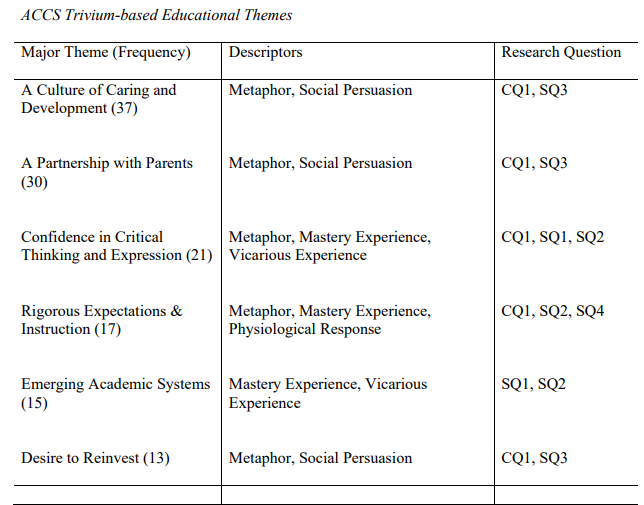
Each horizoned theme that rose to the level of invariant constituent are elaborated upon below in order of their frequency. Furthermore, it should be noted that frequency speaks to the impact each of the themes had on the experience and students’ descriptions as they relate to selfefficacy, persistence, and academic success.
A culture of caring and development. Each student went to great lengths to express their gratitude and appreciation for their faculty members. This commonality was shared by every participant and expressed more frequently than any other theme throughout the interviews. Faculty members at the representing schools shared an overt desire to see students become successful in their application of trivium education. Libby shared, “I really developed, I almost want to say friendships with my teachers. You know, I still go back just to see them, and my friends are still there.” She also shared how those relationships helped to develop her academically as many of her teachers went above and beyond their duty to critique here writing, or engage in philosophical dialogue outside of the classroom, or even serve as readers for her senior thesis. Mya saw her faculty uniquely in that it drastically, according to her, affected her experience:
Their involvement in my life affected my choices, interests, desires, and habits. I already loved to read, but my literature teacher’s recommendations honed my tastes, and his willingness to discuss them (and the movies made from them) taught me that analytical reading is not only meant for ‘the great books’ but deepens the enjoyment of children’s literature, historical fiction, and modern literature alike.
Her description certainly paints a picture of how profoundly a teacher could affect student experiences in general.
Mason identified faculty members by name and expressed how they impacted him; especially when he described his father as somewhat absent later in his life. He shared, “I wanted to change how I approached my schoolwork. I wanted to view it, not just as a chore, but to pursue wisdom and I thank Mr. Smith for fundamentally changing my approach to learning.” Mason described his relationship with other teachers as helping, “not just in the subject that I love, history, but on a personal level… I wasn’t coping well, and he provided pastoral counseling…I’m in debt to him for that and I will always love him for it.”
Oak discussed the various roles that teachers played and how many of them wore several hats within the school building. He shared,
One of my favorite teachers was also our drama director. He would direct our plays, and he was my literature teacher. It was really cool to be able to see him in those different settings. In one scenario I was being directed by him in a play, but then I also learned about the ‘Lord of the Rings’ from him. It was enlightening to be able to participate in those different types of conversations with him.
Mya concurred and emphasized that the various roles added to the depth of the experience with those faculty members. In her journal she said, “I chose to participate in after school activities, not because I was particularly interested in the sport, drama, mock trial, etc., but because I wanted to spend more time with the faculty of the school.” While there was a formal academic setting that existed in every case, participants also described the informalities of their experience. Marleigh stated, “I like that I could go into the office and sit and talk to my principal about my thesis or about anything and their doors were always open.” While the faculty interactions described may be common across Christian schools, the experiences described certainly serve to add another layer of depth to the overall experience that is not consistent with traditional educational settings; be they public or private.
A partnership with parents. A common theme discussed by each of the participants was their respective school’s unique partnership with their parents. While family involvement can be commonplace among public education, Christian schools, and even private schools in general, the relationship described by the co-researchers of this study seemed deeper and more universally understood as a partnership with parents who delegated portions of their disciplining, God-ordained authority to the school for the purpose of Christian admonishment and teaching. While the schools never assumed the position of the parent, teachers and administrators were commonly given certain authority to temporarily act in place of the parent in their absence. Many of the sites referenced the Latin phrase in loco parentis, which is literally translated in English as, “in the place of a parent.”
None of the descriptions revealed any misuse of this authority either. In fact, the descriptions inferred a natural respect for the practice and a willingness for each to respect their teachers and administrators as they would their parents. One important consideration is that six of the eight participant’s mothers taught at their respective school. Mya captured the essence of the concept best when she stated,
The school’s position is that the father of a family is responsible and will answer to God for his children’s education. He is the one responsible for their education both their academic education (whether each child has been faithful with the gifts and talents and opportunities God has given him) as well as their Christian education. The school’s role is to come alongside of parents–to serve them–in their pursuit of following God’s commands to train up their children. It is not the school’s role to take the place of the church in instructing parents on how to raise their children or the teacher’s role to take the place of the parent in the life of a child. The teacher is merely the person a parent has hired to perform a particular duty, if an extremely important duty. The teacher stands before the student with the authority of the parent given to them by the parent for the day, but not with the ultimate responsibility of answering for the child.
She even elaborated on her statement by giving metaphors to describe the position taken by her school. “It was explained to me that the teacher stands in the shadow of their parents while they are at school.” Another example she gave was the picture of a maid or butler. “Teachers stand at the entrance of the school with a white towel draped over their arm, prepared to serve.”
According to participant descriptions, each of the schools sought to maintain the role of the family established by literal interpretation of the Psalmist and the Apostle Paul. In Paul’s letter to the Ephesians, verse four of chapter six he asserted, “Fathers, do not provoke your children to anger, but bring them up in the discipline and instruction of the Lord.” The Psalmist also illustrates the family’s role in education in chapter 78:5-7, “He established a testimony in Jacob and appointed a law in Israel, which he commanded our fathers to teach to their children, that the next generation might know them, the children yet unborn, and arise and tell them to their children, so that they should set their hope in God and not forget the works of God, but keep his commandments.” There was a strong sense that it was the common position and practice among the represented families that the primary responsibility of education fell on the fathers. Mothers and/or teachers are thought of as assistants who support him in his duty. Furthermore, the school itself was a tool, fitted to the hand of the family head for the distinct purpose of executing his duty of chief educator.
Oak illustrated this idea from the perspective of his one-on-one relationship with his own father. He shared, “I remember my dad just instilling in me an understanding of the importance of reading the Bible daily. It’s your spiritual food and that is the way you are nourished and that is the way you grow.” He went on to say, “you might not always want to eat but you know you have to eat to be nourished and survive, to thrive. That’s one of the most important habits that I ever learned from my dad.” It was clear from their testimonies that these parents had a special interest in their academic and Christian education. Marleigh stated, “I would say my parents were more influential on me, academically and spiritually, than the school. But I say that because most days I’d come home from having long discussions and dive into it even deeper with my parents.” It seemed that with each of their experiences there was this home life that resulted in a constant conversation that revolved around philosophy, life, and deeply spiritual things. Lyla added, “Our home was structured according to the scriptures and the oversight that my parents gave my education was vital to my growth, both academically and spiritually.” While not every participant agreed, whole-heartedly, with their parents on every issue related to their education and experience; all described their experience with each school as having a special partnership and the frequency of this theme communicates the parental prerogatives considered throughout the education of students.
A confidence in critical thinking and expression. In every case, save one, participants described an acquired ability to think critically and express themselves eloquently as a result of their educational experience. While they were all careful not to ascribe any prideful superiority over their collegiate peers or professional colleagues, they did believe their trivium experience provided them with the advantage of advanced thinking skills and the ability to formulate those thoughts into convincing, persuasive arguments. The lone exception experienced the only unstable and transitional academic environment; Sophia attended a total of four ACCS schools from kindergarten through twelfth grade.
In describing her freshman year of college, Mya stated,
Many students that I befriended in college did very well in high school, but they never learned how to study. It just came very naturally to them and so when they got into college and the material was harder, they really struggled with that and didn’t know how to encounter that.
During the focus group, Oak followed-up on Mya’s comments, asserting, “Academically I was very confident just in my ability to write well and to think critically. I was very surprised by the amount of people who couldn’t write well or verbally express their thinking.” As the discussion developed, participants showed an appreciation for the rigorous approach taken by their schools. Lyla shared, “Having graduated now and being in college where I do interact in classes with other students, I just can kind of tell, I’ll just say, I really appreciate my background and I appreciate my classical Christian education.”
As I stated in her introduction, Libby noticed, “their line of reasoning was never as clear, and they didn’t always know why. They had a difficult time articulating their thoughts and it seemed my ability to reason was stronger than theirs.” She prefaced those comments with the fact that her peers were “brilliant individuals.” So, it was not aptitude that these students believed gave them an advantage in college, but rather, the training and development experienced in the trivium classroom; namely, explicit instruction in logic and rhetoric with a solid grounding from the grammar stage of learning.
Lyla used concrete examples in her descriptions for what this explicit training looked like. She shared,
It was expected that we incorporate higher-order reasoning and thinking to argue our positions. If we had something to say, we were required to back it up with evidence or how we derived the idea. This included our writing. If we had books that we were reading and we found something to be interesting then we were really encouraged to explain what we thought was interesting but also why we thought it was interesting and how it could be applied to our lives as students. In addition, in our actual logic course we wrote out syllogisms and took things apart into their constituent parts. They also really encouraged us to use reasoning and logic to incorporate what we were learning in other subjects.
Integration and the incorporation of a cross-content approach was described by each of the participants. Many described the bleed over from one class to the next. Knowledge was never acquired in a vacuum, but rather with an interconnectedness that allowed students to see implications that would not traditionally be observed. In summarizing her thoughts on the topic, Lyla stated, “I was being taught how to think, not just what to think. I definitely believe that I can think for myself which is ultimately the goal of classical education.”
One prompt of the individual interviews was that participants were asked to describe their favorite level of the trivium. Libby discussed the concrete nature of her training and while she described the logic stage as challenging it was also her favorite learning experience. She stated,
Logic was the most meaningful academic area to me. Specifically, when we studied informal logic and learned to recognize fallacies in an argument. I’m still able to pick out a lot of them even if I don’t remember the technical names…Being in a college atmosphere people are constantly making some kind of argument for something…In advertising, just being able to recognize, ‘that’s not actually a sound argument.’ That’s appealing to the mob, or a straw man argument, or ad hominem…And so I feel like I’m able to effectively reason through what other people are saying.
Mya also pointed out that one reason the logic stage was so enjoyable, was because middle school students are so naturally inclined to argumentation. The trivium approach capitalizes on the natural development of students at their respective ages.
Rigorous expectations and instruction. A rigorous curriculum with high expectations from both parents and faculty was a major component of each description. In every case, students were required to enroll in rigorous academic courses over and above the typical core standards-based instruction found in the traditional modern school. The additional workload included biblical and historical timelines and Latin grammar at the primary and intermediate level of elementary education; formal and informal logic, classical and medieval literature, a western civilization’s introductory course, and a continuation of theology and Latin courses in the middle school; and philosophy, apologetics, formal rhetoric, progymnasmata writing courses culminating with a senior thesis, Greek or Latin honors courses, a continuation of western civilization and classical and medieval literature in the high school. Each participant expressed that instructors also had high expectations in terms of performance, production, and work ethic beyond the academic rigor.
While some described the rigor negatively, others embraced it and believed that maturing in the program from the grammar stage made the overall experience tolerable and sometimes enjoyable. Lyla expressed, “Just thinking about it makes me not want to ever have to work that hard again. Not that I’m afraid of hard work but it was just so much; it was too much to get done in a single day.” On the contrary, Oak explained, “I grew to appreciate the classics that we read. I developed an insatiable love for reading…Without the rigor of my school, I don’t think I would have the appreciation for thinking and learning that I do today.” In many cases the rigor and academic adversity that participants described came to serve as the catalyst or inspiration for what they later became in life professionally. Mya shared, “The books we read were difficult to engage with, difficult to understand what the author was saying, difficult to enjoy, let alone be able to track themes and character development or analyze philosophies.” Yet, she went on to share that she became an English major in college and now teaches classical literature to middle schoolers at her trivium alma mater.
A major component of rigor in ACCS schools is the integration of Latin grammar instruction that, in every case represented, began in the grammar school around second or third grade, continued through the logic stage, and was a bridge to Greek or the other romance languages in the rhetoric stage. In relaying her experience with Latin, Lyla described the following,
We memorized the Latin vocabulary intensely at the grammar stage. We also studied the English translations and Latin derivatives. At the logic stage we made comparisons to the English and thought about certain connections. Beginning in the rhetoric stage we did a lot of translating, we were able to look at different sentences in Latin and then put them together in English and draw out conclusions.
Lyla’s experience was similar to others in how the scope and sequence was implemented in each of the schools. Other factors, such as curriculum and teacher experience, affected the efficacy of the Latin program at each school; but the linguistic rigor was common to all of the sites represented.
Many of the students expressed a distaste for language study during their time in the classroom, but later realized of just how helpful those courses were. Mason shared,
We studied Greek and Latin, which at the time I saw as a waste of time. I saw it as something impossible to be successful at. But now, as I take college level history classes, college level theology classes, I see how important linguistics are, especially Greek and Latin. I’ve already gone back on one of my visits home to apologize to my language teacher from CCS.
The negative feelings towards Latin study seemed to be related to the rigor rather than the benefits that can come from an intense training in the content. Kain even expressed that the language study was the one aspect of his trivium experience that he continues to benefit from more than any other academic area.
A commonality that also came from the rigor was an appreciation for the traditions of western civilization and the traits and habits that were developed to be enjoyed later in life. Oak shared, “I learned to value tradition and to preserve what’s happened, what’s been written before us…PCCA instilled a love for tradition and a desire to respect, admire, and model your life after what has gone before us.” Kain shared, “I still have a bookmark in the middle of Plato’s dialogues that I pick up every now and then. Today, I make it a point to read original texts instead of only listening to others commentary.” The rigor opened a world beyond the twentyfirst century to these students and they now claim to have an ability to analyze current events with a cultural, historical, and theological sensitivity or perspective that many of their collegiate peers do not share.
Emerging academic systems. Due to the age of the schools in the phenomenon, many of their academic systems, typical for trivium education, were still under development. Ancient pedagogical practices, where the trivium was employed, enjoyed years of development. Ancient scholars spent generations perfecting their craft, and naturally those who executed trivium education in later generations were more adept at developing the ideal product. The same is true with the modern phenomenon. Modern classical schools do not function or operate in a uniformed fashion; nor are all ACCS schools operating with the same level of expertise within their faculty. In today’s ACCS school, instructional methods are constantly being revised or improved upon. Students who graduated within the first wave of the phenomenon, which began in the early 1990s, were not as advanced in their critical thinking or oral expression as the ACCS graduates of today.
The criteria of this study required participants be at least 18-years-old having graduated through and from an ACCS member school. Therefore, the youngest graduate participating in the study was born during 2000-2001. The oldest participant was born between 1991-1992. For the purpose of this study, the median years of birth are 1996-1997, making the first year of instruction to be 2001. The youngest school site participating in the study was incorporated in 2005 and began its first year of operations in August of 2006. The oldest school site began instruction in 1993, making the median starting year 1997. Therefore, on average, the represented schools only experienced four years of operation prior to the median starting year of their participants. As a result, pedagogical practices were very much in the developmental stages. Participants recognized those formative years and the learning curve that was ongoing.
Each description spoke to a lack of experience and shortcomings in instructional practice for their school. However, in every case they also speak to the growth and improvements their respective schools made over time. Mya’s perspective regarding this topic was most important as she returned to her alma mater to join the faculty. Speaking about her logic stage, she explained,
I struggled to recognize syllogisms within the writing of others…and I didn’t enjoy that very much. But as a teacher I see how I could have been instructed better. For instance, “This is how you’re going to apply logic to your writing or even to your arguments or to your thought processes.” Those dots were never quite connected and so it really wasn’t until I was in late high school that I started recognizing, “Oh, this is how you apply that.” Looking back on it now as a teacher, seeing that teachers were not formally trained in logic, it was new to everybody in the beginning.
Later, she went on to say, “But, the faculty understood what needed to be done and they learned and developed as instructors.” Her teacher perspective gives her additional insight not privy to students and she has been able to see the development of not only the instruction, but also the schools approach to professional development. “I remember studying the progymnasmata style of writing…which takes you through the process of learning to write fables, narratives, stories, and then chreias, culminating in a thesis.” As a teacher she described having a better understanding of the skills being taught and also now understands the connection between the process and the culminating thesis activity. She revealed, “As a student, I was never told how to apply those skills. And the curriculum that we used at the time did not help me learn to apply those skills.” As a matter of fact, PCCA had even less than the median four years of development when compared to the other site representatives. The school began its operation the same year she started kindergarten.
Other participants shared a similar sampling of related topical descriptions. Lyla stated, “I didn’t really progress in Latin as I feel like I would have if we’d had more of a consistent progression. I ended up repeating some of the same grammars and it really wasn’t emphasized in the older grades.” Regarding the rigor in high school, she shared, “Since PCS was just developing its high school and my class was the first, I think they didn’t want to be perceived as setting the bar too low. They really stretched us in the beginning and the workload was unrealistic.” Kain shared his struggle with finding a proper balance between remaining grateful for all the sacrifice and work that went into his education and at the same time, having the freedom to speak about things that may have helped to improve his school. He shared, “I would hope school leaders would listen to students who have now passed through the trivium, other life experiences, and other educational institutions who could likely come back with, maybe not paradigmatic shifts, but significant ideas for innovation or improvement.” In every case, participants described some form of development in pedagogy and practice, even in the most established of schools.
Desire to reinvest. In every case, students described a desire to reinvest in trivium-based education and Christian missional causes. While this reinvestment was described differently by each participant, it was inevitably present. Every participant discussed interest in having their own children educated in a similar environment. Sophia stated she was willing to consider an ACCS school for her children with the caveat that she be able to give them more freedom than she had herself. Most importantly, she saw great value in the pedagogy were it to be implemented with greater consistency, fidelity, and expertise than her own experience. Mason shared, “I’d love to send any children that I may have one day to a school like CCS, if not CCS itself. I think it is how education should be done.” Marleigh shared, “My dream would be to send my kids to CCA. That’s definitely something that I want to do.” In keeping with her principled belief for the role of the family and the duty of the head of the household, Mya stated, “I can’t really say this with certainty, because it is ultimately the decision of the head of the family, but I desire to have my children in classical education even if it’s a supplemental one at home.” In addressing her desire for her children’s education, Libby emphasized the classical approach over the private and Christian aspects of the ACCS. “I really do appreciate classical education itself. I would love for it to be a Christian education, but most importantly I want them to be trained in grammar, logic, and rhetoric.”
Beyond having their own children educated in a trivium-based environment, there was also several references to reinvesting in the schools financially or by way of program development. Oak expressed, “I’ve talked about reaching out to my headmaster because I want to get involved in communicating to the current students there, to show how valuable of an opportunity it is to be there.” He described a desire to develop an attitude of thankfulness and appreciation among students so they would be more motivated to take full advantage of their educational opportunity. Kain described a desire to be a part of the steering or executive leadership of an ACCS school board in the city he eventually settles in. Marleigh went so far as to say, “I’ll do anything for CCA because I love my school.”
During the epoché activity, it was assumed that one node that would horizon as a major theme was that the pedagogy instilled a natural inclination toward the field of education; an aspiration to teach professionally. Mason aspired to be a professional historian in academia. Mya had returned to her alma mater to teach at the logic level. Kain stated that he, being left to his own devices, would have chosen teaching as a profession. Marleigh stated that she desired to return to her alma mater and serve as the school psychologist. Sophia earned a minor in CCE but presently did not believe she would be a proficient teacher. Oak and Libby, who both majored in economics, mentioned a desire to use their degrees as a platform for missions, whereby they would teach the gospel to unreached people groups. And finally, Lyla is currently undecided as to a career, but is pursuing a degree in mathematics where she could easily follow in her mother’s footsteps and teach math in an ACCS school.
As the evidence mounted it was important to remain in the state of epoché until the entire data set was collected so that all prejudgments could be avoided. However, I did supplement the prearranged, semi-structured interview questions originally developed to determine the validity of the potential horizon of teaching as a profession. As a result, the descriptions did not substantiate the idea that the pedagogy instilled a natural inclination for the teaching profession; but did substantiate something else. Mya described it best when she stated,
I do not think that CCE as a model creates a desire to teach, but I do think it builds a desire to educate. I think it places an emphasis on the importance of education. Your knowledge base becomes something worth sharing. While a few of my friends from high school are now teachers, many of them participate in educating others in different ways.
With their confidence to think critically and argue persuasively, participants seemed to have a keen desire to share this newfound knowledge. As they enter the work force or the classroom, they have a mission to winsomely and eloquently persuade their colleagues or students toward truth. Participants shared that their experience included an intrinsic motivation to live missionally with an eye toward Kingdom citizenry.
The six horizoned themes listed above and in Table 1 were validated as invariant constituents using the validation test designed by Moustakas (1994). The validation model is comprised of the three steps below:
1. Are they expressed explicitly in the complete transcription?
2. Are they compatible if not explicitly expressed?
3. If they are not explicit or compatible, they are not relevant to the co-researcher’s experience and should be deleted.
Each of the themes identified were explicitly expressed in the complete set of transcripts without exception. While there were some variations in the expressions, the essence of the horizoned theme remained consistent. Furthermore, each of the themes have an organic inter-related effect on one another that can be explicitly expressed and all of them contribute to the composite description found below. I determined the six horizoned themes withstood the validation test. What follows are the descriptions that were observed as the co-researchers conveyed their experience and the final step in Moustakas’ (1994) reduction process.
Textural descriptions. The purpose of constructing textual descriptions is to evoke clear images of what was happening during the experience. Moustakas (1994) asked, “What happened during…what are the thoughts, feelings, and struggles of the person” (133). Using verbatim snippets of the transcribed interviews, my objective was to develop textual descriptions that presented the vivid nature and focus of the experience. To that end, the use of the metaphor precisely captured the essence of each individual experience. For the purpose of this study, participant’s metaphorical descriptions were used as their individual textural descriptions. Those textural descriptions were then used to construct individual textural-structural descriptions of the meanings and essences of the experience, incorporating imaginative variation.
Imaginative Variation. The objective for this activity was to determine meanings for the experiences through my imagination and to observe the phenomenon from alternative perspectives. Moustakas (1994) asked, what are the “underlying and precipitating factors that account for what is being experienced…How did the experience of the phenomenon come to be what it is?” (p. 98). This was achieved by using the textual descriptions derived from the participant’s metaphors to formulate structural descriptions of the experience. Those descriptions follow.
Textural-structural descriptions. Lyla likened her experience to a carpenter receiving tools for a toolbox. In receiving such tools, she learned their purpose and function. She became acquainted with the tool and understood its limitations and power. Once mastered, she would be free to create, build, or design with the capacity that she acquired. The more experience she had in using the tool, the richer and more dynamic her creations would become.
Lyla’s trivium experience was very much connected to the concept of work. Even her metaphor carried connotations of labor. She was very much aware of the time and effort required to be successful and any negative feelings she communicated about her experience was related to the rigorous nature of her high school experience and the workload expected of her. While she communicated that she was not afraid of or opposed to working hard, she did conclude that she never wanted to have to work as hard as she did during her rhetoric years again.
Libby explained that her experience reminded her of learning to play the piano. In her formative years she mastered simple tasks such as finger placement or reading music with fluency and automaticity. As her rote skills developed, she was asked to think about the relationships that existed between certain notes or chords. She studied music theory. Now, as a semi-professional musician, she is able to be evaluative with the playing of the piano. She has an appreciation for what makes quality tones and melodies. She can even articulate or provide commentary on a particular piece of music and the time period from whence it came. For Libby, the structural nature of her trivium experience was an academic progression of learning. She understood the continuum of the system in which she found herself. She enjoyed approaching her education as a student rather than a social being who should be entertained. School was not simply a social event, even though she was social in the experience. It was also clear that she had thought about the benefits her experience afforded her and she was pleased to have those benefits; specifically, her critical thinking skills at her disposal.
Mason described his experience as a formative period of training in a tower of protection. He defined his education as his defining years and his school was a bulwark established to protect him during the formation and sculpting of his mind. While the school protected him from outside influences, there was liberty in how and what he could think, so long as he did. He described a period of time where he was free to develop his own ideas with the protection of his peers, teachers, and administrators. His experience was also described as substitutionary. The later portion of his tenure was experienced with the absence of a father figure, save the male faculty members of his school. They acted in place of his own father, whom he felt had abdicated his role as the primary educator.
Sophia expressed that she was living in someone else’s dream. She shared, “I spent my entire schooling playing a part to maintain an image. I was so concerned about maintaining that image that I didn’t focus on my education.” Her experience was nothing more than a role-play to satisfy the high expectations of her parents and the facade she believed they required of her. She might argue that instead of having an educational experience of her own, she was forced to live in the education of her parent’s dream.
Oak likened his experience to the work of a blacksmith and the formation of a doubleedged sword. Just as a sword is formed from steel through the labor, sweat, and effort of the smith, he viewed his education through the sweat equity of the school’s faculty. He described his grammar stage as the initial hammer swings of the smith when the sword may still look nothing like its final product. His logic stage was compared to the work of the smith to bring a proper balance to the sword with the placement and formation of the hilt and crossbar. Finally, the rhetoric stage was compared to the sharpening, testing, and initial swinging of the sword as it is now prepared for its ultimate purpose and use.
Marleigh’s metaphorical description was simply expressed as a family. While it was not without its academic rigor, her experience seemed to be very social in nature. She described the inter-personal connections between students and faculty. She emphasized her desire to return “home” and serve “my” school in the future. Even the academic and rigorous elements of her school were described nonchalantly as a “typical way of life.”
Kain compared his experience to an engineer’s steel strand. He likened a traditional approach to education as a single strand that would be weak or faulty, physically unable to support the weight of life. On the contrary, his experience was equated to a steel strand that had been interwoven with three separate cords. The stages of learning represented each cord and added to the strength of the strand. His strand was not weak. Instead, the interwoven nature of the strand added to its physical strength and supportive capacity.
Mya associated her trivium experience to the development of a soccer player. Soccer was a natural comparison for her as her entire family played the sport during her childhood. She described a connection between the formative years of a player who learned basic skills by drilling to create muscle memory and herself as a young student building up a store of knowledge and content. The player began to develop an understanding for how those drills could be effectively applied to the game and she similarly learned how to insert her knowledge into conversations with people. Finally, she describes being able to create and deliver sound winsome articulations of her passions just as the soccer player can strategically setup the bicycle kick for the match-winning score.
Composite descriptions. The participant descriptions can be categorized into three major structures. Either they equated their trivium experience to the natural development of a skill, the formation or creation of a product, or as a known familial narrative. The capstone of Moustakas’ (1994) phenomenological research is a final synthesis of the statements, themes, and descriptions of the experience. Compositely, the objective of this research was to develop a single texturalstructural description of the meanings and essences of the experience, representing the entire group of participants, integrating the three structures named above and the metaphors or textural descriptions of participants into an amalgamated statement of the experience.
The principal essence of trivium education in ACCS schools is an experience whereby students progressively journey through organic, developmental stages with the scaffolding of familial members or representatives, whose destination was a Kingdom citizenship designed to illuminate the shadows of the world. The trivium journey, when traveled with fidelity and consistency, results in citizens transforming into spiritual and cultural leaders, able to think critically, argue persuasively, and articulate winsomely with a missional desire to usher in a new age. Trivium graduates have an insatiable desire to dialogue, persuade, and educate peers given their newly acquired tools. They see themselves as free citizens able to speak at the city gates in an effort to affect society, rather than simply enculturate into it. Finally, they want to reinvest into the outcomes they have enjoyed and the mission of their respective schools.
Narrative Responses to Research Questions
Given the principal essence identified, the next research objective was to understand how the composite description above speaks to the pre-designed research questions of the study. Furthermore, how do their metaphorical descriptors and psychological factors contribute to participant success? The research questions of this study are constructed around the concept of metaphorical descriptions and the theoretical framework of academic self-efficacy (ASE) used to guide the study. According to Bandura (1986), the four predictors of ASE are mastery experiences, vicarious experiences, social persuasion, and physiological responses. These predictors help individuals to determine if they possess the capacity to achieve specifically assigned academic tasks. Student’s ASE can indicate how much effort individuals will expend on tasks, their persistence levels, and how resilient they appear when facing unfavorable conditions (Bandura, 1986). As stated in Chapter Two, students with lower ASE tend to see tasks as challenges beyond their capacity and will likely avoid them altogether, whereas student with higher ASE approach academic tasks as nothing more than challenges to be overcome (Bandura, 1997).
Below is a narrative description for how student experiences were categorized within the framework of ASE and narrative responses to the central and subordinate research questions. Verbatim statements that speak specifically to the horizoned constituents were used to develop the narratives and more precisely communicate the essence of the experience. As stated above, the reduction process resulted in the horizoned constituents of a partnership with parents, emerging academic systems, rigorous expectations and instruction, confidence in critical thinking and expression, a culture of caring and development, and a desire to reinvest.
Central research question. How do graduates of classical Christian schools metaphorically describe their lived experiences during their trivium-based education?
The very idea of describing an experience with a metaphor is a mentally taxing and rigorous task that requires planning and abstract, higher-order thinking. In the focus group, Kain stated, “I found the question regarding metaphors to be the most difficult. I was probably the least satisfied with my comparison of all the things we discussed…It was challenging I think partly because it requires a change in perspective.” Despite these challenges, graduates of Christian, trivium-based education not only understood the power of the metaphor to describe an experience, they were also able to articulate each component of their comparison, making connections to the various appendages of their experience. Each of the participants depicted their experience using one of three metaphorical structures. The three metaphorical structures used were the mastery of a skill, the creation of a product, or the comparison of a familial or communal relationship.
The mastery of a skill was the most effective structure at communicating the progressive nature of the trivium. An educational experience is naturally developmental, and so any description would be progressive in nature. But what underlying or inferential meaning can be taken from comparing an experience to the mastery of a skill; specifically learning to play the piano or learning the strategic game of soccer? Libby explained, “The basic understanding of the grammar of the piano strengthened my ability to be articulate with my fingers…When I understood the musicality of the notes that added to the quality of my music.” In both cases the participants were communicating that a store of knowledge within a specific content area enhanced their ability to apply logical or sound reasoning. Furthermore, it can be inferred that participants ability to create, analyze, synthesize, critique, interpret, or evaluate was rooted in the development of those stores of knowledge and the quality time spent in critical, logical analysis. These participants understood how they learned and had a strong sense of metacognition; they were very much aware of and understood their own thought processes.
The second metaphorical structure used in participant descriptions was the creation of a product. Participants compared experiences to the establishment of a fortress, the formation of a sword, an engineering strand developed from three chords, and the accumulation of tools for a carpenter. The inferential meaning made from this structure comes in the differences observed between the mastery of a skill and the creation of a product. Because both structures are formative or developmental in nature, the only major difference is the result. Participants who compare their experience to the creation of a product are viewing their experience artistically. While products are typically made with a purpose in mind, there is also an artistic element to be considered. These participants envision their experience as something that was developed by the skillful hand of the faculty. They view their experience from the perspective of beneficiaries who were developed by individuals keenly interested in a suitable result. Beyond that, they now have a sense of duty to emulate their craftsman, especially since they have been given the freedom and capacity to create for themselves. Oak’s statement exemplified this best when he expressed,
In the end, or at graduation, the blacksmith is prepared to sell or gift the sword to be used for its ultimate purpose…At PCCA, the mission is, or what is most stressed is that your ultimate purpose is to glorify God with whatever you do. We’ve educated you; we have imparted wisdom, now go out in the world and do the same for others.
Finally, the third metaphorical structure used by participants to describe their experience was the familial or communal relationship comparison. Two cases likened their experience to being part of a community or family. Their experience was portrayed relationally. They made meaning through the relationships that were fostered during their trivium tenure. Marleigh described her trivium tenure as follows: “I would definitely compare it to a family. I was very close with students at every level of the school. I knew them and they knew us…We knew what everyone was going through, just as any family would.” These participants also compared their successes and failures to others, and even evaluated their education based on how they compared to peers. While their experience occurred in an academic setting and they were required to develop the same coping mechanisms to manage the academic rigor, their experience was a social one. Their descriptions were rooted in their interactions with other stakeholders.
Ultimately, in response to the central research question, and as stated in the composite description above, students portrayed a progressive journey through organic, developmental stages with the scaffolding of familial representatives, whose destination was a Kingdom citizenship designed to illuminate the shadows of the world. Furthermore, I found it fitting to develop a composite metaphorical response, representative of all of the co-researchers, that communicated a rich reply to the central research question. Metaphorically speaking, graduates
were developed into trained assassins during their trivium experience in ACCS schools.
At the conclusion of the focus group participants were asked to think about and consider the following quote from N.D. Wilson:
The world is rated R and no one is checking IDs. Do not try to make it G by imagining the shadows away. Do not try to hide your children from the world forever, do not pretend there is no danger. Train them. Give them sharp eyes and bellies full of laughter. Make them dangerous. Make them yeast, and when they have grown, they will pollute the shadows.
Participants were asked to compare their experience to the message communicated by the author and determine whether their respective schools created a comparable environment. Were they dangerous to the world, in the sense that they polluted darkness and were trained to wield a sword of truth? Oak immediately responded by saying, “Yes, I think PCCA embodied that quote…they weren’t sheltering any student from the world. They did well at exposing us to the world, whereas not to celebrate the evil that existed in it.” Mya followed up by stating, “I think that’s the commandment of scripture to parents. As children we are drenched in the word, we’re taught how to use scripture as a sword; it’s not a shelter or a hole in the ground to crawl into.” These students have been trained to affect culture. They are assassins, dragon-slayers, capable of dispelling the darkness in every corner and illuminating the shadows with the light of truth.
Subordinate research question one. How do participants describe their mastery experiences during their trivium-based experience in CCE? As stated in Chapter Two, Bandura (1994) believed the most effective way of creating a strong sense of self-efficacy was through mastery experiences. Mastery experiences are those solidifying experiences where individuals were resilient and performed successfully in spite of duress, challenge, or threat of failure and the experience itself becomes a keystone memory used to inspire future belief in oneself. The trivium experience described by each participant revealed many examples of social, academic, or spiritual growth through resiliency which could be identified as a mastery experience. While all participants described their environments as academically rigorous, some of the environments were certainly more rigorous than others and thus created more opportunities for resiliency than those environments that were perhaps still under development or not as advanced in their implementation of the trivium.
One collection of verbatim descriptions of mastery experiences came in the form of major school transitions. Oak and Mya explained that their school leadership changed drastically in the middle of a school year bringing in a new headmaster the following year that caused a great deal of change to the school. Mya shared, “It was a good thing, but it was really hard. It involved friends and it involved broken friendships and people leaving the school and it brought about some deep reflection and a realization of where we were as a school.” Similarly, Lyla described a change in leadership that was theological in nature that eventually led her family to transfer her younger siblings to other private schools within the same community. She stated, “The change was fairly dramatic…I think theologically, it became more intellectual. Everything we did was from an intellectual consideration, and I think it made life very dry. While there was so much thinking, there was not much relating.”
Libby and Sophia experienced some early transition while Sophia’s entire tenure is comprehensively transitional. Both students graduated from VCCS, yet their time in the trivium looked very different. Libby attended only one other ACCS school in Kindergarten while Sophia attended a different ACCS school at each level of the trivium and two different ACCS schools at the rhetoric stage for various reasons. In her journal, Libby shared, “When there was a church split which led to a school split and a birth of a new school, I felt the need to pick sides, and fight for the right group.” Kain discussed a rapid and exponential growth that took place in TCA during his tenure, which brought about some unwelcomed socio-economic changes from his perspective. And while Marleigh and Mason did not discuss specific macro-changes that impacted them on a personal level, their tenures coincide with the time period in which both of their respective schools were going through the initial accreditation process with the ACCS; which would inherently be a time of great transition and growth.
These shifts were a part of the overall journey for every participant and should be considered as a mastery experience. The occurrences were at least important enough for most of the participants to speak of the stories with great specificity during the interview process and they were also able to describe how it affected their view of the schools and the ever-changing cultures. Still, the question remains, how were these mastery experience described?
In each case, the changes were expounded on with somewhat negative associations. Students and families were described as being hurt. Members of the community were cut-off or ostracized. Families moved on and were identified as unfit for the culture. Leaders were found to be in public sin, which brought about additional social and emotional trauma. And in some cases, participants simply explained the growth itself was negatively impacting their comfort level of the environment and the culture of their school. Yet, at some level, each of them also recognized the changes ultimately brought about a greater capacity for the schools to develop or improve in terms of effectiveness or governance. The changes also allowed the participants themselves to see they could persevere through these socially murky waters. While this positive side of growth was observed, it did not lessen, in anyway, the undesirable taste students remembered. Compositely, the co-researchers portrayed this mastery experience as a necessary evil, or the growing pains that come naturally with progress and development.
A second collection of experiences to be considered as mastery were the words of affirmation and encouragement and exchanges with the school faculties. In every case, even those who lacked stability, spoke of their faculties as if they were genuinely concerned for the well-being of every student on campus. Mason explains the faculty-student relationship with the richest of terms. He shared,
Our faculty invested in you beyond the classroom, they were there to help you in any area of life that you weren’t sure about…My relationships with my college professors are not even comparable to my relationships with my teachers at CCS…There was a certain uniqueness to the culture, and to the camaraderie that existed between faculty and students. We were treated and spoken of as scholars…One would have to look far and wide if they wish to reanimate such an experience.
Such was the image etched by all students interviewed. There was no reference to rigidity, intolerance, or extreme harshness with the discipline process. It is important to note, that just as much can be learned about an experience from what is unsaid, as to what is said. It is to be expected that students would elaborate upon, at least some, unpleasant disciplinary encounters when explaining their entire primary, intermediate, and secondary school years. Yet, there is not one suggestion in the entire set of transcripts. Students confessed to wrongdoing, cheating, taking short cuts, or simply not abiding by the high expectations established by the schools. Still, they remember being handled justly, with the proper measures of grace and love.
The faculty interactions and conversations seemed to have inspired and emboldened each of the co-researchers, building onto their capacity for achievement. Participants expressed that they were capable to accomplish anything asked of them because of the belief their teachers instilled. These high expectations, lofty conversations, and scholarly dialogues became lasting, keystone memories that stirred these graduates to great heights and must be considered as mastery experiences.
Subordinate research question two. How do participants describe their vicarious experiences during their trivium-based experience in CCE?
The vicarious experience, as defined by Bandura (1994), is the process of seeing someone of perceived likeness in ability succeed through sustained effort in the face of adversity. Students certainly had ample opportunity to observe peers under the pressure of similar academic rigor and high expectations. However, where participants were academically, in relation to their peers varied and so did the ability level of those peers. Despite these limitations, students were given the opportunity to explain their experience vicariously through the eyes of their student colleagues’ successes or failures.
The vicarious experiences described were not wholly positive. Oftentimes students saw the success of peers as a measure of inspiration for themselves. However, as described, the pedagogy inherently created a sense of competitiveness that was sometimes frustrating or deflating for participants. It could be argued that anytime students are comparing themselves to others, there is a risk that the comparison will be viewed adversely. Sophia described a lack of confidence when she compared herself to peers. In fact, during the focus group interview I sensed her attempting to measure herself in comparison with the others, and she was not comfortable. At one point she even shared, “The way you guys all talk, it seems like you were deeply impacted by the trivium and classical Christian education. But I’m not sure it impacted me in the same way.” Sophia was expressing, in her own way, that she had components of her trivium experience that she believed to be missing when compared to similar graduates.
On the contrary, there were various types of comparisons that really served to inspire when students from outside the familiar trivium environment were considered. Marleigh discussed the struggles that students transferring in from traditional educational environments had when attempting to adapt to the rigor of the trivium or the ACCS environment. She stated, “I don’t remember it being super rigorous because it’s what I’m used to. Although, students who came in late, especially in high school found it to be incredibly rigorous, because it’s teaching in a completely novel way.” Mya concurred by describing an experience once she attended college. She shared that many of her contemporaries in college lacked the study skills that she acquired during her trivium tenure. She asserted,
When you come from a school where you graduated with three other students, you don’t have a great concept of how you measure up against a broader spectrum of people. And so, when I went to college I really didn’t know where I was going to fall in the spectrum…Many students that I was friends with did very well in high school, but they didn’t know how to study. Academics came naturally to them. But, when they got into college and the material was more complex, they really struggled.
In most cases, when considering their success through the eyes of peers, participants built their confidence and developed superior communication skills, as described vicariously through their counter-experience.
Subordinate research question three. How do participants describe their socially persuasive experiences during their trivium-based experience in CCE?
Bandura (1994) determined that social persuasion is the process by which individuals are convinced by peers, be it deliberately or inadvertently, that they are or can be successful. While all participants described examples of peer encouragement throughout their trivium experience, the vast majority of the descriptions related to social persuasion came from the interactions between the students and faculty members or students and family members. However, one exceptional verbatim description of social persuasion came from Libby. She shared,
I went to Virginia Girls State, I think the summer after my junior year, and I was around brilliant girls who were very well educated. But one thing I noticed, their line of reasoning was never as clear, and they didn’t always know why. They had a difficult time articulating their thoughts and it seemed my ability to reason was stronger than theirs. They were really having a hard time articulating their train of thought when we conversed. Now college feels the same. I felt in some ways a little behind on facts, but my ability to reason seems more advanced than most.
Libby is explicitly describing an event where she was socially persuaded that she was a successful communicator, due to her training in the trivium. She believed that her experience at VCCS developed her into a more natural correspondent who was able to listen to argumentation critically and decipher or determine the soundness of an argument, given its design.
The horizoned theme of a culture of caring was evident in answer to this research question especially. Every participant described a closeness and familial bond between students and faculty. Those participants who compared their experience with the social metaphorical structure, were more inclined to emphasize those relationships in their descriptions. Marleigh stated, “I grew up in a really small neighborhood that has really close families within. My family and I were blessed to have a really great community.” When asked to name the elements of her school that made her experience enjoyable, she asserted,
The teacher and student relationship. I never had a teacher that I felt like I couldn’t come talk to. I never had a teacher that didn’t notice when I was struggling and who wasn’t willing to help me. I like that I can go into the office and sit and talk to my principal about my thesis or about anything and their doors were always open.
This openness was common to every site studied. Students believed they were deeply cared for, loved as progeny, and encouraged to give their best in all things. Students consistently described the school faculties as persuading them toward success and the achievement of the high expectations set by stakeholders.
Subordinate research question four. How do participants describe their physiological response to adversity during their trivium-based experience in CCE?
According to Harvard Health Publishing (2018) potential physiological responses include any combination of changes in blood pressure and increased heart rate, dilatation of the pupils, increased respiration and perspiration, changes in skin and body temperature, and increased muscle tension. “These combinations of physical responses are survival mechanisms, enabling individuals to react quickly to life-threatening situations” (Harvard Health Publishing, 2018). Also known as “fight or flight,” physiological responses occur most often as simple responses to stress. Participants described multiple accounts of failure or adversity throughout their trivium experience. Due to the nature of these experiences, stress would have been induced, thus creating physiological responses from the participants.
Actual physical responses or combinations of responses were not recorded or gathered for study. However, stressful situations within participant experiences were identified. Sophia stated, “most of my memories of school revolve around my responses to stress.” Lyla agreed, “I think what made our school extremely rigorous was the amount of work that was expected of us.” Students described a rigorous environment at each school site and the significant expectations were stressful for students. Some coped well by minimizing stress while others struggled with the adversity. One task assigned in every interview was for participants to identify a coping mechanism, be they organic or intentionally built into their respective programs, that facilitated their persistence.
The coping mechanisms varied. Mason pointed to the extra-curricular activities to manage his stress. “There were definitely things that allowed us to channel our angst with our schoolwork. I played soccer, baseball…things like that, to just get outside a bit to help destress from the school day.” Mya did not describe any built-in systems to manage stress but did express the role of her parents in helping her cope with the stress. She shared, “There were times that my parents said it’s time for you to stop, and that’s okay. It’ll be a late paper and that’s our choice and you’re done for tonight.” It could be argued from the transcripts that family involvement was a much more prominent mechanism than was specifically described.
Participants also shared that reliance on the faculty was a common response to adversity throughout their tenures. In her journal Lyla shared, “I was greatly impacted by the godly examples of my teachers. I respected them, they showed great care for me even in my struggles. They shared their stories with me, they were fair and forgiving, and they were always kind.” Along with the other verbatim examples shared above regarding faculty interactions, students in ACCS schools consistently relied on and utilized their teachers and their counsel as a means of persisting through adversity and the stress associated with the academically rigorous environment. While intuition might ascribe the source of stress to the instructor in an academic setting, ACCS student’s viewed their teachers, and the modeling of them, as a pathway for development into successful spiritual and cultural leaders who would go on to dispel darkness in the ushering in of a new age.
Summary
This chapter specified the procedures and findings for the transcendental phenomenology of student experiences in trivium-based education within ACCS schools. An anonymous, rich portrayal of student experiences was provided to explain the essence of what it means to be a graduate of the trivium in modern classical Christian schools within the United States of America. Following the persistent analysis protocols of transcendental phenomenology, horizoned themes were reduced into the six invariant constituents of parental partnerships, emerging academic systems, rigorous expectations and instruction, confidence in critical thinking and expression, a culture of caring, and a desire to reinvest. These six constituents were then elaborated upon with verbatim examples from the journal, interview, and focus group transcripts. From those elaborations and narratives, textural-structural and a composite texturalstructural description was developed to describe the essence of the phenomenon. Finally, the chapter concluded with a narrative response to all major research questions previously identified in the proposal of the study. Those narratives were grounded in the composite descriptions of the phenomenon.
CHAPTER FIVE: CONCLUSIONS
Overview
Finally, the purpose of this transcendental phenomenological research was to describe the lived experiences of students who graduated through trivium-based education in ACCS schools. Chapter Five is a synthesis of the study’s findings written from my interpretive perspective. Chapter Five includes six major sections that bring conclusions to the determinations of the study. First, the chapter begins with this overview detailing its contents. Second, a concise summary of the findings is provided to address the central and subordinate research questions. Third, a discussion of the findings in relation to the theoretical and empirical literature detailed in Chapter Two is given to determine how this study contributes to previous research. Forth, a summary of the theoretical, empirical, and practical implications of the study are provided to stakeholders of the ACCS. Fifth, an analysis is given of the decisions used to limit or delimit the study and justify those decisions with their specific rationale. Sixth, recommendations for future research is provided based on the findings, limitations, and delimitations of this research. The chapter concludes with a final summation of the most important constructs discovered during or taken from this research.
Summary of Findings
With a concise response to each of the major research questions, this section will summarize Chapter Four and the findings of the study. Moustakas (1994) concludes, “The final step in phenomenological research is the intuitive integration of the fundamental textural and structural descriptions into a unified statement of the essences of the experience of the phenomenon as a whole” (p. 100). In this section, the five research responses are synthesized into a composite portrayal that defines the essence of the trivium graduate from an ACCS school.
Central research question. How do graduates of classical Christian schools metaphorically describe their lived experiences during their trivium-based education?
Prior to the interviews, there was concern for the participants in their understanding the objective of the use of the metaphor. To the contrary, the graduates grasped the idea and described their experience profoundly. Their descriptions provided vivid imagery that allowed for a rich narrative of their contexts. Additionally, their metaphors fit nicely into the protocols and system of Moustakas’ (1994) transcendental phenomenology. For the purpose of this study, I used the metaphors captured from participants in the interviews and journals as my textural descriptions; which were later developed into the textural-structural description and then into the composite description of the overall essence of the experience. Moustakas (1994) asserted that the objective in developing textural descriptions was to evoke clear images of what was happening during the experience. I was to determine the thoughts, feelings, and struggles of the participants. The metaphorical descriptions captured each of these ideas precisely and allowed for a more experiential understanding of the participants time in the trivium.
Ultimately what was discovered was that the principal essence of the student experience in trivium education at ACCS schools was that of a student progressively journeying through organic, developmental stages with the scaffolding of familial members or their representatives, whose destination was a Kingdom citizenship designed to illuminate the shadows of the world. Compositely and metaphorically, students in ACCS schools who were instructed with fidelity and consistency, using the norms and methods common to the trivium, were fitted to become assassins trained to slay dragons, dispel darkness, and conquer the realm for their King.
Subordinate research question 1. How do graduates of classical Christian schools describe their mastery experiences during their trivium-based education?
Co-researchers expounded on two separate forms of memories or experiences that could be described as mastery. Memories most acutely described by graduates were those regarding the major transitions that brought about drastic changes in the life of the school. Be they changes in leadership, public sin, or outright divisions, those transitions became mastery experiences in the minds of students as they persisted in spite of the negative impacts they may have caused. These major transitions were solidifying experiences that inspired graduates to believe they could be resilient and endure hardship, duress, and challenge.
A second form commonly described by students were the affirmations and encouragement of their faculty. Teacher’s positivity, belief, and willingness to invest in students cannot be overstated. In every case, without exception, the faculty members were esteemed by their student counterparts as instrumental in their persistence and success. Each student described interactions that were comparable to that of the relationship of Paul and Timothy from the scriptures. In Timothy 1:18-19, Paul illustrates, “This charge I entrust to you, Timothy, my child, in accordance with the prophecies previously made about you, that by them you may wage the good warfare, holding faith and a good conscience” (ESV). Timothy was not Paul’s biological child; but similar to these students, he was a part of Paul’s spiritual progeny. Moreover, Paul had trained young Timothy for warfare; made him an assassin prepared to usher in a new age spoken of in the later part of Paul’s letter in Timothy 6:15-16,
The appearing of our Lord Jesus Christ, which he will display at the proper time—he who is the blessed and only sovereign, the King of kings and Lord of lords, who alone has immortality, who dwells in unapproachable light, whom no one has ever seen or can see. To him be honor and eternal dominion (ESV).
It is worth noting, Paul’s use of Old Testament language that paints the image of the suzerain ascending his throne in the proper time, ushered in by his sovereign hand.
Subordinate research question 2. How do graduates of classical Christian schools describe their vicarious experiences during their trivium-based education?
The most effective means of summarizing graduate descriptions of vicarious experiences would be to underscore the competitive culture organically created by the nature of sin. From a Christian ethic and educational perspective, competition is never to be a spiritual emphasis or instructional aspiration worthy of pursuit. Yet, the students were adamant throughout the transcripts that many struggled to avoid viewing one another without an eye toward comparison, competition, or rankings. While it is plausible to see why individual students develop academic self-efficacy through vicariously observing peers of perceived likeness be successful, it is also plausible to see sinners go further and desire to compete with those peers for position, affection, or status. However, it is not the pedagogy or any instructional method common to the pedagogy that is the source of this problem. The sinful nature of man, when left to his own devices, interrupts and detracts from what is good. As Moses stated in Genesis 6:5, “The Lord saw the wickedness of man was great in the earth, and that every intention of the thoughts of his heart was only evil continually” (ESV). In every case, it was incumbent upon the student, by God’s grace and through the training and admonition of the faculty, to avoid the sinful response of competitiveness and to use vicarious experiences to mature or persist.
Subordinate research question 3. How do graduates of classical Christian schools describe their socially persuasive experiences during their trivium-based education?
Social persuasion rang evidently in the testimonies of graduates. Interactions with peers and faculty members enabled persistence, empowered success, and gave confidence to think and learn at high levels. Many of the participants expressed a clearer sense of this persuasion later in their collegiate or quadrivium careers as they interacted with non-trivium trained individuals. However, each student communicated a confident persuasion that naturally developed among their peer groups. As reported, this persuasion in confidence was derived from the deeply rigorous discussions between students and the modeled dialogues of the faculty. Again, the impact of faculty, with this particular construct was instrumental. Members described that faculty saw it as their mission to be encouragers, even persuaders that their students had the capacity to succeed academically or persist through hardship. They also express these admonitions came in the form of critique or criticism and in the form of high expectations for thinking. In either form, students were convinced they could persist and maintain a high level of academic self-efficacy.
Subordinate research question 4. How do graduates of classical Christian schools describe their physiological responses during their trivium-based education?
Specific physiological responses of students under stress were not recorded or studied. However, experiences considered to be stressful or stress inducing were identified by participants and their responses to that stress were questioned and described. The rigor of the pedagogy commonly brought about stressful situations. Those stressful situations naturally brought about physical responses that included the need to manage or cope with stress. Two major mechanism were commonly described. First, students used the extra-curricular events hosted by the school to channel their angst; sports, mock trial, debate teams, etc. Second, students relied heavily on their faculty interactions to deal with the stress related to the academic rigor. While each graduate discussed a challenging program, students did describe an environment where they grew or matured more effectively because of the added stress or expectations.
Discussion
The following discussion is designed to elaborate on the empirical and theoretical literature reviewed in Chapter Two as it relates to the overall findings of this study. The discussion seeks to determine if previous research was corroborated and where this study may extend or even diverge from the work and thinking of previous researchers or theorist. The section concludes with the novel contributions of the study and its additions to the field of education.
Theoretical Framework
As stated in Chapter Two, one objective of the research, as it relates to ASE, was to frame the research questions around the four predictors of ASE and then use those predictors as classifications for student experiences. While the classification of experiences proved to be a challenge, the results extended the use of Bandura’s (1986) ASE as it has never been used to study trivium-based education. ASE has also never been used to study student experiences within a particular pedagogy or classify those experiences by predictors. It does have a history and a basis for use with previous phenomenological studies.
Another challenge related to the application of the theoretical framework was the inclusion of or addition of the metaphorical descriptions. As previously mentioned, those descriptions fit nicely with the textural descriptions. Yet, the metaphorical descriptions served more as an addendum to Bandura’s framework for efficacy. They allowed for strong, rich illustrations of experiences and they provided visualizations of life, environments, and events. But they were not seen as or considered to be predictors of self-efficacy. Rather, the metaphorical descriptions were seen as evidence of self-efficacy. As evidence of such, those descriptions spoke directly to the effectiveness of the pedagogy in general and showed a capacity to build a confidence in students who experienced the trivium in ACCS schools.
Findings from this study suggested that mastery experiences and social persuasion were the strongest predictors of ASE in trivium-based students graduating through ACCS schools. Students attributed their success to the cultures of caring that were present in each site, the parental partnerships that schools promoted, the developing academic systems, the rigorous expectations and instruction, the direct instruction in critical thinking and expression, and the missional reinvesting philosophies that were cultivated by the stakeholders. Specific memories fondly articulated by the participants were largely associated with the faculty members and their execution of the expressed mission of their school.
Related Literature
The literature identified in Chapter Two surveyed eight major fields of research: Christian education, trivium-based education, the historicity of the trivium, classical and Christian education, contemporary theorists studying classical education, contemporary research on CCE, student descriptions of educational environments, and frameworks for lived experiences. The following level four headings further discuss these research fields as they relate to the findings of this research. Ultimately, this section looks to show how descriptions of graduates of trivium-based education from ACCS schools either concurred or conflicted with the existing literature in each of the fields surveyed in Chapter Two.
Christian education. As mentioned in Chapter Two, a plethora of anecdotal evidence from parents and school sources has been written on historical and modern CCE. However, no empirical research exists to describe the phenomenon of the experience of CCE from the student perspective. The findings of this study expand on the fields of research listed above and provide researchers and stakeholders alike with indisputable evidence of the student experience. Strictly speaking and as described by the co-researchers of this study, modern trivium students, who follow the norms assigned by the ACCS and are progressing through the stages of learning with fidelity are being educated and prepared with a congruence to that of the ancient Greeks and Romans over 2000 years ago, the paideia introduced by Augustine in the middle ages, and the Christian theological rigor of the Puritans and early American forefathers whose wisdom and eloquence were used to frame our constitution and establish the liberties that Americans enjoy today.
Johnson (1990) identified the motivation or rationale behind the rapid growth of Christian education in America following the inconsequential challenge to public education in the 1920s and 1930s. The two reasons for the expansion were: a revival of Christian ideals in educational reform by committed believers, and a desire by some parents to escape the dangers of secular educational venues. As mentioned in Chapter Two, many modern parents chose Christian schools for various reasons other than the former rationale; namely, deliverance from drugs, premarital sex, gangs, and violence. They were chosen because they were private, rather than because they were Christian.
Contrary to this majority position, the phenomenon of the ACCS movement was not motivated by a desire to escape secular education. Rather, the sampling of participants in this study described a motivation to avoid secular education and to propagate the revival of Christian ideals instituted by Christian educational reformers like Dorothy Sayers and Cornelius Van Til. Such reformers taught that the duty of the Christian educator was to bring students face to face with God and not the universe; and that education should not define religion as a condiment added to neutral territories of life. As participants described their respective school’s mission and its successful execution, the descriptions consistently aligned to the ideals of those Christian reformers and they were regularly grounded in the scriptures and what is reformed orthodox traditions.
A final piece of literature surveyed in Chapter Two related to Christian education was a study by Gunther and Horner (2018). In it, they sought to determine a divine pedagogy using the doctrine for the clarity of scripture, progressive covenantalism, and the teachings of Calvin in the Institutes. Three conclusions were determined. First, all areas of study point to Christ as revealed in the scriptures. Second, the study of the scriptures should be foundational and integrated across all content areas in order to make connections to all of God’s creation. Third, God’s condescension in Christ is the model for Christian educators and their students. All three conclusions were embodied in the experiential descriptions provided by graduates.
Trivium-based education. Perrin (2004) described the trivium, or qualitative arts, as “the three ways” (p.7). Grammar, Logic, and Rhetoric, as defined by the Circe Institute (2018) are the study of the system and structure of language, the study of reasoning, and the science of persuasion, respectively. Graduates consistently described, as a part of their experience, direct instruction in the qualitative arts. They were not only trained by the pedagogy; they were trained in the pedagogy and each were able to articulate convincingly the components and their function. This demonstrates that meta-cognition was a component of the educational process and students were consistently asked to think about how they were learning.
Historical foundations of the trivium. Chapter Two also addressed the discussion surrounding the beginnings of the trivium and the liberal arts. Much debate exists over which Greek or Roman scholar was responsible for designing the curriculum of the seven arts that are the trivium and the quadrivium. Chapter Two highlights those who were most likely responsible in Plato, Isocrates, and Cassiodorus and it also shows the potential for the seven liberal arts being wed to the teachings of Christianity by Augustine (Graves, 1910; Marrou, 1998; Muir, 2015; & Wilson, 2003). In terms of the relatedness to student experiences, Wilson, who serves as one of the most important pioneers of the ACCS, emphasized the work of Cassiodorus and Augustine. According to Wilson (2003), Cassiodorus equated the seven liberal arts to the seven pillars found in Proverbs 9 and Augustine modeled the integration of the pagan liberal arts to Christian theology. Other than Wilson’s emphasis, the history of the trivium had little impact on how students described their experience. Where students did describe personal impact was in the wedding of the trivium with their Christian education.
The empirical evidence provided by participants corroborates previous research that speaks to the efficacy of the pedagogy. Tertullian, Augustine, Calvin, and many other ancient and medieval scholars all described the benefits of a classical pedagogy. Modern students confirm CCE’s impact on the ability to think critically and rationalize through complex arguments. In harmony with Vance’s (2016) study where women, Caucasian males, African Americans, and Algonquin Indians successfully integrated into classical conversations and used classical principles to advance cultural agendas, modern graduates of the trivium also experienced a similar building of capacities across gender, ethnic, and socio-economic classifications.
Classical and Christian education. Many biblical scholars believed that teaching classical philosophy alongside the teachings of Christianity was harmful to the naïve and spiritual mind (Glanzer, Ream, & Talbert, 2003 & Mot, 2017). However, it is the belief of the ACCS that the classics are to be scrutinized and studied in light of scripture and the teachings of Christianity (ACCS, 2016). As referenced in Chapter Two, the terms of classical and Christian merge most appropriately with a proper understanding of the concept of paideia. Augustine used this concept in his allegory, The City of God. In it, he demonstrated the perfect enculturation of man (Gruenwald, 2016). This perfect enculturation and shaping of the ideal citizen is synonymous with paideia as used in chapter six of Paul’s letter to the Ephesians. Wilson (1999) argues on behalf of the ACCS that classical and Christian education is the process of bringing that perfect, sanctified culture about by God’s sovereign hand. Yet, it is important to note, this enculturation does not happen without an understanding of the happenings within the City of Man; which can be synonymous with pagan philosophies and beliefs.
Graduates spoke extensively about their study of the classics in their Christian school environment. They described the profit of studying the realities of ancient Greek and Roman societies and the philosophies that guided culture. Participants believed their study of these civilizations and philosophers developed their understanding for the establishment of Western Civilizations and strengthened in them an appreciation for Christian tradition. Descriptions of student experiences echoed the literature surveyed in Chapter Two; specifically, where Lowe (2012) stated that by understanding the pagan classics one could more aptly correct the errors of modernism. Most importantly, the findings of this study showed that graduates of ACCS schools learned how to learn, learned to perceive philosophical errors, learned how to communicate truth winsomely, and metaphorically learned to become a citizen for The City of God.
Contemporary theorists of classical education. The literature surveyed and studied in preparation for this research identified the various veins of classical education in its modern application. The works of Adler, Hicks, and Sayers and Wilson were shown to be the theorists whose thoughts were most impacting to modern education in the United States. Wilson’s (1991) seminal work of Rediscovering the Lost Tools of Learning essentially became the framework for the mission and vision of the ACCS and the phenomenon of CCE in America.
In reviewing the experiences, participants unequivocally described their environments as schools that sought to mirror the ACCS model in terms of mission and vision. Yet, one novel contribution of this research would be that while the representative institutions were looking to design their programs to meet the standards established by the ACCS, accredited schools had systems, integral to trivium-based instruction, that were still very much under development. This is not to say that they were not in compliance with accreditation standards. Rather, the institutions were inconsistent in their approach to implementing specific elements inherent to classical education even after they achieved an accredited status. Examples include Latin instruction, formal and informal Logic, and Rhetoric courses. This comes as no surprise since all ACCS schools are autonomous and have no governing body that requires a specific curriculum.
Contemporary CCE research. In Chapter Two, I explained that after extensive queries through numerous databases, only four empirical studies were found relating to CCE. Of those four, three were quantitative in design and the fourth sought to forecast the longevity of the classical Christian movement. This study certainly adds to the field of literature as it is another qualitative study specifically designed to educate stakeholders about the student perspective, as it relates to CCE. This study also uses the student experience to explain the essence of the pedagogy. Most importantly, in terms of adding to the field of study, students now have a voice in describing what classical Christian education is like within the ACCS.
Student descriptions of educational environments. Much of the literature reviewed regarding descriptions of educational environments referred the use of metaphor as instrumental in the describing process. In other qualitative narratives reviewed, it was claimed that metaphors transformed the complex task of describing into a simple, highly useful descriptor (Nurretin, 2015; Akturk, Mihci, & Celik, 2015). While the acquisition of the metaphors was not simple, the results did provide rich illustrations of the phenomenon. I would argue that a solid contribution to this field of research be that metaphors become a standard method of describing educational environments. It was found that when students failed to identify or recall words or assimilate thoughts that would aptly describe their experience, comparisons or images emerged that compelled the narrative forward.
A framework for lived experiences. ASE, a component of Bandura’s (1977) SLT, has never been utilized as a framework to interpret or describe lived experiences. This research has extended the use of the four descriptors in ASE by not only being a way to predict success and persistence, but in the case of this study, can now be utilized as a method or framework for classifying experiences that impact participant descriptions of experiences in educational environments. As was theorized in Chapter Two, mastery experiences and social persuasion were the two classifications that largely supported student descriptions. These classifications were also the two greatest predictors of success and persistence in ACCS graduates.
As has been previously stated, there is a substantial amount of anecdotal evidence to show support from parents, teachers, and administrators for CCE. The common refrain from ACCS schools and supporting organizations seeking to build support among families is, “You’ll wish you could go back to school” (Veith & Kern, 2001, p.1). As all this literature exists, empirical evidence remains sparse, and field research is yet to give voice to student perceptions of trivium-based education in ACCS schools; until now. Many educational models deployed in the 21st century serve as mere information delivery systems, treating students as receptacles to be filled, and yet, they remain visibly incompetent in achieving even that end. To the contrary, CCE delivered via ACCS member and accredited schools partners with families in the development of a future Kingdom citizenry. ACCS leaders are determined that Christian education, from an evaluative perspective, should be considered superior because it is Christian in nature. Similar to the prominence of Christian art during the Italian Renaissance, which was considered to be the superior art of its time; CCE now seeks to corner the market on what is considered good, as it relates to education. A major finding of this study was that participants who graduated through the trivium in ACCS schools described their experience, with all their imperfections, as nothing short of superior.
Implications
The findings of this transcendental phenomenological study revealed specific implications for stakeholders involved with trivium-based education in ACCS schools. The purpose of this section is to identify and discuss those theoretical, empirical, and practical implications that affect students, parents, teachers, administrators, educational researchers, community benefactors, and causal philanthropist. Additional recommendations, applicable to stakeholders, are made as a result of the findings and the implications identified.
Theoretical Implications
As previously stated, findings of this study extended the use of Bandura’s (1971) SLT, with specific application to ASE. The study uniquely utilized the theoretical framework in conjunction with metaphorical descriptions to classify experiential descriptions. Bandura originally posited that individuals learn most effectively through observation, imitation, and modeling. The success or persistence of learning came to be known as self-efficacy (Bandura, 1986). The application of the self-efficacy framework to the educational environment came to be known as ASE (Bandura, 1994). Huebner, Gilman, & Furlong (2008) asserted that Bandura’s SLT has been connected to countless arenas and has become one of the most investigated subjects in the social sciences.
Findings of this study certainly support the determinations of SLT. The greatest predictor of participant’s ASE were their mastery experiences or instances of social persuasion; both of which were related to their interactions with faculty members. The role of the faculty was extremely important in how students described their experience and how successful or persistent they were in completing challenging task. Where students described failure, they generally had no encouragement, no mentor interactions, or no words of affirmation directing them to persist. In every case where they described experiences of overcoming complicated tasks, they were being encouraged or affirmed in what they did. The horizoned constituents where these experiences were expressed were the culture of caring established by each school site, the rigorous expectations and instruction, and the confidence in critical thinking and expression.
Phenomenological researchers of student perceptions who utilize ASE in educational environments can be confident in their application of the descriptors of ASE as classifications for various experiences. Experiences that are evaluated as keystone memories should be designated as mastery and will be strong predictors of self-efficacy. Vicarious experiences where students observe success or persistence in similarly talented individuals also offer a strong prediction criterion for efficacy. Social persuasive experiences where students are verbally encouraged to persist are strong predictors of efficacy as peer motivation commonly is. This study showed that faculty motivation was highly effective in developing efficacy. Finally, physiological responses were less effective as they were challenging to capture after the fact. However, responses to stressful situations were described and interpreted to understand their effect on future persistence. The effectiveness of each predictor is contingent on the experience itself; even more so on the student’s perception of the experience.
Empirical Implications
The empirical implications of research are the results beyond the scope of the preidentified research questions of this study. The question posed and answered in the following section is: What of these results impact the generic components of research within the field of education? This study addresses student perceptions of educational experiences in trivium-based environments inside ACCS schools. So, the missing components in the empirical literature that are now addressed by this research are: phenomenology in trivium-based environments, student perceptions of the ACCS environment, modern student perceptions of the trivium experience, and trivium student’s descriptions of ASE.
This study is the first of its kind to investigate the phenomenon of classical Christian education empirically. As was mentioned in Chapter One, educators in the early 1980s began to realize the well-suited design that the trivium provided the modern student. The findings of this study qualitatively confirm the quantitative data that speaks to the success of the pedagogy. While evidence exist to show that students from trivium-based schools are largely successful when compared to their public and private counterparts, this study showed that students freely describe their experiences to be both highly effective and edifying; from an academic, social, and spiritual perspective.
Students also empirically described their experiences in ACCS environments for the first time through this research. The ACCS (2016) intends to cultivate intellectual, cardinal, moral, and rhetorical virtue and to immerse students in a Christian view of all things. To the contrary, mainstream public education endeavors to develop a productive workforce. Participants of this research, all of which were students in ACCS environments, described their schools as successfully cultivating these virtues and successfully immersing them in a Christian view of all things. Students’ descriptions aligned with the anecdotal commentary offered by many ACCS parents, teachers, and administrators. Because of the concurrence of these findings with the existing literature, I recommend that the ACCS and their schools utilize the qualitative data to recruit and retain families and train them to see education as Kingdom citizenry development.
Lastly, trivium students collectively described their ASE as high, with very little exception. Classified by mastery experiences, vicarious experiences, social persuasion, and physiological responses, students were regularly describing examples of their willingness to take on challenging activities and their commitment to persisting in the face of adversity. According to participant testimony, it was rare for trivium students to avoid challenges, focus on failures, or perceive adversity as synonymous with a lack of ability. As a result, the ASE of ACCS students should become a more prominently discussed among stakeholders. Schools and associations should use the concept of increased self-efficacy among students in these rigorous environments as a recruitment tool and evidence in support of their mission.
Practical Implications
The practical implications stemming from the findings of this research are numerous. Those practical implications also relate to specific stakeholders within the phenomenon. For the purpose of clarity, I will describe the implications below according to the stakeholders, and how they may be affected.
Students of the ACCS have the opportunity to participate in educational environments similar to the educational systems of ancient Greek and Roman civilizations. Those same systems were responsible for inspiring democracy and serving as a model for early American and Western educational systems that now have track-records for developing some of the greatest thinkers in history. Yet, as mentioned in Chapter One, Blamires (1963) stated, “There is no longer a Christian mind” (p. 3). Blamires (1963) asserted,
As a thinking being, the modern Christian has succumbed to secularization. He accepts religion – its morality, its worship, its spiritual culture; but he rejects the religious view of life, the view which sets all earthly issues within the context of the eternal, the view which relates all human problems – social, political, cultural – to the doctrinal foundations of the Christian Faith, the view which sees all things here below in terms of God’s supremacy and earth’s transitoriness, in terms of Heaven and Hell. (pp. 3-4)
Sure, secularism has marginalized idealists in today’s society; especially the Christian idealist. But, the findings of this study reveal that Blamires, who was a contemporary of Sayers, failed to recognize the model solution to his identified problem. The integration of the ancient trivium with a Christian worldview, namely CCE in the ACCS school, does develop the Christian mind. In it, Kingdom citizens are developed and trained to think critically and christianly and view all things in terms of God’s supremacy. Blamires call for Christians to think has been answered by the modern efforts of the ACCS.
It is my recommendation that students remain in ACCS when given the financial opportunity to do so. As is becoming an increasing practice, students may choose where they attend school, especially as they increase in age. Several factors may lead students to choose schools based on perceived benefits, rather than the actual development of virtue. Based on the qualitative findings of this study, the historical and empirical results of education in classical civilizations, and the historical quantitative results of the ACCS, it is my recommendation that students choose to remain in classical Christian environments where they will acquire the virtuous grammatical, logical, and rhetorical skills not present in traditional private or publicschool environments. Not only do I believe they will acquire these virtues, but I also believe they will become the best thinkers among us, which should be the case when considering the nature of Christianity.
Another implication for students was the emphasis on Latin instruction by CCE programs. The ACCS (2018) identified that one objective for teaching Latin was to develop critical thinking skills. Drawing on research from the National Committee for Latin and Greek (NCLG), evidence suggested that classical language’s non-English word structure and sentence patterns stimulate the mental qualities of observation, accuracy, analytics, and logic (NCLG, 2013). The NCLG (2013) stated, “The mind is developed in demanding and practical ways. Classics majors are hired by firms that need personnel who can define and identify problems, think on their feet, and arrive at sound and creative solutions” (p. 1). Mya described her experience with Latin in ways that concurred with the NCLG statements. She shared, “I loved Latin. It was very mathematical. I enjoyed that it went together almost like a code. For us, Latin was very translation oriented, and we were eventually able to read Latin manuscripts with understanding and comprehension.” Students who are educated in these environments have substantial advantages over students who do not study Latin grammar elsewhere. Moreover, the Latin grammar adds to the rigor of these program, while simultaneously supporting the critical thinking elements that supplement the vision of CCE.
Christian parents looking to educate their children must determine which priorities will guide their decision for home or school placement. The findings of this research indicate that CCE in an ACCS school is a superior choice for parents. The theme of A Partnership with Parents, which horizoned from the data analysis, should communicate the reality of the relationship that commonly exists in these schools. Christian parents can be confident when placing their students in this type of environment. They can also trust that their students will receive a rigorous, academic, Kingdom focused education that fulfills the obligations of the Shema and satisfies the intellectual and spiritual yearnings of young Christians.
ACCS school faculties have much to discover in the findings of this study. Most importantly is their impact on the mastery and socially persuasive experiences of students. I recommend that teachers read to understand the relatedness between ASE and the interactions between students and their teachers in these environments. It was not simply the fact that students interacted with ACCS faculty members that made them persistent. Rather, it was the kind of interactions that were described that led to students’ thoughts of self-efficacy.
Teachers consistently maintained high academic expectations and rigorous instructional practices while simultaneously offering several modes of verbal encouragement and affirmation. According to participants, teachers revered the ideal potential for each student and worked continuously toward that end. Teachers also acted in the place of the parent, having portions of the parental authority delegated to them while serving in their capacity as teacher. Their defined objective was described as the scriptural fulfillment of the Shema as a representative of the parent. Their practical objective was to model the Christian life to enhance the development of the Kingdom citizenry.
Administrators and ACCS leaders are continuously, like any healthy organization, looking for ways to improve and expand on the mission and phenomenon of classical Christian education. The ACCS (2016) is on record, communicating to its leadership that they observed a plateau in the growth trends enjoyed throughout the 1990s and early 2000s. More than any stakeholder for CCE, the findings of this research solidified and upheld the execution of the ACCS vision. Organizational leaders should use the findings of this study to determine pathways for improvement, particularly with how the horizoned emerging systems relate to the accreditation process. They should leverage the strengths described by participants to help them improve in those areas identified as developing. Second, organizational leaders should expand on the means of communication used to distribute these findings to the proper stakeholders who would benefit from their insight. The personal experiences described by students who graduated through the trivium can be helpful to schools in the recruitment of Christian families with likeminded interest who may yet to be convinced of the classical components of their programs. Finally, I recommend that leaders invest in and participate with empirical, quantitative research initiatives who study the efficacy of their programs and the data and results from standardized assessments utilized commonly by ACCS students. This study should awaken stakeholders to the effectiveness of empirical research and how CCE can be viewed in the field of education in general.
Delimitations and Limitations
It is the intention of this section to justify the rationale behind each decision made to limit or define the boundaries of the study. Delimitations are the boundaries purposefully determined by the researcher throughout the design and execution of the project, whereas limitations are the potential weaknesses that could not be controlled throughout the process. Decisions of this study were made before and during the project to more effectively address the research questions and determine student perceptions of trivium-based education in classical Christian schools.
This qualitative, transcendental, phenomenological method was originally chosen to give voice to a voiceless subgroup of the human population. By using qualitative research, I was able to capture the experience of individuals and express them in a flexible, narrative format (Creswell, 2013). Phenomenology was chosen in order to describe a particular phenomenon undergone by the voiceless subgroup (Husserl, 1970). The transcendental approach to phenomenology was chosen in order to perceive the experience freshly, as if for the first time (Moustakas, 1994). Furthermore, I used Moustakas’ (1994) modification of Van Kaam’s (1959, 1966) seven-step model to analyze the data and produce a rich narrative capturing the essence of a trivium-based student’s experience.
Participants were selected from among six separate ACCS school sites from various regions of the United States. A purposeful, criteria sampling was used to recruit eight students who were at least 18-years-old who graduated through the trivium at an ACCS accredited or member school. I collected five journals from the participants, and I conducted eight individual interviews via Skype or FaceTime. I also conducted a focus group interview using a digital audio-visual recording platform with four of the participants. The interviews were transcribed and the transcripts, along with the journal responses, were loaded into Nvivo 12 for Mac for data analysis. The analysis led to the production of the rich narrative described above.
The limitations of this empirical research were the factors outside of my control that could potentially weaken the ultimate findings of the study. Judgments on how these limitations are perceived will be left to the reader. However, they are discussed in detail below. There are three limitations that could serve to minimize the results of this study: sample size, site inclusion, and my previous involvement with CCE.
As mentioned in Chapter Three, a phenomenology can range in sample size from one to 325 with the preponderance of evidence recommending a sample of three to 10 participants (Creswell, 2013; Dukes, 1984; Edwards, 2006; Padilla, 2003; & Polkinghorne, 1989). I originally had a goal of 15 graduates but was unable to secure that number for various reasons. I believe the criterion of trivium graduate was an extremely limiting factor. I concluded there were very few students that have attended an ACCS school from first grade through the twelfth grade despite the phenomenon’s growth in the United States over the last 30 years. Attempts were made to alter my recruitment tactics. A change of protocol was submitted to increase the incentive for participation, and a change of protocol was submitted to lessen the stringency on site inclusion to later accommodate ACCS member schools. Even with these changes, I was only able to identify eight students willing to participate who met the criteria. I engaged with well over 20 students who failed to meet the criteria for one reason or another.
Despite what seems like a limitation in sample size, research indicates my sample of eight participants would meet the range recommended by the preponderance of evidence. Other factors related to sampling that could be considered as limiting the findings were gender, race, or ethnicity. While such diversity would have been welcomed in the inclusion of participants, none of these factors were specific considerations as participants were recruited. Had I received an abundance of interest in participation where individuals all met the criteria of the study, I would have been more discriminatory, with those diverse factors guiding my selection of participants.
Second, I originally planned to only admit participants into the sample who graduated from schools accredited by the ACCS. Accredited schools account for 42 of the 290 ACCS member schools; which is less than 15 percent of the population. Accreditation ensures the school sites currently meet the minimum accreditation standards listed in the Setting from Chapter Three and are operating with a common approach consistent with the beliefs, mission, and vision of the ACCS. This does not mean, however, that member school sites not accredited do not also meet those same standards. Member school status only ensures sites meet the standards for ACCS membership; also found in the Setting from Chapter Three. Of the six sites studied, four were currently accredited and one of the remaining member schools was actively pursuing accreditation with the ACCS.
Accreditation is important as it validates the mission of the school with an added sense of accountability. However, it is important to note that the phenomenon in question is relatively novel. The ACCS, as an organization, is young and many of these schools have only reached their accreditation status in recent years. As a result, the participating graduates described their experiences at various stages in the life of the school and at various periods of accountability in relation to the ACCS. What is important to note, is that each of these sites represent a conservative, reformed, Christian worldview that integrates biblical instruction into a rigorous academic learning environment heavily influenced by ancient civilizations and the beginnings of Western culture.
Finally, as mentioned in chapters One and Three, a potential limitation of this study is my previous involvement with CCE. Qualitative research is born out of the inquirer’s worldview and grounded in fixed philosophical assumptions; both ontological and axiological (Creswell, 2013). As I approached this study, my ontological assumptions were that participants would show evidence of multiple realities, each viewing their experience differently. Axiologically, I assumed my role of researcher, knowing my previous experience could impact the interpretive process; especially given my beliefs as a social constructivist and presuppositionalist. My assumptions would seem to contradict the very nature of transcendental phenomenology, and thus would be a limitation to the study. However, an honest prescriptive execution of epoché and bracketing, as defined by Moustakas (1994) and Creswell (2013) respectively, was utilized throughout the research, and especially during analysis. Essentially both concepts can be equated to the suspension of judgements or opinions resulting from previous experience in order to cultivate curiosity about the phenomenon. This process was utilized in order to perceive the
descriptions freshly and ultimately deescalate the limitation.
Recommendations for Future Research
In consideration of this study’s findings, limitations, and delimitations, I would recommend the following qualitative and quantitative projects that would serve to advance the conversation on CCE. First, a qualitative case study approach using several cross-case analyses of similar sized traditional and classical Christian school sites would be beneficial to determine what components contribute to ASE in students. Such a study would also allow for a greater understanding regarding the components that distinguish ACCS schools from traditional Christian school environments and what truly contributes to thoughts and feelings of selfefficacy in Christian educational environments.
A second qualitative study worthy of consideration would be a historical analysis of the ACCS or an ethnography of the ACCS founders. Such a study would trace the beginnings of the association and study its geography, religious influences, tribal or familial connections, shared experiences, and manner of living together. The qualitative narrative could serve as a portrait of the people. The challenge for the historical analysis would be acquiring the access to those specific individuals. The challenge for the ethnography would be the necessity to live with and like those being studied. In either case, the findings would serve to empirically inform of the philosophical underpinnings of CCE in modern America.
Finally, a quantitative design that would be valuable for the educational field in general would be a correlational study that looks at the components of CCE and determines effect-size for each of those components as they relate to student success on national criterion-referenced and norm-referenced standardized assessments. The focus of this research would be on the efficacy of the pedagogy in general. The ACCS has statistical information that shows performance, but the data is not empirical, and it does not correlate student performance to components of CCE or the trivium. Such a study would remove all doubt to the superiority of CCE that ACCS stakeholders consistently speak of.
Summary
Chapter One identified the problem to be examined by this study as to whether students described their experience in trivium-based education as an effective model for primary, intermediate, and secondary education and does the pedagogy enable students to think critically and christianly about the modern secular world. The empirical findings sought to give voice to students in these settings to determine if their descriptions concur with the outcomes described by the educators and adult stakeholders who train them. Chapter One also stated that the purpose of this transcendental phenomenological study was to describe the lived experiences of students who graduated through trivium education in ACCS schools. The problem of how students will describe their experience has been addressed in the findings of this work. Students described the principal essence of their experience in trivium education as a progressive journey through organic, developmental stages with the scaffolding of familial members or their representatives, whose objective was a Kingdom citizenship designed to illuminate the shadows of the world. The purpose of this study was realized both compositely and metaphorically, as students in ACCS schools who were instructed with fidelity and consistency, using the norms and methods common to the trivium, were fitted to become assassins trained to slay dragons, dispel darkness, and conquer the realm for their King.
My part in this journey of giving students a voice, has been an exhilarating, joy-filled experience that I will not soon forget. I was able to see a relational connection between students and teachers that I was not prepared to find. I was able to meet and grow fond of students that demonstrated regularly an eagerness to learn. I was able to interact with individuals who recognized shortcomings in their educational experiences but loved their environments none the less. I witnessed the rational, logical thought processes that were developed and honed during their logic stage and I witnessed the execution of all the assembled tools from the rhetoric stage. As I interviewed each participant they winsomely and persuasively described their time of maturation. I was able to hear graduates of the trivium tell their story and the result was greatly satisfying. I urge anyone interested in pedagogy or instructional practice to consider the wisdom of Solomon as it relates to classical education. Wherein Proverbs 6 he said,
Go to the ant, O sluggard; consider her ways and be wise. Without having any chief, officer, or ruler, she prepares her bread in summer and gathers her food in harvest. How long will you lie there, O sluggard? When will you arise from your sleep? A little sleep, a little slumber, a little folding of the hands to rest, and poverty will come upon you like a robber, and want like an armed man (ESV).
It is evident that CCE is a time-tested model of education, yielding attractive descriptive result. To ignore these findings is to assume the role of the sluggard. To at least consider them would be an act of wisdom.
REFERENCES
Abeles, T. P. (2014). Is there a case for a “liberal education”? On the Horizon, 22(1), 67-71.
doi:http://dx.doi.org.ezproxy.liberty.edu/10.1108/OTH-10-2013-0038
Adeleke, T. (2015). “Much learning makes men mad”: Classical education and black
empowerment in Martin R. Delany’s philosophy of education. Journal of Thought,
49(1/2), 3-26.
Adler, M. (1982). The paideia proposal: An educational manifesto. New York, NY: MacMillan.
Akçay, R. C., & Üzüm, P. A. (2016). University students’ perceptions and attitudes about
freedom of claiming educational rights: Ege University. Universal Journal of
Educational Research, 4(9), 1958-1964.
Akturk, A. O., Mihci, S., & Celik, I. (2015). Metaphors of high school students about the concept
of “interactive whiteboard”. International Journal of Education in Mathematics, Science
and Technology, 3(2), 120-131.
Ari, O., Fisher-Ari, T. R., Killacky, J., & Angel, R. (2017). “This is my family outside of my
family”: Care-based relating in a model early college high school. Education Policy
Analysis Archives, 25(61).
Anderson, E. R. (2016). Teacher self-efficacy in a classical Christian environment versus a
traditional Christian environment. Retrieved from ProQuest Dissertations and Theses
database. (Order No. 10109972)
Association of Classical and Christian Schools. (2016). The lost tools. Retrieved from
http://www.accsedu.org
Bandura, A. (1971). Social Learning Theory. New York, NY: General Learning Press.
Bandura, A. (1986). Social foundations of thought and action: A social cognitive theory.
Englewood Cliffs, NJ: Prentice-Hall. 90
Bandura, A. (1993). Perceived self-efficacy in cognitive development and functioning.
Educational Psychologist, 28, 117-148.
Bandura, A. (1994). Self-efficacy. In V. S. Ramachaudran (Ed.), Encyclopedia of human
behavior, 4. New York: Academic Press.
Bandura, A. (1997). Self-efficacy: The exercise of control. New York: W. H. Freeman.
Bates, D. K. (2016). Perceptions from athletic training students involved in an intentional peerassisted learning pedagogy. Athletic Training Education Journal, 11(4), 181-188.
Bazaluk, O. (2017). Plato’s and Isocrates’ traditions in the development of educational theories in
the history of culture. Annals of The University of Craiova, Series: Philosophy, 40(2), 5-
18.
Berard, R. N. (1983). Norms and Nobility (Book). Educational Studies, 14(1), 90.
Bitterman, A., Gray, L., Goldring, R., & National Center for Education Statistics. (2013).
Characteristics of Public and Private Elementary and Secondary Schools in the United
States: Results from the 2011-12 Schools and Staffing Survey. First Look. NCES 2013-
312.
Blamires, Harry. (1963) The Christian mind: How should a Christian think? Ann Arbor, MI:
Servant Publications.
Boyd, W. (1921). The history of western education. London: Adam and Charles Black.
Boutin, S., & Rodgers, J. B. (2011). Jefferson’s classical curriculum. American Educational
History Journal, 38(1/2), 399-412.
Busey, C. L., & Russell, W. I. (2016). “We want to learn”: Middle school Latino/a students’
discuss social studies curriculum and pedagogy. RMLE Online: Research In Middle Level
Education, 39(4) 1-20.
Calhoun, S. D. (1999). The classical trivium in contemporary contexts: Receptions and
reformations of an ancient model of schooling (Order No. 9950958). Retrieved from
http://ezproxy.liberty.edu/login?url=https://search-proquest-com.ezproxy.liberty.edu/
docview/304510206?accountid=12085
Chaddock, K. (2015). Tim Lacy. The dream of a democratic culture: Mortimer J. Adler and the
Great Books Idea. American Historical Review, 120(1), 271.
Circe Institute. (2018). What is a Christian classical education? Retrieved from http://
www.circeinstitute.org/resources/what-classical-education
Conrad, L. (2014). Integration and the liberal arts: A historical overview. On the Horizon, 22(1),
46-56.
Corbett, E. (1989). Isocrates’ legacy: The humanistic strand in classical rhetoric. Southern
Methodist University Press, 267-277.
Creswell, J. W. (2018). Qualitative inquiry & research design: Choosing among five
approaches (4th ed.). Thousand Oaks, CA: Sage Publications, Inc.
Dawson, C. (1989). The crisis of western education. Steubenville, OH: Franciscan University
Press.
Dernlan, T. J. (2013). Spiritual formation: A comparative study of modern and classical
Christian schools. Retrieved from ProQuest Dissertation and Theses database. (Order
No.)
Devault, G. (2018, March 15) Establishing trustworthiness in qualitative research. Retrieved
from https://www.thebalance.com/establishing-trustworthiness-in-qualitative-research2297042
Dewey, J. (1922). Human nature and conduct: An introduction to social psychology.
Doumas, K. (2012). Students’ experiences and perceptions of in-depth approaches in teaching
and understanding subject matter. Scandinavian Journal of Educational Research, 56(3),
295-313.
Drake, P. (2018, March 14). Best practices in research & evaluation. Retrieved from
https://www.etr.org/ebi/assets/File/etr_best_practices_focus_groups.pdf
Drane, A. T. (1910). Christian schools and scholars. New York: G.E. Stechert & Co.
Egalite, A. J., & Wolf, P. J. (2016). A review of the empirical research on private school choice.
Peabody Journal Of Education, 91(4), 441-454.
Fomin, A. (2005). The power of tradition: Methods for teaching Latin in the context of history of
educational thought. American Educational History Journal, 32(2), 202-207.
Frame, J. M. (2000). Presuppositional apologetics. In S.B. Cowan (Ed.), Five views on
apologetics (pp. 207-264). Grand Rapids, MI: Zondervan.
Gelmez Burakgazi, S., Yildirim, A., & Weeth-Feinstein, N. (2016). Communicating science to
impact learning: A phenomenological inquiry into 4th and 5th graders’ perceptions of
science information sources. Journal of Science Education & Technology, 25(2), 244-
262.
Good, H. (1939). Education in the ancient world. Review of Educational Research, 9(4), 391-
394. Retrieved from http://www.jstor.org/stable/1167570
Graves, F. (1910). A history of education during the middle ages and transition to modern times.
New York: Macmillan.
Gruenwald, O. (2016). The postmodern challenge: In search of normative standards. Journal of
Interdisciplinary Studies, 28(1/2), 1-18.
Haegele, J. A., Sato, T., Zhu, X., & Avery, T. (2017). Physical education experiences at
residential schools for students who are blind: A phenomenological inquiry. Journal of
Visual Impairment & Blindness, 111(2), 135-147.
Hargett, E. S. B. (2005). Standard education or standard failure: A qualitative study of the
alienation of students in rural schools. Retrieved from ProQuest Dissertations & Theses
Global. (Order No. 3210451).
Harvard Health Publishing. (2018). Understanding the stress response. Retrieved from
https://www.health.harvard.edu/staying-healthy/understanding-the-stress-response
Hicks, D. (1981). Norms and nobility: A treatise on education. New York, NY: Praeger
Publishers.
Holliday, L. R. (2012). The benefits of Latin. Educational Research Quarterly, 36(1), 3-12.
Hoi, C. W., Zhou, M., Teo, T., & Nie, Y. (2017). Measuring efficacy sources: Development and
validation of the sources of teacher efficacy questionnaire (STEQ) for Chinese teachers.
Psychology In The Schools, 54(7), 756-769.
Huebner, E., Gilman, R. & Furlong, M. (2008). Handbook of positive psychology in schools.
New York: Routledge.
Hughes, J. 1. (1999). Educating the aristocracy in late medieval England. History Today, 49(2),
26-33.
Husserl, E. (1931). Ideas (W.R. Boyce Gibson, Trans.). London: George Allen & Unwin.
Husserl, E. (1970). Logical investigations. (J. N. Findlay, Trans.). New York: Humanities Press
Husserl, E. (1977). Cartesian meditations: An introduction to metaphysics (D. Cairns, Trans.).
The Hague: Martinus Nijhoff.
Jaeger, W. (1944). The conflict of cultural ideas in the age of Plato. New York City, NY: Oxford
University Press.
Jain, R. (2015). Love, life, and understanding: What is Christian classical education? Retrieved
from https://www.genevaschool.org/wp-content/uploads/2015.03.12-Love-Life-andUnderstanding.Jain_.pdf
James, T. (2016). The juxtaposition of steps to the undergraduate arena: The lived experience of
transitioning into undergraduate study. Australian Journal of Adult Learning, 56(2), 250-
267.
Jasso, J. J. (2014). Merging pedagogies and converging media: Classical meets critical in the
digital age. Explorations in Media Ecology, 12(1/2), 121-134. doi:10.1386/eme.12.1-
2.121_7
Kimball, B. (1983). Founders of “Liberal Education”: The case for Roman orators against
Socratic philosophers. Teachers College Record, 85(2), 225-49.
Kimball, B. (2010). The liberal arts tradition: A documentary history. Lanham, MD: University
Press of America.
Kitsantas, A., Bland, L., & Chirinos, D. S. (2017). Gifted students’ perceptions of gifted
programs: An inquiry into their academic and social-emotional functioning. Journal for
The Education of The Gifted, 40(3), 266-288.
Kockelmans, J.J. (Ed.) (1967). Phenomenology. Garden City, NY: Doubleday.
Krafchek, J., & Kronburg, L. (2015). Sources of global academic self-efficacy in academically
high-achieving females before the onset of eating disorder. Gifted and Talented
International, 30(1-2), 49-60.
Johnson, D.E. (1990). Editor’s preface. In D.E. Johnson (Ed.), Foundations of Christian
education. (pp. v-viii). Phillipsburg, NJ: Presbyterian and Reformed Publishing
Company.
LaMorte, W.W. (2016) Behavioral change models. Boston University School of Public Health.
Retrieved from http://sphweb.bumc.bu.edu/otlt/MPH-Modules/SB/BehavioralChange
Theories/BehavioralChangeTheories5.html
Lawler, P. A. (2013). The place of liberal education in America. Perspectives on Political
Science, 42(4), 226-232.
Leithart, P. J. (2008). The new classical schooling. Intercollegiate Review, 43(1), 3-12.
Lincoln, Y. S., & Guba, E. G. (1985) Naturalistic Inquiry. Beverly Hills, CA: Sage Publications.
Littlejohn, R. & Evans, C. (2006) Wisdom and eloquence: A Christian paradigm for classical
learning. Wheaton, Ill: Crossway.
Lowe, C. (2012, June 1). Why Christians should read the pagan classics. Memoria Press.
Retrieved from https://www.memoriapress.com/articles/why-christians-should-readpagan-classics-reason-1/
Mackenzie, J. (1987). Tottering to reason and speech. Journal of Philosophy of Education, 21(1),
247-260.
Marrou, H. (1982). A history of education in antiquity. Madison, WI: University of Wisconsin
Press.
Marsh, C. (2010). Millennia of discord: The controversial educational program of
Isocrates. Theory & Research in Education, 8(3), 289-303.
Mayes, R. D., & Moore, J. L. (2016). Adversity and pitfalls of twice-exceptional urban learners.
Journal of Advanced Academics, 27(3), 167-189.
McDonald, H. (2006). Three ways of looking at a blackboard: A “trivial” approach to writing
and speaking. CEA Forum, 35(2).
McHatton, P. A., Shaunessy-Dedrick, E., Farmer, J. L., Ray, S. E., & Bessette, H. J. (2014).
Investigating middle school students’ perceptions of their learning environments through
drawings. Middle Grades Research Journal, 9(2), 37-55.
Meyer, K., & Wurdinger, S. (2016). Students’ perceptions of life skill development in projectbased learning schools. Journal of Educational Issues, 2(1), 91-114.
Moustakas, C. (1994). Phenomenological research methods. Thousand Oaks, CA: Sage
Publications.
Muir, J. (2005). Is our history of educational philosophy mostly wrong?: The case of Isocrates.
Theory and Research in Education, 3(2), 165-195.
Muir, J. (2015). Overestimating Plato and underestimating Isocrates. Journal of
Thought, 49(3/4), 18-34.
NGLG. (2013). The national committee of Latin and Greek. Retrieved from
www.promotelatin.org
Nurettin, B. (2015). A study on high school students’ perceptions of “geographical environment”.
Educational Research and Reviews, 10(7), 1009-1014.
Odom, S. F. (2015). Undergraduate student perceptions of the pedagogy used in a leadership
course: A qualitative examination. Journal of Leadership Education, 14(2), 17-29.
Oldenburg, C. J., & Enz, A. E. (2017). The rhetorical education of William Jennings Bryan:
Isocrates, character, and imitation. Advances in the History of Rhetoric, 20(3), 302-319.
Paideia Active Learning. (2018). Paideia research. Retrieved from http://www.paideia.org
Pajares, F. (1996). Self-efficacy beliefs in academic settings. Review of Educational Research,
66(4), 543-578.
Perrin, C. (2004). An introduction to classical education: A guide for parents. Camp Hill, PA:
Classical Academic Press.
Pitts, T. W. (2011). Common schools: Classical schools citizenship education in a pluralistic
state (Order No. 3475664). Available from ProQuest Dissertations & Theses Global.
(893128073). Retrieved from http://ezproxy.liberty.edu/login?url=https://searchproquest-com.ezproxy.liberty.edu/docview/893128073?accountid=12085
Pratt, R. L. (2003). Commentary on Deuteronomy. In R. L. Pratt (Ed.), Spirit of the reformation
study bible (p. 265). Grand Rapids, MI: Zondervan.
Ravitch, D. (1983). The proposal in perspective. Harvard Educational Review, 53(4), 380-383.
Rehan, R., Ahmed, K., Khan, H., & Rehman, R. (2016). A way forward for teaching and
learning of Physiology: Students’ perception of the effectiveness of teaching
methodologies. Pakistan Journal of Medical Sciences, 32(6), 1-6. doi:10.12669/
pjms.326.10120
Robins, G. (2012). Praise, motivation, and the child. New York, NY: Routledge.
Rollins, M. R., & Cross, T. L. (2014). A deeper investigation into the psychological changes of
intellectually gifted students attending a residential academy. Roeper Review, 36(1), 18-
29. doi:10.1080/02783193.2014.856372
Sala, G., & Gobet, F. (2016). Do the benefits of chess instruction transfer to academic and
cognitive skills? A meta-analysis. Educational Research Review, 18, 46-57.
https://doi.org/10.1016/j.edurev. 2016.02.002.
Sayers, D. L. (1948). The lost tools of learning: Paper read at a vacation course in education,
Oxford, 1947. London: Methuen.
Schmitt, R. (1968). Husserl’s transcendental-phenomenological reduction. In J.J. Kockelmans
(Ed.), Phenomenology (pp. 58-68). Garden City, NY: Doubleday.
Sherfinski, M. (2014). Contextualizing the tools of a classical and Christian homeschooling
mother-teacher. Curriculum Inquiry, 44(2), 169-203.
Shokri, M. (2015). Rhetoric tradition and democracy: Isocrates’ role in ancient Greek political
idea, the start point of western political philosophy. Studia Humana, 4(3), 14-36.
Siebach, J. L. (1998). Re-introducing the trivium as a model for teaching in the
humanities. Interdisciplinary Humanities, 15(1), 23-37.
Simons, D. R. (2010). Native American students: Perceptions of lived experiences attending a
small predominantly white university in the upper Midwest. Retrieved from ProQuest
Dissertations and Theses database. (Order No. 10109972).
Splittgerber, A. (2010). The effects of classical education on achievement in Lutheran schools
(Unpublished doctoral dissertation). Concordia University, Portland, OR. Retrieved from
http://www.zionkearney.org/wp-content/uploads/2010/12
/Splittgerber.classicalresearch.spring2010.pdf
Stancienė, D. M., & Žilionis, J. (2006). The educational reception of seven liberal arts by
Aurelius Augustine. Pedagogy Studies, (81), 127-132.
Stanek, T. B. (2013). Susan Bauer’s 2003 theory of well-educated mind: Could the classical
approach to teaching history work in southern California history K12 classrooms?
Journal of Transdisciplinary Writing and Research from Claremont Graduate University,
3(1), Art. 17. Retrieved from http://scholarship.claremont.edu/cgi/viewcontent.cgi?article =1065&context=lux
Ullman, B. (1943). The Teaching of Latin. Review of Educational Research, 13(2), 127-134.
Retrieved from http://www.jstor.org/stable/1168510
Van Dinther, M., Dochy, F., Segers, M., & Braeken, J. (2014). Student perceptions of assessment
and student self-efficacy in competence-based education. Educational Studies, 40(3),
330-351.
van Kaam, A. (1959). Phenomenal analysis: Exemplified by a study of the experience of “really
feeling understood.” Journal of Individual Psychology, 15(1), 66-72.
van Kaam, A. (1969). Existential foundations of psychology. Garden City, NY: Doubleday.
Van Til, C. (1990). Antithesis in education. In D.E. Johnson (Ed.), Foundations of Christian
education. (pp. 3-24). Phillipsburg, NJ: Presbyterian and Reformed Publishing Company.
Veith, G. A., & Kern, A. (2001). Classical education: The movement sweeping America.
Washington, DC: Capital Research Center.
Veith, J. (2012). Teaching the quadrivium. Classical and Lutheran Education Journal, 6, 11–15.
Retrieved from http://www.ccle.org/wp-content/uploads/2013/09
/59961345851208CLEJ2012.pdf
Vitanza, V. (1997) Negation, subjectivity, and the history of rhetoric. Albany, NY: State
University of New York Press.
Wang, C. W., & Neihart, M. (2015). Academic self-concept and academic self-efficacy: Selfbeliefs enable academic achievement of twice-exceptional students. Roeper Review,
37(2), 63-73.
Welch, K. (1990). The contemporary reception of classical rhetoric: Appropriateness of ancient
discourse. Hillsdale, NJ: Lawrence Erlbaum Associates.
Wilson, D. (1991). Recovering the lost tools of learning: An approach to distinctively Christian
education. Wheaton, Ill: Crossway Books.
Wilson, D. (1999). The paideia of God: And other essays on education. Moscow, ID: Canon
Press.
Wilson, D. (2003). The case for classical Christian education. Wheaton, IL: Crossway Books.
Wise, J., & Bauer, S. W. (1999). The well-trained mind: A guide to classical education at home.
New York: W.W. Norton.
Wright, D. (2015). The plena of participation. Journal of the Society for Classical Learning, 8, 12–15.
Won Gyoung, K. (2017). Long-term English language learners’ educational experiences in the
context of high-stakes accountability. Teachers College Record, 119(9), 1-32.
Yıldırım, A., & Şimşek, H. (2006). Sosyal bilimlerde nitel araştirma yöntemleri (6. Baskı).
Ankara: Seçkin Yayıncılık.
Yilmaz, A., Esenturk, O. K., Demir, G. T., & Ilhan, E. L. (2017). Metaphoric perception of
gifted students about physical education course and physical education teachers. Journal
of Education and Learning, 6(2), 220-234.
Yin, Y., Adams, C., Goble, E., & Francisco Vargas Madriz, L. (2015). A classroom at home:
children and the lived world of MOOCs. Educational Media International, 52(2), 88-99.
doi:10.1080/09523987.2015.1053287
Zumbrunn, S., Doll, B., Dooley, K., LeClair, C., & Wimmer, C. (2013). Assessing student
perceptions of positive and negative social interactions in specific school settings.
International Journal of School & Educational Psychology, 1(2), 82-93.
APPENDICES
Appendix A: IRB Approval Letter
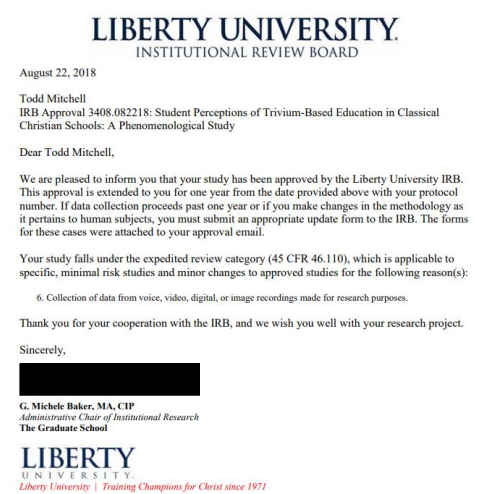
Appendix B: Recruitment Letter
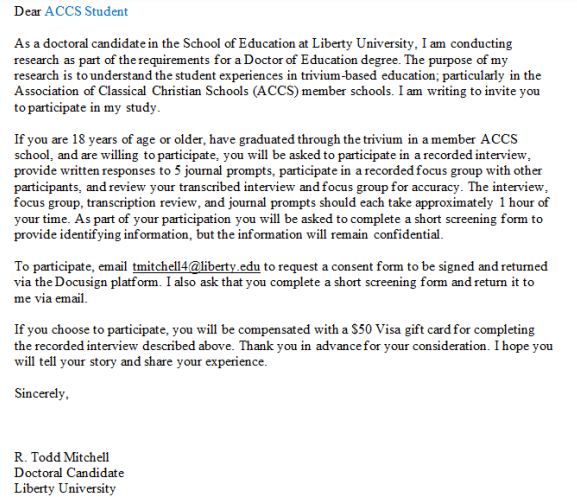
Appendix C: Demographic Screener
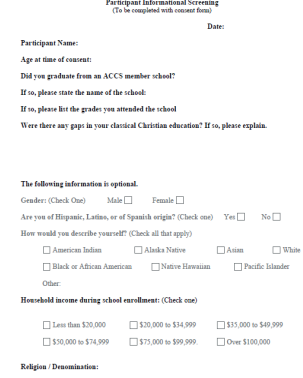
Appendix D: Consent Form
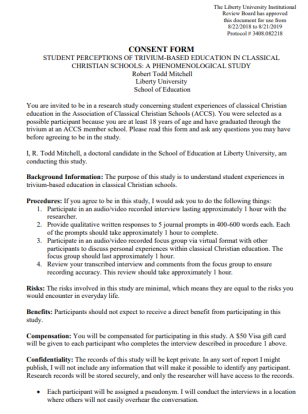
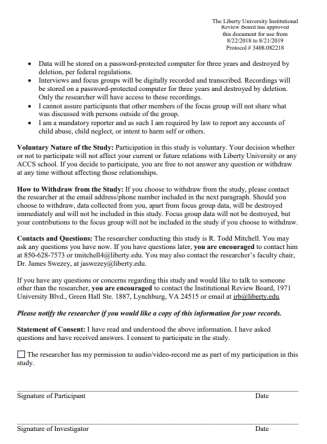
Appendix E: Thank You Letter to Co-Researchers
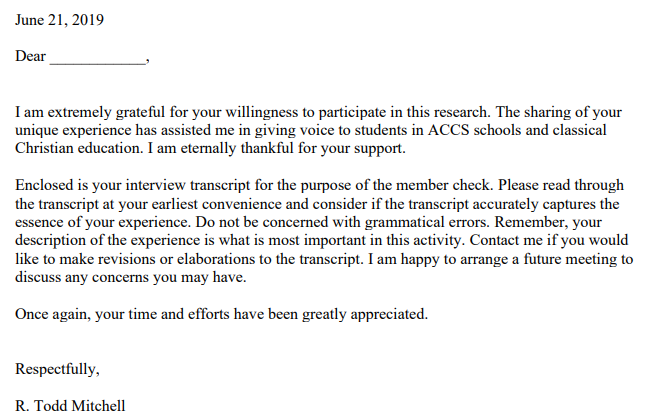
Appendix F: Interview Questions
Introductory Questions
This interview is being recorded for research purposes. Do you consent to proceed? Please state your name, age and hometown and introduce yourself for the record by telling how you came to be a part of this research project.
1. Tell me about your family.
2. What was it like growing up in your home?
Central research question: How do graduates of classical Christian schools metaphorically describe their lived experiences during their trivium-based education?
3. How would you describe your parent’s interest in your education?
4. What do you believe were your parent’s expectations for your future?
5. What can you tell me about classical Christian education?
6. What are your thoughts on CCE as a school model?
7. How would you describe the CCE culture of your school?
8. Metaphorically speaking, what would you describe your school, and how would you explain the comparison?
Subordinate question one: How do participants describe their mastery experiences during their trivium experiences?
9. Describe the elements of your school that made it enjoyable or interesting to be a part of.
10. Which memories of your experience, if any, were most meaningful to your experience? Please share the memory and why it may have been important.
11. How would you describe the religious aspects of your school?
12. What impact did the religious instruction of your school have on your spiritual growth?
Subordinate question two: How do participants describe their vicarious experiences during their trivium experiences?
13. How did you view yourself among your peers at each level of the trivium?
14. How did you view yourself among peers outside of your school experience?
15. How did you view your peers, in terms of their academic ability?
Subordinate question three: How do participants describe their socially persuasive experiences during their trivium experiences?
16. What aspects of CCE did you see as most important to your preparation for the future?
17. How would you describe your relationship with the faculty of your school?
18. How would you describe your everyday interactions with the faculty of your school?
19. How would you describe your everyday interactions with your fellow students?
Subordinate question four: How do participants describe their physiological response to adversity during their trivium experiences?
20. How would you describe the rigor of your school?
21. What components of your education were rigorous? Explain why.
22. What strategies did your school teach to minimize stressors or cope with the demands of
the rigor?
Review Questions
23. Having recently graduated from high school, what are your plans for the future?
24. How do you believe CCE as a model prepared you to accomplish your plans?
25. In what ways would you be willing to personally invest into your trivium school’s future?
26. Describe how you might educate your own children when the time comes.